When the smart people you know give you an unconditional recommendation, you should pay attention.
My friend Terrence Burns doesn’t recommend books lightly. When he handed me Breakneck: China’s Quest to Engineer the Future, I knew I was in for serious intellectual stimulation.
Terrence is smart and successful.[1] He operates in a completely different league. He’s the guy who shaped global sports marketing and who countries call when they want to win Olympic bids. China hired his firm, and they won.
So when someone like that says, “Read this,” the book went to the top of my reading list.
It’s a book I will read slowly. I have completed Dan Brown’s The Secret of Secrets (689 pages), during which I have only covered 56 pages of Breakneck. It’s not exactly a breakneck pace, but here’s why.
The author Dan Wang spent years working as a technology analyst in China, watching the country transform in real time. Right in the first chapter, Wang made a claim that stopped me cold. He calls China an engineering state and America a lawyerly society. In plain terms:
China is run by engineers. Lawyers run America.[2]
Eight words that could reframe everything about global competition.
I sat back in my seat and thought: Is that actually true? And if it is, what does it mean for America’s future?
“When I was growing up, my parents used to say to me, ‘Tom, finish your dinner—people in China are starving.’ But after sailing to the edges of the flat world for a year, I am now telling my own daughters, ‘Girls, finish your homework—people in China and India are starving for your jobs.’”
Thomas Friedman, “It’s a Flat World, After All,” The New York Times Magazine, April 3, 2005
- The Filters That Change Everything
- The Numbers Nobody Wants To Talk About
- The PhD Pipeline: Where The Future Gets Built
- Hold On, Here’s The Plot Twist: Quality Still Matters
- The Real Problem: Where Does Talent Flow?
- What Makers Do vs. What Regulators Do
- The Strategic Advantage We’re Squandering
- Why This Is A National Security Issue
- How We Got Here (And Why It Matters)
- What’s At Stake
- Two Big Ideas to Rebalance America’s Talent
- What You Can Do
- The Bottom Line
- Postscript
- Reference Sources
The Filters That Change Everything
I’ve written before about my four-filter system for deciding what deserves my time: Is it true? Is it kind? Is it necessary? Is it consequential?
Wang’s claim screamed “consequential” from every angle. If China systematically develops a different type of talent than America, that’s more than an education story. It’s an economic story, a national security story, and a story about which country will lead the century we’re living in.
But first, I needed to know: Is it actually true?
Wang had credibility. He grew up in Canada[2] and studied in the USA. From 2017 to 2023, he lived in China, where he published his observations on the country’s economy, technological development, and culture.[3] He witnessed their transformation firsthand. That gave him ethos, credibility based on direct experience. But credibility without data is just compelling storytelling. I needed numbers. Would the data back up this observation?
So I did what I always do: I went looking for the numbers.
What I found shocked me.
The Numbers Nobody Wants To Talk About
Let me show you something that should be front-page news but isn’t.
China had 17.7 million engineers as of 2020. America has about 1.6 million.[4][5]

Stop and absorb that.
China doesn’t have slightly more engineers. They don’t have double. On these counts, they have 11 times more engineers than America.
“Well, sure,” you might think, “China has a bigger population.”
Fair point. China has about four times our population.[6]
So what is the gap per person? The honest answer is that nobody has a clean number. These counts are rough estimates that may not define an engineer the same way, and they come from different years (2020 for China, 2025 for America). China’s figure is a 2020 State Council tally reported without a definition, and America’s comes from a recruiting blog. Norman Augustine, writing for the National Academy of Engineering, estimates about 2 million American engineers, which would shrink the total gap to just under nine times. His broader count of the engineering workforce, 3.5 million in 2021, which includes architects, technicians, surveyors and sales staff, would cut it to about five times. The total gap is large on any count. The per-person gap depends on who you count as an engineer.
Now look at the legal profession:
In 2023, America had 1.33 million lawyers. China had more than 730,000.[7][8]

We have 1.8 times more lawyers than China in absolute numbers. But here’s where it gets interesting: Per capita, we have about 7.5 times as many lawyers for every 100,000 people as China.

Let that sink in for a moment.
In raw numbers, America has about 1.8 times as many lawyers as China, and China has roughly five to 11 times as many engineers. Per person, the lawyer gap grows to about seven and a half times.
We’re tilted in different directions. We are influencing and shaping fundamentally different societies.
The PhD Pipeline: Where The Future Gets Built
If you think the engineering gap is concerning, wait until you see what’s happening at the doctoral level. That’s where we can see the future of breakthrough innovation.

A 2021 study by Remco Zwetsloot and colleagues at Georgetown University’s Center for Security and Emerging Technology (CSET) projected that in 2025 China would produce 77,179 STEM PhDs and the United States 39,959, including international students who study here.[9]
China was on track to graduate nearly twice as many STEM PhDs as America.
But here’s the really challenging part: the trend line. Since 2000, China’s STEM PhD production has grown at about nine percent a year. America’s growth rate? Just three percent.[10]
China overtook America by 2007, and the gap has grown substantially since. Count only domestic American graduates, and CSET projected that China’s 2025 total would be more than three times ours.[9]
That’s not a skills gap. That’s a consequential civilizational shift.
Hold On, Here’s The Plot Twist: Quality Still Matters
Before we panic, let’s add critical context.
Not all PhDs are equal, and not all universities produce the same quality graduates. This is where the story gets more nuanced and interesting.
China has a tier system for universities.[11] When CSET did its 2021 study, the top tier was 42 “Double First Class” institutions.[9]
CSET estimates that about 45 percent of all Chinese PhDs come from the upper sub-tier of this group, known as Class A. It has no STEM-only figure. If the same share holds for STEM, that is roughly 35,000 of China’s projected 77,179 STEM PhDs in 2025.[9]
The other 55 percent? They come from a wider mix of schools. Most are still run by national ministries. Only about one in five Chinese PhDs comes from local or private universities, which CSET describes as lower in quality on average.[9] CSET also found that much of China’s recent PhD growth comes from its higher-quality universities.[9]
Now look at America’s system. By the Times Higher Education 2026 world rankings, a league table I treat with caution, America has 55 universities in the top 200 and seven in the top 10. Mainland China has 13 in the top 200 (20 counting Hong Kong and Macao) and none in the top 10.[12]

A fair question: why set every American STEM PhD against only China’s elite share? I treat China’s Double First Class universities as the match for American universities in general, not for our elite schools alone. That match is my judgment, not CSET’s. CSET does write that the usual critiques of American doctoral programs “do not mean U.S. universities are low-quality.”[9] And in my ROI work, very few American engineering schools show weak earnings outcomes.
When you adjust for population, something remarkable emerges:
Per 100,000 people, using 2023 populations of 343.5 million Americans and 1.42 billion Chinese[6]:
- US total STEM PhDs: 11.63
- US domestic STEM PhDs, international students excluded: 6.77
- China’s elite university STEM PhDs, estimated: 2.45
- China total STEM PhDs: 5.44
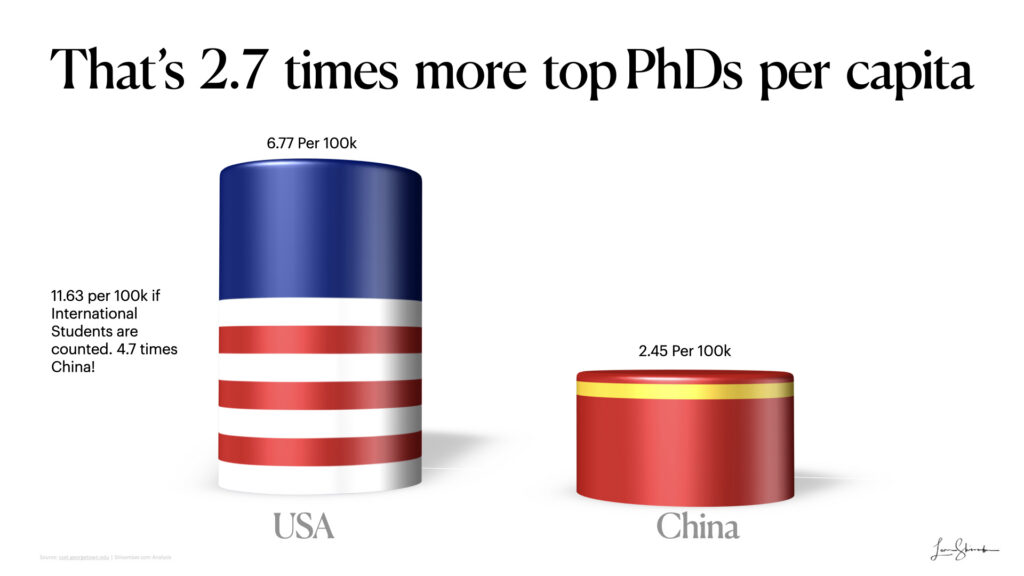
Per capita, even when we count only domestic students and exclude the international students who study here, America produces more than 2.7 times as many STEM PhDs as China’s elite universities. That comparison applies the quality filter to China alone. Drop the filter on both sides, and our domestic rate of 6.77 still tops China’s total of 5.44.
So per person, we’re not losing the PhD race. Not yet.
But we’re losing something more important.
The Real Problem: Where Does Talent Flow?
Here’s how I read these numbers: Both countries are educating talented people. But they’re pointing that talent in very different directions.

America is funneling many of our best minds into law, finance, consulting, and regulatory work. Into managing complexity. Into navigating the rules around what gets built.
Both professions matter. I’m not here to bash lawyers. We absolutely need them. They protect rights. They enable commerce. They make civil society function.
But ask yourself this: When was the last time a brilliant legal argument built a bridge? When did regulatory compliance create a manufacturing ecosystem? When did litigation solve an infrastructure crisis?
The problem isn’t that we have lawyers. The problem is that we’ve forgotten how to celebrate the people who build things.
What Makers Do vs. What Regulators Do
Engineers build, design bridges, create manufacturing systems, develop new technologies, and turn ideas into physical reality.
China has about 30,000 miles of high-speed railway, more than the rest of the world combined. Early in the 2000s, China chose to build separate lines just for high-speed passenger trains, with the 2008 Summer Olympics in mind. The Olympics that Terrence helped win for Beijing gave this strategy an early deadline. The line between Beijing and Tianjin was operating one week before the Olympics began. In less than two decades, they went from zero to the world’s largest network.[13]
In Shenzhen, I can design a new product in the morning, walk to a factory three blocks away to get the prototype made, pick it up in the afternoon, and have a revised version ready the next day. The whole supply chain I need, from raw materials, specialized molds, electronics, assembly, and packaging, sits within a few square miles.
In my experience, an engineer in China can iterate more quickly than engineers almost anywhere else on Earth. Chinese engineers built an entire physical ecosystem optimized for making things, and that ecosystem lets them move faster.
Meanwhile, back in America, Amtrak’s Acela, our fastest train, takes three and a half hours on its quickest schedule to travel from New York to Boston, a route it has been running since December 11, 2000. While it can reach a maximum speed of 160 mph, the average speed for this route is around 66 mph.[14]
The American Society of Civil Engineers gives our infrastructure a C grade. There are 623,000 bridges in the country. Of those, 49.1 percent are in fair condition, and 6.8 percent are in poor condition.[15]
We passed the Infrastructure Investment and Jobs Act in 2021.[15] But we face a workforce crisis. Twenty percent of current engineers will be eligible to retire within the next decade, and we’re not training enough replacements.[16] Boston Consulting Group estimates that the US will need about 400,000 new engineers every year.[17]
Lawyers don’t build physical infrastructure. They create legal infrastructure. They write contracts, navigate regulations, and resolve disputes, all necessary functions.
But one creates tangible economic output. The other manages the rules around that output.
We’ve tilted heavily toward the managers and away from the builders.
The Strategic Advantage We’re Squandering
Here’s the good news: America has one decisive structural advantage that has kept us competitive despite everything else.
As of 2017, about 77 percent of the international students who earned STEM PhDs here between 2000 and 2015 were still living in the country. For Chinese nationals specifically, that number jumps to 90 percent.[18]
Think about what that means. China educates brilliant students. They come to America for graduate school, and years later, nine out of ten were still here.
They join American companies, start American businesses, file patents in the US, and teach at our universities.
As I see it, this brain drain from China to America has been one of our most significant strategic advantages for decades, and one of the pillars of Silicon Valley’s success. It’s a big part of how we stayed competitive in technology even as our universities graduated fewer STEM PhDs than China’s.
But here’s the uncomfortable question: How long will the world’s best talent continue to choose America?
It depends on our immigration system remaining functional, our universities staying world-class, and America remaining the most attractive place on Earth for ambitious technical people.
We’re currently testing all three of those dependencies.
Why This Is A National Security Issue
Modern warfare runs on far more than hardware. It’s about artificial intelligence, cyber capabilities, autonomous systems, hypersonic missiles, and quantum computing. Every single one requires advanced STEM talent.
In 2011, the Department of Defense employed about 150,000 civilian STEM workers, close to half of the federal government’s civilian STEM workforce. A 2012 National Academies review found no general shortage of STEM workers for the department, except in specialized but important areas such as cybersecurity and some intelligence fields. Its real concern was quality: getting its share of the most talented people.
Meanwhile, the Information Technology and Innovation Foundation notes that many of the technologies at high risk of a Chinese monopoly have clear defense uses, such as radar, drones and swarming robots.[19] China isn’t waiting for us to catch up.
Here’s the stat that should terrify every policymaker: as of this writing, China’s researchers lead America’s in the most-cited research in 57 out of 64 critical technology categories tracked by the Australian Strategic Policy Institute.[19]
Not some. Not many. Fifty-seven out of sixty-four.
This isn’t about pride. It’s about who controls the technology that defines power in the 21st century.
How We Got Here (And Why It Matters)
This didn’t happen by accident. Several forces converged over the course of decades to create this imbalance.
We glorified the wrong careers. As I remember the 1980s and 1990s, the most prestigious paths for brilliant students led to Wall Street, McKinsey, and elite law schools. Engineering often looked like the fallback for people who couldn’t get into Harvard Business School. We told an entire generation that real success meant corner offices and six-figure consulting fees, not construction sites or building things.
We made technical careers unnecessarily complex. From what I have seen, engineering degrees often take longer to complete. The courses are often more challenging, and the grading is harsher. In my experience, many engineering students graduate with about the same debt as their business-major peers but with fewer networking opportunities. In my college ROI work, engineering is among the highest-return majors. However, that message has not broken through culturally.
We stopped selling the romance of building things. We forgot to tell young people that engineers solve humanity’s most significant problems, design Mars rovers, cardiac stents, and renewable energy systems, literally shape the physical world future generations will inherit, and change lives through their work.
China made a different choice. As I read it, they made engineering a national priority, celebrated engineers as heroes, and built university systems designed to crank out technical talent at scale.
And it worked.
What’s At Stake
If current trends continue, America risks losing several critical advantages:
Innovation leadership. The countries that produce technology set the standards, shape the rules, and control the supply chains.
Economic competitiveness. Manufacturing expertise drives productivity growth. Countries that build things learn how to make them better. That knowledge compounds over time.
National security. Modern defense depends on advanced technology. You can’t defend what you can’t build. You certainly can’t maintain what you don’t understand.
Middle-class opportunity. Engineering and skilled trades provide pathways to prosperity. We need those pathways multiplied, not diminished.
Two Big Ideas to Rebalance America’s Talent
We’re not lost yet. Our universities remain world-class. Per person, we still graduate more STEM PhDs than China, even counting only our domestic students. We keep most of the international STEM PhDs we train.
But we need action. Here are the two big ideas that matter most:
1. Fix the Education Pipeline
Support STEM teachers aggressively. I have watched schools struggle to find qualified physics and chemistry teachers, and too many high school students never get the chance to take these courses. Programs like the NSF’s Robert Noyce Teacher Scholarship help, but we need them scaled 10 times.
Improve retention rates. A 2012 White House science advisory report found that fewer than four in ten students who start college planning a STEM major finish with a STEM degree.[20] Better mentoring, paid research opportunities, and financial support would help. We’re losing talent we’ve already recruited.
Expand apprenticeships dramatically. Not everyone needs a PhD. We need skilled technicians, welders, and electricians. These roles can pay well and are critical to infrastructure. To be on par with the top 10 OECD countries, the USA would need to increase its number of registered apprenticeships from 600,000 per year to 4.3 million.[21] That’s a policy choice that requires leadership, not an inevitability.
2. Rebalance Incentives and Keep Global Talent
Make America irresistible to global STEM talent. Our historic retention of Chinese STEM PhDs, about 90 percent as of 2017, is our secret weapon. But it requires functional immigration systems, competitive compensation, and research freedom. We’re testing all three right now with bureaucratic delays and visa uncertainty.
Reduce regulatory barriers that shift talent from building to compliance. Many new regulations need lawyers to interpret them and engineers to comply with them. Some regulation protects us. But excessive regulation shifts talent from creating value to navigating complexity. We need a rigorous cost-benefit analysis before adding layers.
Reward building over credentialing. We need to value demonstrated skills over degrees alone. Competency-based assessments enable talented individuals to advance more quickly. This will not lower standards. It recognizes that a 22-year-old who’s built three successful apps might know more than someone with a freshly minted degree and no portfolio.
What You Can Do
If you’re a parent: Talk to your kids about engineering and skilled trades as noble professions, not fallback options. Show them that building things matters.
If you’re an educator: Advocate for better STEM teacher compensation and training. Push for hands-on learning experiences. Connect students with mentors in technical fields.
If you’re a business leader: Create apprenticeship programs. Partner with community colleges. Stop requiring bachelor’s degrees for jobs that don’t need them. Fund STEM scholarships without strings attached. We send scouts out to find and cultivate promising athletes. Similarly, support the building of a STEM youth pipeline.
If you’re a policymaker: Streamline STEM immigration. Expand apprenticeship funding. Rigorously evaluate which regulations protect people versus which create compliance jobs. Tie education funding to outcomes.
If you’re a young person choosing a career: Consider that building things has a tangible impact. Engineering, skilled trades, and technical roles let you see your work change the world. That matters more than you think.
The Bottom Line
The numbers fit Dan Wang’s framing. China has systematically developed an engineering culture, whereas America has leaned toward law.
But here’s the nuance: America still has advantages. We have far more universities near the top of the global rankings. We produce more STEM PhDs per capita. We attract global talent, and most of the international STEM PhDs we train stay.
The question isn’t only where we stand today. The question is whether we maintain these advantages.
That depends on the choices we make right now, including those regarding education funding, immigration policy, cultural values, and what we celebrate and reward.
These aren’t abstract policy debates. They are questions about what kind of country we want to be.
Do we want to be the country that builds the future? Or the country that manages what others build?
We can do both. But right now, we’re dangerously out of balance.
And when China was projected to graduate nearly twice as many STEM PhDs as we would in 2025 and has roughly five to 11 times as many engineers, while we have about 1.8 times as many lawyers, balance isn’t optional.
It’s survival.
The makers are building the 21st century. The question is: where will they be?
Postscript
I can hear you saying, “Leon, AI changes everything. Why does any of this matter when AI can do engineering work?”
Let me say that AI only exacerbates this problem. We may not sustainably lead in AI if we don’t address the above issues. This piece is already much longer than I intended, so I will follow up on that question later.
Reference Sources
- Burns, Terrence. “About.” Rings, Dreams and Things to Ponder, www.tburnssports.com/about. Accessed 31 Oct. 2025.
- “Breakneck: China’s Quest to Engineer the Future.” Danwang.co, 25 Jul. 2025, https://danwang.co/breakneck/. Accessed 31 Oct. 2025.
- “Dan Wang: Research Fellow.” Hoover Institution, www.hoover.org/profiles/dan-wang. Accessed 31 Oct. 2025.
- Ren, Shuli. “China’s ‘Engineer Dividend’ Is Paying Off Big Time.” Bloomberg.Com, 24 Mar. 2025, www.bloomberg.com/opinion/articles/2025-03-24/china-s-engineer-dividend-is-paying-off-big-time. Accessed 2 Nov. 2025.
- Fujiwara, Liz. “How Many Engineers Are in the U.S. in 2025?” Fonzi.Ai, 22 Jul. 2025, https://fonzi.ai/blog/engineers-in-us. Accessed 2 Nov. 2025.
- “Population and Demography Data Explorer.” Ourworldindata.Org, https://ourworldindata.org/explorers/population-and-demography?country=CHN~USA&indicator=Population&Sex=Both+sexes&Age=Total&Projection+scenario=None. Accessed 2 Nov. 2025.
- “Profile of The Legal Profession.” American Bar Association, www.americanbar.org/content/dam/aba/administrative/news/2023/potlp-2023.pdf. Accessed 2 Nov. 2025.
- “No Time To Rest.” China Business Law Journal, 9 Oct. 2025, https://law.asia/china/chinese-law-firms-data-highlights-revenue-struggles/#:~:text=Has%20this%20goal%20been%20attained,(CAGR)%20of%2011.5%25. Accessed 2 Nov. 2025.
- Remco Zwetsloot, Jack Corrigan, Emily Weinstein, Dahlia Peterson, Diana Gehlhaus, and Ryan Fedasiuk, “China is Fast Outpacing U.S. STEM PhD Growth” (Center for Security and Emerging Technology, August 2021). https://doi.org/10.51593/20210018 Accessed 2 Nov. 2025.
- Long, Trelysa. “America’s Innovation Future Is at Risk Without STEM Growth.” Information Technology & Innovation Foundation (ITIF), 10 Sept. 2025, https://itif.org/publications/2025/09/10/americas-innovation-future-at-risk-without-stem-growth/. Accessed 2 Nov. 2025.
- Peters, M. A., & Besley, T. (2018). China’s double first-class university strategy: 双一流. Educational Philosophy and Theory, 50(12), 1075–1079. https://doi.org/10.1080/00131857.2018.1438822
- “World University Rankings 2026.” Times Higher Education, http://web.archive.org/web/20251101122736/https://www.timeshighereducation.com/world-university-rankings/latest/world-ranking. Accessed 2 Nov. 2025.
- Alvarez, Antonio. “The Global Rise of China’s High-Speed Rail Network.” China Today, 17 Oct. 2025, www.chinatoday.com.cn/ctenglish/2018/commentaries/202510/t20251017_800418146.html#:~:text=China’s%20economic%20ascent%20is%20often,tourism%2C%20and%20stimulating%20regional%20industries. Accessed 2 Nov. 2025.
- “Acela.” Wikipedia, https://en.wikipedia.org/wiki/Acela. Accessed 2 Nov. 2025.
- “A Comprehensive Assessment of America’s Infrastructure 2025 Report Card.” American Society of Civil Engineers, https://infrastructurereportcard.org/wp-content/uploads/2025/03/Executive-Summary-2025-Natl-IRC-WEB.pdf. Accessed 2 Nov. 2025.
- Augustine, Norman R. “The Uncapped Potential: Engineering an Opportunity of a Lifetime.” National Academy of Engineering, 26 Sept. 2024, www.nae.edu/323243/The-Uncapped-Potential-Engineering-an-Opportunity-of-a-Lifetime#:~:text=In%20many%20of%20these%20instances,will%20need%20to%20be%20replaced. Accessed 2 Nov. 2025.
- Kodey, Abhi, et al. “The US Needs More Engineers. What’s the Solution?” Boston Consulting Group, 13 Dec. 2023, www.bcg.com/publications/2023/addressing-the-engineering-talent-shortage. Accessed 2 Nov. 2025.
- Jack Corrigan, James Dunham, and Remco Zwetsloot, “The Long-Term Stay Rates of International STEM PhD Graduates” (Center for Security and Emerging Technology, April 2022). https://doi.org/10.51593/20210023
- Riggi, Justin. “How China Is Outperforming the United States in Critical Technologies.” Information Technology and Innovation Foundation, 23 Sept. 2025, https://itif.org/publications/2025/09/23/how-china-is-outperforming-the-united-states-in-critical-technologies/. Accessed 2 Nov. 2025.
- Stevens Institute of Technology. “Why Don’t Students Stick with STEM Degrees?” Phys.Org, 11 Jan. 2023, https://phys.org/news/2023-01-dont-students-stem-degrees.html. Accessed 3 Nov. 2025. The same figure appears in President’s Council of Advisors on Science and Technology, “Engage to Excel,” Feb. 2012, https://obamawhitehouse.archives.gov/sites/default/files/microsites/ostp/pcast-engage-to-excel-final_2-25-12.pdf.
- McSwigan, Curran. “America’s Apprenticeship Gap in Two Charts.” Third Way, 23 Feb. 2024, www.thirdway.org/memo/americas-apprenticeship-gap-in-two-charts. Accessed 3 Nov. 2025.
Also linked in the text: National Academy of Engineering and National Research Council. “Assuring the U.S. Department of Defense a Strong Science, Technology, Engineering, and Mathematics (STEM) Workforce.” The National Academies Press, 2012, https://doi.org/10.17226/13467.
Fascinating insights—thought-provoking, indeed!