Paul Graham is a cofounder of Y Combinator, the startup investor that funded Airbnb, Dropbox and Stripe. In a June 2026 essay, based on a talk at the Oxford Union, he explained how people earn a billion dollars.[1]
His answer starts with arithmetic. There are only two numbers, he wrote, “the growth rate and how long it continues.” Make something people love enough to tell their friends about, keep it growing, and exponential growth does the rest.
The mechanics are real, and almost no one will ever use them. So let me explain the opposite, the thing almost everyone takes part in without meaning to. How to manufacture poverty.
I do not mean the poverty of bad luck or hard circumstance, or a line the census draws. I mean the engineered kind, the kind that leaves people poorer than they would have been. The kind a prosperous society does to itself, with good intentions and a respectable institution running the machine.
I have watched it happen twice. The first time was the country I was born in, where ideology and patronage took a literate, capable nation and hollowed it out until nearly nine in ten of its people with schooling past high school had left.
The second time is quieter. It is happening here, and we file the paperwork for it ourselves every fall.
College changed my life. I went to Baruch on a full scholarship and earned an MBA at Indiana on a paid stipend. A good degree at a fair price can be one of the best investments a person ever makes.
The machine runs on the belief that every degree pays, so no one has to check which ones do.
Graham gave a recipe. Here is the opposite one.
Run compounding in reverse
Graham’s two numbers work for ordinary money too, only slower. The whole secret of wealth is boring, and it is about time. You earn early, you invest early, and you spend late. Money put to work at twenty-two has forty years to compound. The same money put to work at thirty-two has thirty.
That missing decade is a quarter of the years, but it is not a quarter of the money. Because compounding curves, at the kind of returns the market has delivered over time, it costs closer to half.[2]
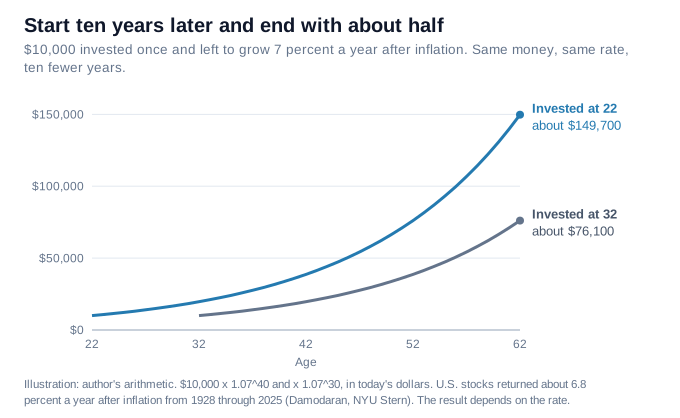
So if you wanted to make someone poor, you would invert all three. You would have them earn late, invest late, and spend early. You would take the most valuable decade they will ever have for building capital, their twenties, and arrange for them to start it producing no income, saving nothing, and borrowing against a future that has not arrived and might not.
There is a familiar way to do exactly that. You send them to spend four years and, at many schools, a six-figure sum buying a credential, on the promise that it always pays.
For the median student, at full price, it does not.
Run the median four-year degree through honest math: the cost, the four years of pay given up, the higher taxes on the higher salary, and the fact that money today is worth more than money later, and it leaves the median graduate about $82,000 behind simply going to work.[3]
A median high school graduate’s lifetime earnings after taxes are worth about $484,000 today. The median four-year college graduate’s, after paying full price, are worth about $402,000. At the median, the degree subtracts the difference.[3]
Even at the net price families actually pay, the gap is still about $17,500.
That median hides a wide spread.
Across the 1,679 four-year colleges in the model, about four in five leave their typical graduate behind a typical high school graduate at full cost, and about one in five come out ahead.[4]
At the net price families actually pay, about four in ten come out ahead and more than half still leave their graduate behind. Even at zero cost, about 30 percent of the 1,679 still leave their graduate behind.[4]
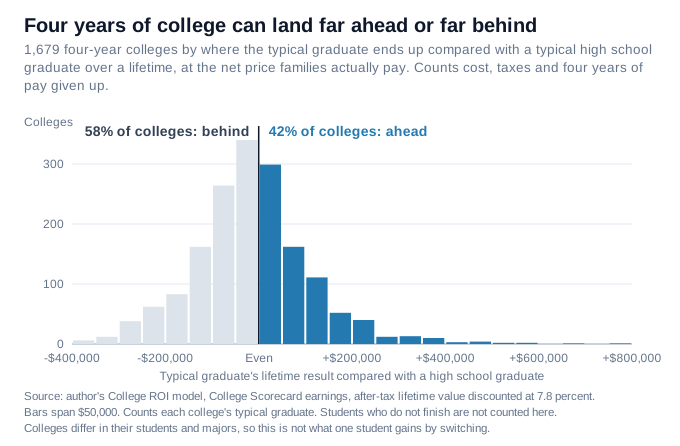
Look up nearly any college on collegeroi.org.
Count students instead of schools, and about a quarter of those who enroll at these colleges earn less than a typical high school worker six years after they start. That includes finishers and non-finishers alike, and it comes before a dollar of college cost is counted.[4]
Same dollars, same decade of life, opposite compounding. One path builds capital while it is cheapest to build. The other consumes the principal at exactly the age when wealth compounds the hardest. That is the engine. Everything else is delivery.
Kill the signal that tells good from bad
A machine like this cannot run if buyers can see what they are buying. So the second step is to make sure they cannot.
In a working market, price carries information. A thing that returns nothing gets cheap, a thing that pays stays dear, and buyers sort themselves using the spread. The college market has a wide spread in payoff. A strong major at a fair price can still pay off handsomely, sometimes by a fortune.
The trouble is that the price tag does not track the payoff. The school that drains you and the school that makes you can cost the same, send the same glossy brochure, and carry the same federal aid.
You hold that arrangement in place by subsidizing demand without checking whether the purchase repays its cost. Lend against almost any program at any price, and price comes loose from value.
The federal earnings test Congress passed in 2025 asks only whether an undergraduate program’s graduates out-earn a typical high school worker. It never asks what the degree cost them.[5]
The buyer is left to choose on brand, on feeling, on what the neighbors will think. Which is to say, on everything except the number that matters.
Make sure no one looks
This is the step that keeps the machine running, and Graham named it himself near the end of his essay. Your beliefs about how people get rich, he wrote, can’t be “determined by ideology, or movies, or historical examples that are centuries old.” You “must look at the world around you and see how it’s actually done.”[1]
The poverty machine runs on the opposite of looking. It runs on a belief, college always pays, held firmly enough that no one feels the need to check. The belief is doing the work that arithmetic should do.
Families do not run the return because everyone knows the answer, and everyone knows the answer because no one runs the return.
Borrowers owe about $1.7 trillion in student loans, for many of them the largest financial commitment of their young lives, signed on a return almost none of them were shown.[6]
This is why the machine is so durable and so polite. No villain is required. You need only a good story repeated until it feels like a fact, and a financing system that asks too few questions. The people who could break it by demanding the math are the same people who were raised to believe the math was already settled.
I watched a country do it
I know how this goes because I grew up inside a smaller, faster version of it.
The country I was born in was not poor by nature. It was a literate country, full of capable, ambitious people. A World Bank report later put its literacy rate in 1960, the year I was born, at an estimated 83 percent, and called that very high.[7]
Then its leaders decided that ideology and loyalty mattered more than how prosperity works. They nationalized the productive parts of the economy and ran them as patronage. They rewarded the right allegiance and punished the wrong one. They asked everything of the system except whether it produced anything.[8]
It did not collapse in a day. It drained, the way a household balance sheet drains, slowly and then fast. The shelves emptied.[8] The talented left. By the World Bank’s count for 2000, eighty-nine percent of the people with schooling past high school had emigrated, the highest rate in the world.[9]
A nation manufactured its own poverty by refusing to look at the thing it was actually doing, and it told itself a noble story the whole way down.
That country has a second act now. In 2015, ExxonMobil found oil off its coast, and today the country is one of the fastest-growing economies in the world.[10] I’m glad.
But oil is luck, and it repairs only part of what came before. It can fill a treasury fast. It can’t give back the decades, and many of the people who left built their lives somewhere else. I did.
No country can plan on that kind of luck.
The American version of this machine is far larger in scale, but gentler and slower, and dressed in the language of opportunity. The blind spot is the same.
Here, we take the people most able to build, point them at something that consumes their capital instead of compounding it, and make the story good enough that no one checks the receipt.
The fix is the recipe, reversed
The good news is that a machine you can describe is a machine you can stop. The fix is just the recipe run backward.
Look at the number. Every program that takes federal money should have to show its real return, after cost and taxes and pay given up and time, right next to the plain alternative of going to work. Other investments are required to make that kind of disclosure.
Congress has started tying loans to what graduates earn, but its bar is a high school paycheck, with the price left out. Tie the lending to whether each program repays what it costs, so the subsidy stops funding the schools that drain people.
And make going straight to work, or into a trade, or an apprenticeship, a respected choice instead of a confession, because for a great many young people it is the path that builds the most.
The recipe runs inside college too, and so does the fix. Three choices shape whether a degree builds capital or eats it.
- Finish, and finish on time, because every extra year delays a graduate’s pay, and a student who never finishes carries the cost without the degree.
- Study a field that pays enough to repay what it costs.
- Pay a price that fits that field, so you borrow less against a future that has not arrived.
Price helps, but it is not enough on its own, since about 30 percent of four-year colleges leave their typical graduate behind even at zero cost.[4] And pay differs far more between engineering and music, near the top and bottom of the pay range, than between cheap and expensive schools in the same field.
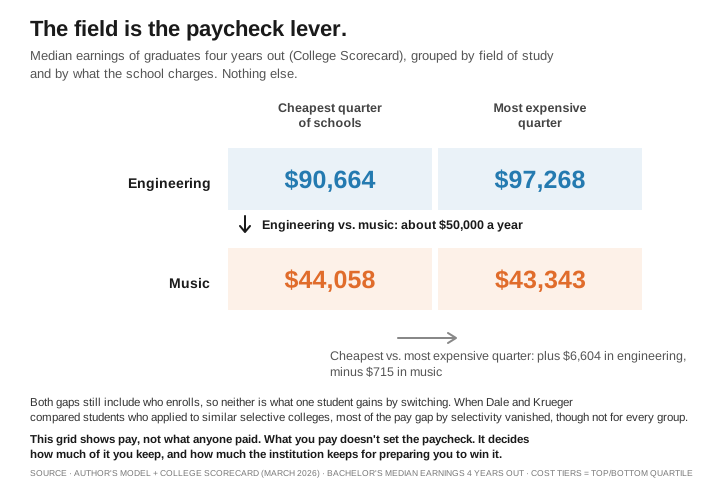
A degree is surest when the student gets all three choices right.
Right now no one is required to show families what those choices return once the cost is counted.
I came to this country because it was the rare place that let you see the machine and say so out loud. That is the whole advantage, and it is not a small one. The first step in not manufacturing poverty is refusing to look away from how it is made.
You can run the real return on nearly any school and major at collegeroi.org. The rest of the argument is in my book.
Reference Sources
- Graham, Paul. “How to Earn a Billion Dollars.” paulgraham.com, June 2026, based on a talk at the Oxford Union. Accessed October 26, 2026. The essay this piece inverts. Graham’s bio says he started Y Combinator with three partners in 2005 and lists Airbnb, Dropbox and Stripe among the startups it funded.
- Author’s arithmetic. At about 7 percent real returns, a lump sum compounding for thirty years instead of forty ends at roughly 51 percent of the value, so the lost decade costs roughly half. The result depends on the rate assumed, which is why the prose hedges it. U.S. stocks, dividends included, returned about 6.8 percent a year after inflation from 1928 through 2025 (Aswath Damodaran, “Historical returns: Stocks, Bonds & T.Bills,” NYU Stern, accessed September 25, 2026). At that rate the lost decade costs about 48 percent.
- Author’s model, built on U.S. Department of Education College Scorecard data covering 1,679 bachelor’s-granting institutions. Net present value against the high school path, after costs, federal income and payroll taxes, forgone earnings, and the time value of money. The median high school graduate’s lifetime after-tax value is about $484,000 and the median four-year college graduate’s about $402,000, a gap of about $82,000 at full price and about $17,500 at the net price families actually pay. You can run nearly any school and major at collegeroi.org.
- Author’s model, same basis. Across the 1,679 four-year colleges scored, about 79 percent leave the typical graduate below the high school baseline at full cost and about 21 percent, one in five, clear it. At net price, about 58 percent still fall below it. About 30 percent stay below the baseline even at zero cost, and about 25 percent of federally aided students who enroll, weighted by enrollment and counting those who do not finish, earn less than the median high school graduate aged 25 to 34 six years after entry (among those working and not in school), before any college cost is counted. The field chart’s Dale and Krueger line refers to Stacy Dale and Alan Krueger, “Estimating the Return to College Selectivity over the Career Using Administrative Earnings Data,” NBER Working Paper 17159, 2011. Comparing students who applied to similar colleges, they found the return to selectivity “generally indistinguishable from zero,” with exceptions for Black and Hispanic students and for students from less-educated families. Accessed September 24, 2026.
- Congressional Research Service. “Amendments to the Higher Education Act Made by P.L. 119-21, the FY2025 Budget Reconciliation Law.” Report R48727, January 8, 2026. Accessed September 25, 2026. The law, enacted July 4, 2025, sets an earnings test for Direct Loan eligibility beginning July 1, 2026. An undergraduate program can lose eligibility if, in two of three years, its completers’ median earnings fall below those of working adults aged 25 to 34 with only a high school diploma. Those adults must not be in school, and they are drawn from the college’s own state, or from the whole country if fewer than half its students live in that state. The statute is 20 U.S.C. 1087d(c).
- Federal Reserve Bank of New York. “Quarterly Report on Household Debt and Credit, 2025:Q4.” Federal Reserve Bank of New York Center for Microeconomic Data, February 2026. Accessed September 28, 2026. Student loan balances of about $1.66 trillion at the end of 2025. The series covers federal and private loans. The body rounds to the house convention of about $1.7 trillion.
- World Bank, Education Projects Department. “Appraisal of an Education Project in Guyana.” Report No. PE-1a, January 13, 1969. Accessed October 26, 2026. “Guyana has a very high literacy rate (estimated at 83% in 1960).” The report’s basic data table gives the same 1960 figure.
- U.S. Library of Congress. Guyana: A Country Study, sections “Postindependence” and “Civil Service.” Accessed September 28, 2026. By the late 1970s the government controlled over 80 percent of the economy, and import controls created shortages. Opposition to the ruling party usually cost civil servants their jobs.
- World Bank. Migration and Remittances Factbook 2011, 2nd ed., World Bank, 2011. Accessed August 17, 2026. Lists Guyana’s emigration rate of the tertiary-educated population at 89.0 percent, the highest in the world. The figure is for 2000, from Docquier and Marfouk (2006). Corroborated by Mishra, Prachi. “Emigration and Brain Drain: Evidence From the Caribbean.” IMF Working Paper WP/06/25, International Monetary Fund, 2006.
- World Bank. “Guyana.” Accessed October 1, 2026. “Guyana is one of the world’s fastest-growing economies, fueled by rapid oil sector expansion.” The page had been revised by November 2, 2026, when it read: “Guyana’s economy has expanded at an unprecedented pace, driven by offshore oil production. Real GDP grew by 19.3 percent in 2025, following growth of 43.8 percent in 2024.” See also ExxonMobil, “Guyana Project Overview.” Accessed October 1, 2026. “The Liza discovery was announced in May 2015.” King, Kemol. “Guyana economy set to grow 16.2% in 2026, oil sector still main driver, finance minister says.” Reuters, January 26, 2026, as syndicated by WIMZ. Accessed November 2, 2026. Reports growth of 19.3 percent in 2025.