The one that makes the other nine worth running
There is a genre of post on social media that promises to replace McKinsey, and other top consulting firms, with a list of prompts. You have seen it. Run a SWOT analysis on my company. Size my market and project its growth. Break down my top three competitors and their pricing. Identify the risks in my expansion plan. Write the strategy. Build the deck.
The lists vary, and I have assembled this one from a dozen of them, but the shape never changes. A row of confident prompts, each mapped to something a consulting firm bills for, and then some version of the same closer: why pay a consulting firm for what you can type?
Every one of these lists is missing the same prompt.
The one that determines whether the AI got any of the others wrong. Whether the market size came from a real report or from a plausible-sounding number. Whether the competitor breakdown describes your actual competitors or a general idea of competitors. Whether the risks in the plan are your risks or the average risks of every expansion the model has read about.
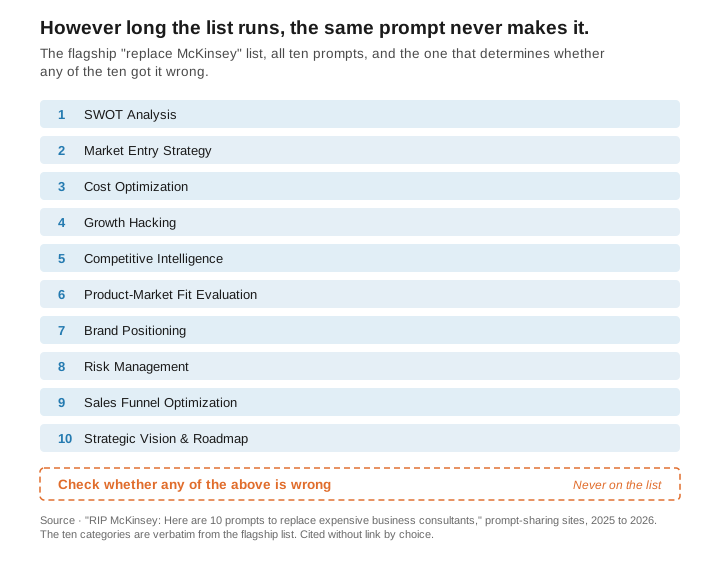
It appears in none of them. Nine prompts in the versions I kept seeing, a single mega-prompt in nine phases in another.[1] The flagship runs to exactly ten, and its tenth is Strategic Vision and Roadmap.[2] The checking prompt is never on the list. Call it the tenth prompt, the one that comes after the list ends, whatever the count. Its omission tells you more about the genre than the prompts do.
Owning the error teaches the check
I was a McKinsey consultant. Here is what the job does to you: it makes the checking prompt the first one you think of.
When you have presented a recommendation that a client then bet real money on, verification stops being a step in your process. It becomes the process. You remember the analysis that almost went out wrong. You remember who caught it, and what it would have cost if nobody had. Anyone who has stood in that room writes the tenth prompt before the first nine, at least in work they have to stand behind.
So when a list of nine prompts arrives with no tenth, it is telling you where its author has stood. On the demo side of the work, where the deliverable is visible and the accountability is not. From that side, consulting looks like documents. Analyses, frameworks, decks. And documents are what AI produces beautifully, so the conclusion writes itself. If documents are all you can see, the document machine has replaced the firm.
Or, less charitably, it is telling you what sells. A list that ends with “then verify everything, slowly, against sources” does not go viral. Either the author has never been where the checking happens, or the author knows and left it off because the checker kills the promise. It does not matter which. Both versions mean the list is not advice. It is content.
If it is the first, that is not a failing of intelligence or of character. It is a vantage point. It is also the wrong vantage point from which to declare a profession obsolete.
The deck was never the product
Now look at what a client is actually buying, from inside the room.
An analyst builds the market model. A manager pulls it apart: where did this growth number come from, why does the sample lean on the wrong region, what happens to the conclusion if the top customer leaves. The analyst rebuilds it.
A partner then pulls apart the story the manager built on top of it, because the partner has watched three companies try this move and knows where the bodies are buried. Days of this, sometimes weeks, before anything reaches a client. The people doing it have domain depth, scar tissue, and a reporting line that exists to catch each other.
The deck that finally shows up is the receipt of that fight. It is proof the process happened, not the process itself.
The nine prompts generate receipts. They produce the artifact that review used to produce, without the review. A receipt without the process behind it is a prop, and the difference is invisible right up until someone bets money on it.
And underneath the substitution there is a strategy error the firms themselves would bill to point out. A tool available to everyone is an advantage to no one. If those nine prompts are good, they are exactly as good for McKinsey, for Bain, for BCG. That is not a hypothetical. McKinsey built its own internal AI platform in 2023 to search the firm’s knowledge base.[3] Bain had built OpenAI’s technology into its research and knowledge systems for its 18,000-person team before announcing the formal alliance in February 2023.[4] McKinsey and Bain were running the same kind of tools by 2023. The difference is what happens to the output next. At a firm like my old one, it lands in front of the manager and the partner who pull it apart.
AI did not hand the challenger a weapon the incumbent lacks. It handed everyone the receipt and left the checking scarce. When the artifact costs nothing, what remains for sale is the fight over whether it is right.
I am not romanticizing my old firm. I have spent part of this summer taking apart a published McKinsey analysis, and I found real problems that made it into print anyway. So I will say it plainly: the apparatus is necessary and it is not sufficient. Wrong sometimes ships past layers of experienced people paid to catch it.
The tenth prompt cannot be a prompt
The genre’s defenders have an answer ready: fine, add a verification prompt. Ask the AI to double-check its work.
This is where a property of the tool matters, one the lists never mention. The output carries no signal about its own reliability. A fluent wrong answer reads exactly like a fluent right one. Same confident tone, same clean structure, same absence of doubt. Nothing in the text tells you which one you are holding.
So asking the generator to check the generation is asking the same process to grade its own homework. It will produce a fluent, confident review. And the review will carry no signal about its reliability either. I made the longer argument in my book: the skill that holds its value in an AI economy is recognizing when a high-confidence output should be doubted. That skill is hard to learn from AI-generated material alone.[5]
Verification has to come from outside the loop. A source pulled and read by hand. A number recomputed from the original data. A person with enough domain depth to feel that a confident figure is wrong before they can prove it. None of those is a prompt. All of them are the job.
Use it where you can check it
I say all of this as a heavy user, not a skeptic. I published my own rule for AI last year: “It’s helpful in areas where you can check or validate its output.” And the standard I hold my own work to: “Nothing that I get from AI goes unchecked or unedited.”[6] I have also written that you would be foolish not to use it. I stand by all three sentences, together.
Here is what together means in practice. One week this July, my own review pipeline scored a new essay of mine 95 out of 100. That pipeline is a chain of AI-driven checks that verify facts, audit reasoning, sweep language, and grade the result. Done, said the score. Then I spent the next several days reading that essay and its companion piece the way an editor reads, questioning lines that felt off and making the checks re-run against the live sources.
That review turned up a source’s definition described wrongly in the companion, an error that had survived its full automated fact-check because every number attached to it was correct. It turned up six places where a claim I had already corrected was still standing in different words, after an automated sweep reported the piece clean. And it turned up repairs, made by AI to fix one problem, that had quietly introduced new problems of their own.
The automated checks were not useless. They caught what they were built to catch: arithmetic, citations, mechanics. Everything else was caught by a person reading. The score said done. The read said otherwise. If I had trusted the 95, I would have published the errors, and the tool that made them would have been the same tool that graded them.
That is the tenth-prompt problem, running in my own shop, on work I know cold. Now picture it running on a market analysis in an industry the prompter has never worked in, feeding a decision the prompter has never had to own.
The rule is one sentence long: use it where you can check it. The nine-prompt genre cannot follow the rule, because following it requires knowing the domain well enough to check, and anyone who knows the domain that well stops believing the firm was just documents.
The tenth prompt exists
It is not a prompt. It is a person who knows the field, pulls the sources, recomputes the numbers, and owns the error if one ships. At McKinsey, the client was paying for layers of those people, and even layers like that fail often enough, at firms and research shops alike, to keep me busy writing critiques. At your desk, the layer is you.
The risk in these posts is that the people most excited to fire the checker are the people least equipped to notice what the checker would have caught. AI did not create that risk. It industrialized it.
Keep the nine prompts. I use versions of them myself. Just know what they replace, and what they do not. They replace the receipt. The tenth prompt was always the product. For now it still has to be human.
Reference Sources
- “RIP McKinsey.” God of Prompt newsletter, 9 July 2025. A representative specimen of the genre: a nine-phase consultant mega-prompt containing no step that checks the output. Cited without link by choice.
- “RIP McKinsey: Here are 10 prompts to replace expensive business consultants.” Prompt-sharing sites, 2025 to 2026. The flagship list: SWOT through Strategic Vision and Roadmap, ten prompts, none of which checks the output. Cited without link by choice.
- McKinsey & Company. “Meet Lilli, our generative AI tool that’s a researcher, a time saver, and an inspiration.” New at McKinsey Blog, 16 August 2023. Accessed July 25, 2026. McKinsey’s announcement of Lilli, its internal generative AI platform for searching and synthesizing the firm’s knowledge base.
- Bain & Company. “Bain & Company announces services alliance with OpenAI to help enterprise clients identify and realize the full potential and maximum value of AI.” Press release, 21 February 2023. Accessed July 25, 2026. Announces the alliance and states that “over the past year, Bain has embedded OpenAI technologies into its internal knowledge management systems, research, and processes,” building on its adoption of OpenAI technologies for its “18,000-strong multi-disciplinary team of knowledge workers.”
- Shivamber, Leon. We Need To Talk About Higher Education, Chapter 26, “What AI Is Actually Doing to Earnings.” The process-versus-judgment frame: the durable skill is recognizing when a high-confidence output should be doubted, and it is hard to learn from AI-generated material alone.
- Shivamber, Leon. “What you should know about my AI Use.” LinkedIn, August 2025. Accessed July 25, 2026. The author’s published AI-use policy: “It’s helpful in areas where you can check or validate its output” and “Nothing that I get from AI goes unchecked or unedited.”