Bryan Walsh wrote a piece for Vox’s Future Perfect in June with a headline I was glad to see someone finally write: “New college grads are doing better than the vibes suggest.”[1] He is right. The panic is overblown. As he puts it, “a rough launch doesn’t mean a rough life.” An AI commencement speech is not a prophecy.
He also did something that, in my experience, many “is college worth it” writers skip. He put the hard numbers in his own article. Fifty-two percent of graduates underemployed a year out, and 45 percent a decade later, by the Burning Glass Institute and Strada’s count. Nursing graduates underemployed under ten percent, criminal justice graduates over sixty-five. He even says plainly that none of his data means “that college bet is a sure thing for everyone.”
I read all of that and thought he was standing on the doorstep of the argument I have spent years making. He just did not walk through it. Here is the one step.
Walsh’s headline answer leans hardest on one number. Two economists at the Federal Reserve Bank of New York, Jaison Abel and Richard Deitz, asked “is college still worth it” and answered 12.5 percent.[2] That is a real number, but read what it measures. It is the return for the students who finish. It sets aside the roughly one in three who start at a public four-year college and do not finish within six years,[3] the students who carry the costs and the lost years with no degree to show for them. Count them, along with the graduates who take five or six years to finish, and the pooled return falls to about 10 to 10.5 percent.[4] That looks like a small change, and it hides the real one. A rate of return flatters small investments, so a student who leaves after two years can still post a positive rate and end up about $31,000 behind a high school graduate in today’s dollars, when future pay is discounted at 7.8 percent a year. And 12.5 percent sits at or above the 66th to 70th percentile of everyone who enrolls, so most students who start do worse than the headline, before anyone has said a word about which school or which major.
That is the gap between the number on the wall and the bet an actual 18-year-old is making.
Then there is the deeper problem, and Walsh’s own article proves it better than I could. He tells you nursing graduates are underemployed under ten percent and criminal justice graduates over sixty-five. The New York Fed’s latest table, from February 2026, puts them at about 13 percent and about 66 percent, still the lowest and the highest of the majors it tracks.[5] Those are not two points near an average. They sit far apart on the board. A single figure that holds both of them describes neither. When the Fed’s 12.5 percent travels on its own, the student headed into nursing and the student headed into criminal justice hear the same number, and both can take it as a sign that the bet is safe. One of them is being misled.
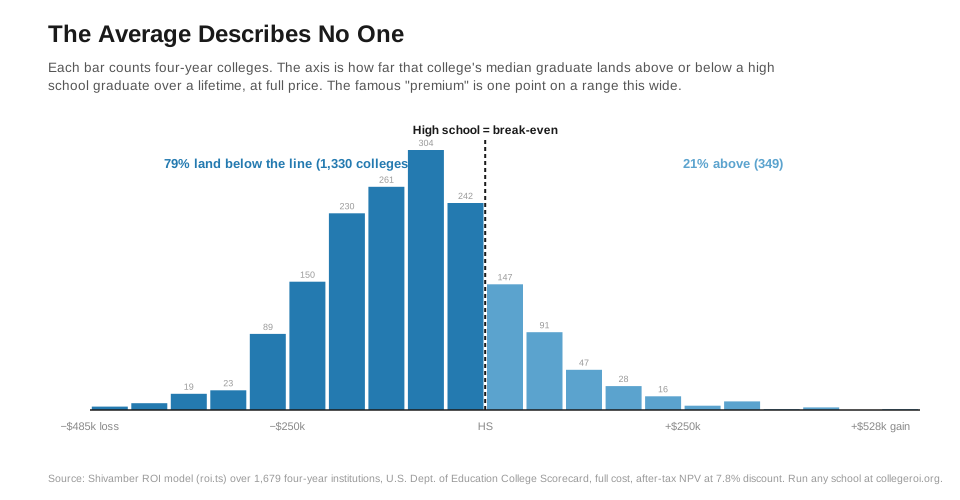
The chart runs on my model, not the Fed’s. It counts taxes and the full cost of attendance, room and board included, where the Fed’s 12.5 percent leaves room and board out, and it counts colleges, not students. Read it for the spread, not the level.
So the answer to “is college worth it” is not yes, and it is not no. It is that this is the wrong question. It asks about a national median, and no one sends a national median to college. They send one student, to one school, for one program, at one price. And here is the part that should make a Future Perfect writer happy, because it is genuinely good news. That individual question is answerable. Before you sign anything, you can look up, on the federal College Scorecard, what graduates of that program earn, how many students at that school finish, and what it costs. The data are public. The math runs in minutes.
Walsh says he would tell the class of 2026 that the diploma is “the most oceanworthy raft they can find.” For many of them, in the right program at the right price, it is. For others it is an anchor. The good news is not that the raft floats on average. The good news is that the students coming behind them can check their own before they push off.
None of this is pessimism about college. It is the only version of this conversation that puts the family in control, instead of handing them a national number and calling it an answer.
Reference Sources
- Walsh, Bryan. “New College Grads Are Doing Better Than the Vibes Suggest.” Vox, Future Perfect, June 2026. The source piece. Its figures (the 12.5 percent return, 52 percent underemployment a year after graduating and 45 percent a decade later (Burning Glass Institute and Strada), nursing under 10 percent and criminal justice over 65 percent underemployment by major) are quoted as his.
- Abel, Jaison R., and Richard Deitz. “Is College Still Worth It?” Liberty Street Economics, Federal Reserve Bank of New York, 16 Apr. 2025. Accessed June 28, 2026. The 12.5 percent median return for graduates. The post says its estimates apply to college graduates, and a companion post finds a college degree “might not be worth it for at least a quarter of college graduates.”
- National Student Clearinghouse Research Center. “Yearly Progress and Completion.” National Student Clearinghouse Research Center, 4 Dec. 2025. About 61 percent of students who start college, at two-year or four-year schools, complete a credential within six years counting transfers (61.1 percent for the fall 2019 cohort), so roughly four in ten do not finish. Among students who start full-time, 67.1 percent finish within six years, so about one in three do not. The four in ten includes the 9.0 percent of all starters who are still enrolled after six years. At public four-year colleges, 67.4 percent of students who started in fall 2017 finished within six years, so about one in three did not (National Student Clearinghouse Research Center, Completing College 2023, Nov. 2023).
- Shivamber, Leon. “Degrees of Assumption: Examining the Fed’s College ROI Math.” collegeroi.org. Superseded on this point by the author’s enrollee-weighted calculation (August 2026), which replicates the Fed’s framework and counts non-completers who leave after two years and graduates who take five or six years: the pooled return falls to about 10 to 10.5 percent, not the 7.6 percent this earlier piece reported. At a 7.8 percent discount rate a two-year leaver ends about $31,000 behind, and 12.5 percent sits at or above the 66th to 70th percentile of enrollees.
- Federal Reserve Bank of New York. “The Labor Market for Recent College Graduates.” Outcomes by major, 2024 data, released February 4, 2026. Underemployment: nursing 12.8 percent, criminal justice 65.8 percent. Walsh’s figures match the previous release (February 20, 2025, 2023 data): 9.7 and 67.2 percent.