There is a checkbox on your job posting that can cost you money every time you use it, and it is the one that says bachelor’s degree required.
In my experience, most managers treat that box as free. It feels like a filter that screens out the unqualified at no cost. But it does the opposite. For millions of roles, it screens out many of the people who could do the job, and then it bills you for the privilege. Here are the line items.
You often pay more for the same work
Start with the wage bill. When Joseph Fuller and Manjari Raman of Harvard Business School, working with Accenture and Grads of Life, surveyed 600 business and human resource leaders at companies with middle-skill jobs in 2016 and 2017, they found something that should stop any finance chief cold. Among the employers who paid recent graduates more than experienced workers without a degree in the same role, about 68 percent paid the graduate 11 to 30 percent more. And in the same survey, many employers said experienced non-graduates perform nearly or equally well, productivity included.[1]
Read that again. If you pay the graduate more, you are most likely paying a double-digit premium for a credential, and by many employers’ own assessment the credential buys little or no extra output. That is not a hiring standard. It is a surcharge you volunteered to pay.
You pay again when they leave
Now the turnover bill. The same survey found that more employers see the recent graduates in these roles as likelier to quit than the experienced workers without degrees who do the same job. Asked which group turns over more, 39 percent of employers named the recent graduates and 21 percent named the non-degree workers with experience. And 49 percent of employers said the graduates were more likely to leave for a competitor, against 12 percent who said that of the experienced non-degree workers. On which group stays longer with the company, though, employers split almost evenly: 29 percent named the graduates, 31 percent the experienced non-degree workers, and 40 percent said both equally.[1]
Some of the turnover gap is the difference between a new hire and a seasoned one, but it is not hard to see why employers see the graduate as likelier to leave. A college graduate in a job that did not need the degree likely knows she is underemployed, and she may well be looking. The worker without the degree, in a job that values her, has less reason to leave. So more of your peers see the safe hire as the likelier flight risk, and every time she leaves you pay again to recruit, hire, and train the replacement.
You pay a third time at the front door
Then there is the time the box itself costs you. Require a degree for a middle-skill role and the seat is likely to sit empty longer. In the same survey, two-thirds of employers said the degree requirement made the job harder to fill.[1] Fuller and Raman called the practice degree inflation and put a scale on it. By their count, more than six million middle-skill jobs were at risk, jobs where employers asked for a degree more often than the people already doing the work held one.[1]
The example that captures it is the production supervisor. In 2015, about 67 percent of the job postings asked for a bachelor’s degree. About 16 percent of the people then working as production supervisors had one.[1]
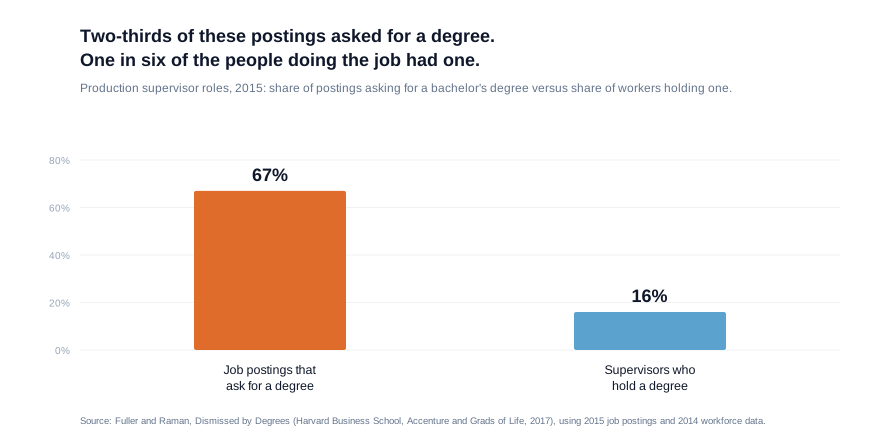
So you are advertising for a credential that, by the evidence of the people already doing the job, the job does not need. The talent shortage you complain about is, in that role, at least partly a shortage you manufactured.
The filter is not telling you what it used to
For a long time the degree was a cheap shortcut. It told you someone could show up, finish something hard, and learn. That shortcut is wearing thin. Recent college graduates now face an unemployment rate of about 5.7 percent. A degree still beats no degree at the same age, but by far less than it used to. In 1990, young workers without a degree ran about 4 points higher than recent graduates. Now the gap is about a point and a half. The cushion has mostly worn away.[2]
Underemployment is about where it was in 1990: roughly 42 percent of recent graduates work jobs that typically do not require a degree.[2] I wrote about the unemployment shift from the employer’s side in Palantir Skipped the Degree, Not the Filter. The short version, as I see it, is that the degree buys a new graduate much less of a cushion than it once did, which is a hint that it tells you less about who can do the work.
The number that decides whether the box is even fair
There is also a number that tells you whether requiring the degree is reasonable to ask of the worker at all. Run a four-year degree as an investment, after the cost, the four lost years of earnings, the taxes, and the time value of money, and at full price it has to clear about $71,000 in earnings four years after graduation just to break even against skipping college and going to work. The median graduate earns less than that and comes out behind over a working life, about $17,500 behind in today’s dollars even at the net price families pay after aid, and on the order of $82,000 behind at full sticker. Even if college cost nothing, the break-even line would still sit at nearly $54,000.[3]
So when you require a bachelor’s degree for a job that pays $40,000, you may be paying a premium for a credential that, at that wage, does not pay off for the person who earned it. The box was supposed to buy you a signal that she can finish something hard and learn. At a salary that far below every break-even line, it also asks her to carry a credential your job will not pay back.
What the box is actually doing
Put the line items together. Where you pay graduates more, the premium most often runs 11 to 30 percent, for a worker most employers in the same survey rate as no more productive than an experienced worker without the degree. You take on workers more of your peers rate as likelier to quit and to leave for competitors. You likely leave the seat open longer. And you do all of it while screening out capable workers and, in the lower-paying roles, asking for a credential the job itself will not pay back. You are not holding a standard. You are paying a tax and calling it diligence.
The first step is cheap. For every role, ask three questions. Do the people who do this job well actually use what a degree teaches? Do my own best performers in it hold the degree? Would I rather have proven skill or a credential?
For some roles the answers point right back at the box. If the work truly runs on what four years of study build, the degree is the right signal and you should keep it. The trouble starts when the box lands on the wrong job.
If the honest answers point away from it, take it off. Replace it with a test of the skill the job needs, an apprenticeship, a portfolio, a probationary project, anything that measures the work instead of the pedigree.
Done that way, taking the box off stops a payment that bought you little, and your standards stay where they were. The companies that see this first will hire the worker who can already do the job, likely see less turnover and likely fill the seat faster, while their competitors keep paying the surcharge.
The other half of this story, the capable people that same box locks out, is the subject of a companion piece, Who You’re Really Filtering Out.
Reference Sources
- Fuller, Joseph, Manjari Raman, et al. “Dismissed by Degrees: How Degree Inflation Is Undermining U.S. Competitiveness and Hurting America’s Middle Class.” Harvard Business School, Accenture, and Grads of Life, October 2017, updated December 13, 2017. Accessed September 24, 2026. The source of the degree-inflation scale, the production-supervisor gap, the 11 to 30 percent wage premium for nearly equal productivity, and the employer-reported turnover and retention figures.
- Federal Reserve Bank of New York. “The Labor Market for Recent College Graduates.” Federal Reserve Bank of New York, 2026. Accessed September 12, 2026 (data updated August 6, 2026). The figures here come from the page’s data workbook, where each month is a seasonally adjusted three-month moving average. In the June 2026 reading, unemployment was 5.7 percent for recent graduates against 4.1 percent for all workers and 7.2 percent for young workers without a degree, and 42.0 percent of recent graduates were underemployed. In January 1990, the first month of the series, recent graduates ran 3.4 percent against 7.6 percent for young workers without a degree and 5.1 percent for all workers, and 42.9 percent of recent graduates were underemployed. Recent graduates are those aged 22 to 27 with a bachelor’s degree or more, and young workers are the same ages without one, as defined in Abel, Deitz, and Su, “Are Recent College Graduates Finding Good Jobs?” Current Issues in Economics and Finance 20, no. 1 (2014).
- The full-price break-even of about $71,000 in earnings four years after graduation, the zero-cost break-even of nearly $54,000, the roughly $17,500 gap at the typical net price after aid, and the roughly $82,000 full-price gap are from the author’s college return model. You can run any school and major at collegeroi.org.