This fall, for its second cohort, the software company Palantir will pay a group of teenagers who never went to college to do the work its engineers do.
The program is called the Meritocracy Fellowship. It runs a full fall semester, it pays a real salary, and it is open only to high school graduates who are not enrolled in a U.S. university and have never earned a degree.[1]
The inaugural class, last year, took 22 fellows out of more than 500 applicants and paid them $5,400 a month.[1][2] The job posting did not bury the pitch. It read, “Skip the debt. Skip the indoctrination.”[1][2] The pitch was to earn the Palantir credential instead.
The company’s chief executive, Alex Karp, has been blunter still. On an earnings call he said that once you are inside Palantir, no one cares whether you went to Harvard or to no college at all, and that Palantir itself is “by far the best credential in tech.”[3]
Part of that pitch speaks to a culture-war audience, and that is the part that got the attention. I am setting that argument aside, because it is not what makes the move interesting.
The interesting part sits underneath the noise.
Palantir did not stop screening people. It stopped trusting the degree to do the screening for it, and started looking at what each applicant could actually do. This is a story about a shortcut that stopped working as well as it used to, and what a sharp buyer does when that happens.
Many announced this. Most did not follow through.
For a few years now, dropping the degree requirement has been the fashionable thing for an employer to announce. Google, IBM, Bank of America and others put out word that some of their jobs no longer required a four-year degree.[4]
It made for good press.
Then researchers checked whether it changed who actually got hired.
In 2024, Matt Sigelman and Alex Martin of the Burning Glass Institute, a labor-market research group, and Joseph Fuller of Harvard Business School studied what happened after companies stripped degree requirements from their postings. From 2014 to 2023, the number of roles that dropped the requirement each year nearly quadrupled. The hiring barely moved.
They found that in 2023 all the talk of skills-based hiring had created new opportunity for, in their words, “not even 1 in 700 hires.”[5] Almost all of the real change came from about 37 percent of the firms. Close to half changed their postings and nothing else, and the rest made gains that did not last.[5]
That is what makes Palantir worth watching. Most of the companies studied dropped the degree on paper and either kept hiring the same people or drifted back to them. Palantir actually brought 22 people without degrees inside, even if only for a four-month fellowship.[2]
Why a smart employer would do this
To see why, look at what the degree used to do for the person doing the hiring.
For decades a degree was a reliable shortcut.
An employer could read it as a quick promise that someone could show up, finish something hard, and do skilled work, and be right often enough that the shortcut paid. That is what a good signal does. It saves you the work of judging each person one at a time.
The shortcut is getting less reliable.
By early 2026, the unemployment rate for recent college graduates had climbed to about 5.7 percent.[6] A degree still beats no degree at the same age. Young workers without a degree sit higher, north of 7 percent. But look at what the cushion is worth now. Recent grads used to sit well below the rate for the whole workforce, which was about 4.2 percent in early 2026. For most of the years since 2019, they have sat above it. And about 42 percent of recent graduates are underemployed, working jobs that typically do not require a degree, about where that share has sat since 1990.[6] I traced that oversupply, and how the country keeps blaming the wrong people for it, in 25 Million in Crisis.
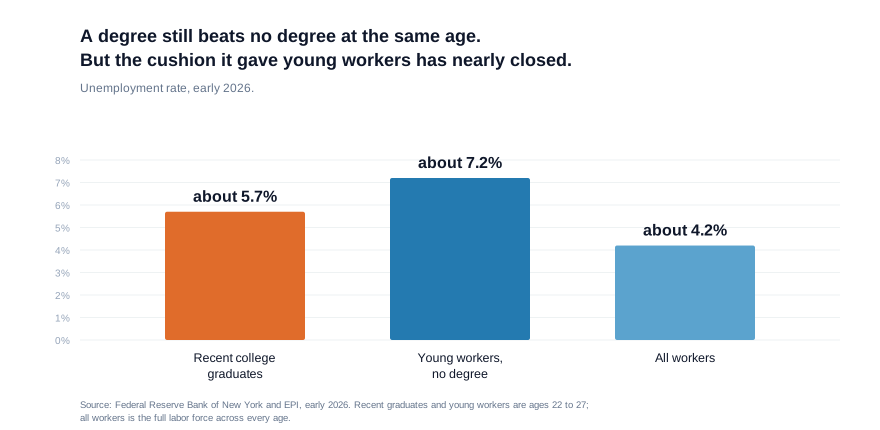
None of that means a degree is a bad deal. I read it as a sign that the results have spread out.
A degree from the right school in the right field, bought at the right price, is still one of the best investments a young person can make.
A degree from the wrong one, in an oversupplied field, at full price on loans, is now a likely loss.
The average sits between those two, and I think it has slipped. So the label by itself, just holding a degree, tells an employer less than it used to. The information did not vanish. It moved from the diploma to the specifics underneath it.
Then there is what is happening to the bottom rung.
Stanford researchers Erik Brynjolfsson, Bharat Chandar and Ruyu Chen, using actual payroll records, found that from late 2022 through September 2025, workers aged 22 to 25 in the jobs most exposed to artificial intelligence saw their employment fall about 16 percent relative to peers in jobs AI barely touches.[7] The authors note that AI-exposed jobs are more likely to require a college degree. That may mean some of the entry-level work a degree used to buy is the work AI is starting to affect, though the authors find a similar gap in jobs that do not require a degree. So the diploma points at a narrower target than it used to, at the same time the target is moving.
When a shortcut stops predicting the thing you bought it to predict, you stop leaning on the shortcut. You do not stop hiring. You start looking closer.
Government made the same move, quietly
If Palantir were alone, you could call it a stunt. It has company. The same shift that earns headlines when a company like Palantir does it has been spreading, with far less culture-war noise, through government. When Burning Glass checked actual hiring, government employers were well represented among the ones that followed through, though not all of them did.[5]
Maryland dropped the four-year degree requirement for thousands of state jobs in 2022, the first state to do it. Utah followed later that year, when 98 percent of its 1,080 classified job types required no degree. Pennsylvania opened about 65,000 jobs, roughly 92 percent of its state government jobs, to applicants without a degree.[8] These were governments run by both parties, and they did it for the plainest reason there is. A blunt requirement was screening out capable people for no good reason.
So the Palantir fellowship is not the leading edge of a fringe idea. It is a loud version of something a lot of serious institutions have already worked out.
It did not drop the bar. It moved it.
Palantir did not abolish the filter. It swapped a blunt one for a sharper one. To be considered for the inaugural class, applicants needed an SAT score of at least 1460 or an ACT of at least 33, a result in the top few percent in the country.[1][9] This year’s posting no longer lists a test score. It says applicants are invited to interview “based purely on merit and academic excellence.”[1] Last year’s class faced what Fortune called “Ivy League-level test scores.”[2] The company that says it does not care about pedigree still screened hard for ability. It traded the degree as the gate for a test and a four-month tryout. Fellows who excelled would get the chance to interview for a salaried job.[2]
The degree is not going away. It is losing its spot as the one filter everyone has to pass through. Reading what a person can actually do is harder than reading the name of their school, which helps explain why most companies that announced it did not follow through. The degree lasted as long as it did because it was a cheap, reliable proxy. It is losing ground now because it became an expensive one that points to a wide range of outcomes.
The same discipline, from the other side
I spend most of my time looking at this from the student’s side of the table, running the return on a degree as a financial investment. The lesson there is the same one Palantir just acted on. Look past the label to the specific case.
When Palantir decides a degree is no longer enough to tell it who to hire, it is making the same move a family should make when it decides whether a degree is worth the price. Both are refusing to let a category stand in for the person. The employer stopped asking did you graduate and started asking what can you do. The family should stop asking does college pay and start asking does this college, in this field, at this price, pay for this student.
There are still plenty of great bets out there. The trouble is the good ones are hard to spot. They sit buried under a pile of signals that have nothing to do with whether a school actually delivers, the prestige, the pretty campus, the famous name, the high price tag that gets mistaken for quality. The averages do not say walk away. They say the easy rule of thumb stopped working as well as it used to, so do the homework the rule used to do for you.
There is a hopeful reading here too. A hiring system that looks at what you can do, rather than what you bought, is a door for exactly the people the old shortcut shut out. The talented kid who could not afford four years, or could not finish, or grew up in the wrong zip code. Done honestly, looking past the label widens the gate. The danger is the fake version, the press release with nothing behind it, which lets a company look open while it changes nothing. I make the fuller case for finding and growing that overlooked talent in America’s Talent Crisis.
The signal worth keeping
So set the culture-war pitch aside. It is the least interesting thing Palantir is doing. The interesting thing is the discipline underneath it. A sharp buyer looked at a signal it had trusted for years, saw that it had stopped sorting cleanly, and went to the trouble of judging each person on the merits.
That is the move worth copying, on both sides of the table. The degree is not going to vanish, and for the right student it is still one of the best investments around. But it is no longer a number you can read off the top of a resume and trust. The people who do best from here, families and employers both, will be the ones willing to look past the label at the thing it was always supposed to stand for. You can start by running the return on your actual school and major at collegeroi.org.
Reference Sources
- Palantir Technologies. “Meritocracy Fellowship.” Palantir Careers. Accessed June 15, 2026. Job posting for the Fall 2026 cohort, archived May 15, 2026. The 2025 posting for the inaugural class, with the SAT and ACT cutoffs, archived June 15, 2025.
- Burleigh, Emma. “Palantir says college is no longer a reliable training ground—so it hired 22 high school students instead: ‘Skip the debt. Skip the indoctrination.’” Fortune, 5 Nov. 2025. Accessed June 15, 2026.
- Karp, Alexander. Palantir Technologies Second-Quarter 2025 Earnings Call, 4 Aug. 2025. Transcript, The Motley Fool. Accessed September 25, 2026.
- Mearian, Lucas. “Companies move to drop college degree requirements for new hires, focus on skills.” Computerworld, 10 Aug. 2022. Caminiti, Susan. “Companies eliminate college degree requirement to draw needed workers.” CNBC, 25 Apr. 2022. Accessed September 25, 2026.
- Sigelman, Matt, Joseph Fuller, and Alex Martin. “Skills-Based Hiring: The Long Road from Pronouncements to Practice.” The Burning Glass Institute and Harvard Business School Project on Managing the Future of Work, Feb. 2024. Accessed June 15, 2026.
- Federal Reserve Bank of New York. “The Labor Market for Recent College Graduates.” Federal Reserve Bank of New York, May 2026 release (2026:Q1 data). Accessed June 15, 2026.
- Brynjolfsson, Erik, Bharat Chandar, and Ruyu Chen. “Canaries in the Coal Mine? Six Facts about the Recent Employment Effects of Artificial Intelligence.” Stanford Digital Economy Lab, revised 12 Aug. 2026. Accessed September 25, 2026. The 16 percent is the regression estimate earlier versions headlined, on September 2025 data. The August 2026 revision stresses a simpler descriptive measure, on which the gap is 19 percent as of June 2026.
- Maryland: Schweitzer, Ally. “Maryland will no longer require four-year degrees for thousands of state jobs.” NPR, 16 Mar. 2022 (nearly half of about 38,000 state jobs). Utah: Office of the Governor. “Gov. Cox launches skills-first hiring initiative for state government.” 13 Dec. 2022. Pennsylvania: Office of the Governor. “Governor Shapiro Signs First Executive Order, Announcing 92 Percent of Commonwealth Jobs Do Not Require a Four-Year Degree.” 18 Jan. 2023. On Maryland as the first state: Thier, Jane. “Pennsylvania axes college degree requirement for 65,000 state jobs.” Fortune, 20 Jan. 2023. On the governors’ parties: Macejka, John. “Pennsylvania latest to eliminate college degree requirements for most state jobs.” The College Fix, 30 Jan. 2023. Accessed September 25, 2026.
- College Board. “SAT User Percentiles.” (a total score of 1460 is at the 99th nationally representative and 96th user percentile). ACT. “ACT Test Score Percentiles and National Ranks.” (a Composite of 33 ranks 98th). Accessed September 25, 2026.
This piece is a companion to my work on college return on investment, including College Is a Bet, which works out the odds from the student’s side. You can run the return on any school and major at collegeroi.org.