Forbes ran a cheerful ranking in June, built from LinkedIn data. The most versatile college majors. English came first, with visual and performing arts close behind.[1] If you majored in one of those, the message was that you bet well. Your degree travels. You can work in all kinds of industries.
I want to show you what that ranking is actually measuring, because it is not what it sounds like.
Read LinkedIn’s definition. Versatility is the share of graduates working outside their major’s top two industries.[1]
The thing being celebrated is how often a field’s own graduates end up somewhere other than where that field mainly hires. English tops the list at 69 percent.
That is not a skill the major handed them. It is the share of graduates who did not land in their field’s two largest industries. Forbes took that number and presented it as adaptability.
The story is told by the survivors
Start with where the data comes from. LinkedIn built this from graduates who finished between 2022 and 2024 and were employed full time the May after they graduated.[1]
Read that condition again. Anyone not working full time that spring is not in the ranking at all.
Then add the platform. LinkedIn is a business professional network. In my experience, people are on it when they have a job worth posting, a title worth listing, a career worth tending. The English graduate behind the espresso machine is usually not on it. Neither is the one selling sweaters at the mall. Nothing wrong with either job. They are simply not the kind of work LinkedIn profiles are built around, which in my experience means the data rarely sees them.
So when the ranking holds up English majors as thriving across many industries, it is reporting on the English majors who had full-time work that spring and a profile to put it on. Everyone else is left out of the count.
This is one of the oldest mistakes in reading numbers. You survey the people who made it and conclude the path is safe. The old statistics story goes like this. The bombers that came back from the war had bullet holes in the wings, so the brass wanted to armor the wings, until someone pointed out that the planes hit in the engine never came back to be counted. LinkedIn is showing you the wings. The engine-shot graduates are off the list.
What a survey built to reach everyone shows
There is a number built on a survey designed to reach everyone, because it comes from the Census and not from a profile people opt into. The New York Fed publishes the underemployment rate for recent graduates by major. It measures the share working in jobs that typically do not require a bachelor’s degree.[2] The barista is in it this time. So is the graduate selling sweaters.
Put the two side by side and the cheerful ranking turns inside out.
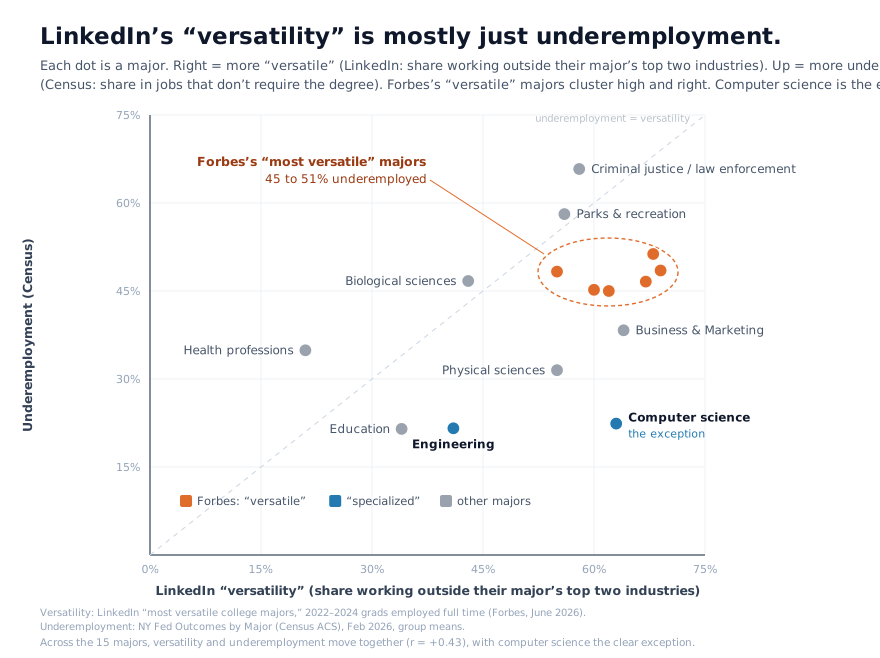
The three majors at the top of Forbes’s list are all well above the 39 percent underemployment rate for recent graduates overall. English, 69 percent versatile, 49 percent underemployed. Visual and performing arts, 68 and 51. Communication and journalism, 67 and 47. Social sciences and psychology sit in the same corner, 45 and 48 percent of their recent graduates in jobs that typically do not require the degree.
These are not the same graduates. LinkedIn counted the ones working full time who keep a profile. The Census survey is built to reach everyone. The two measures still tend to move together. At the top of the list, where LinkedIn says versatility, the New York Fed’s rate says underemployment, and LinkedIn picked the flattering word.
The major is not versatile. The graduate is forced to be. When a field turns out far more degree-holders than it has degree-level jobs, the surplus scatters. It takes whatever is open, in whatever industry will hire, and the part of that scattering LinkedIn can see shows up in its column as versatility. Versatility is what oversupply looks like from the comfortable end of the telescope.
Not every underemployed graduate is a casualty, and none of them is a punchline. Some are funding the plan. The actor pouring coffee between auditions is running her plan, not failing it, and retail can promote from the floor into management. But when nearly half a field lands there, it points to a shortage of jobs that need the degree.
The computer science exception
One major breaks the pattern sharply the other way, and it deserves a careful look.
Computer and information sciences is highly versatile by LinkedIn’s count, 63 percent. But its underemployment is low, 22 percent.[2] Its graduates do scatter across industries, and most of them still land in jobs that typically require the degree. For computer science, the versatility is genuine. The pivot lands somewhere good.
That exception is the whole problem with the metric. LinkedIn’s number cannot tell the difference between a computer science graduate who left tech to run analytics at a bank and an English graduate who left publishing for a full-time office job that does not need the degree. Both work outside their major’s top two industries. Both score as versatile. One pivot uses the degree. The other parks the degree while the rent gets paid, and the ranking counts them the same. So the same number can mean opportunity for computer science and displacement for English, and Forbes reports the one figure as if it carried the same meaning for everyone.
Praising the wrong thing
Now think about who reads a ranking like this. An 18-year-old deciding what to study, and a parent trying to help. They see English at the top of a list called most versatile, and they read it as permission. Study what you love, the degree travels, look how adaptable these graduates turned out.
The ranking has it backward. It takes the majors whose graduates most often land outside their field’s main industries and holds them up as the smart, flexible bet. It praises the symptom of oversupply and calls it a feature. The advice that falls out of it, pick the versatile major, points a teenager straight into the glut.
I am not telling anyone to skip English. I studied things that do not pay, and I regret none of them. I am telling you not to let a ranking sell you the underemployment rate as a selling point.
The question that actually helps
The useful question was never whether a major is versatile. Versatility, the way LinkedIn measured it, often tracks how thinly a field absorbs its own graduates. The useful question is whether the field is oversupplied. The tell for that sits in public data built to reach everyone, not only the survivors.
Here is a handful of the majors in the chart, with LinkedIn’s flattering number next to the New York Fed number it leaves out.
| Major | LinkedIn “versatility”[1] | NY Fed underemployment (Census data)[2] |
|---|---|---|
| English | 69% | 49% |
| Visual & Performing Arts | 68% | 51% |
| Communication & Journalism | 67% | 47% |
| Social Sciences | 62% | 45% |
| Psychology | 55% | 48% |
| Computer & Information Sciences | 63% | 22% |
| Engineering | 41% | 22% |
| Education | 34% | 21% |
For the three majors at the top of LinkedIn’s list, the pattern is hard to miss once both columns are in front of you. Across all 15 majors in the chart the link is looser, a modest tilt rather than a rule. Versatile shows up on the list mostly where the hiring runs out.
I run these numbers school by school and major by major at collegeroi.org, because the cheerful version is everywhere and the full version takes a little digging. Do the digging. It is your four years and your money, and the people ranking your major are working from a list that left out every graduate who was not working full time.
Companion Pieces
Reference Sources
- Connley-Hampton, Courtney. “The College Majors Most Likely To Get You Hired In Your Field And Outside Of It.” Forbes, 25 June 2026, updated 14 July 2026. Accessed July 30, 2026. The LinkedIn “most versatile college majors” ranking, defined as the share of graduates working outside their major’s top two industries. LinkedIn’s universe is US students who completed bachelor’s degrees from 2022 to 2024 who were employed full time in the May following their graduation year. Full article archived at the Wayback Machine, 25 Sept. 2026. The full list of 15 majors is also reprinted in Oyelakin, Saheed. “FULL LIST: University majors most likely to get you hired in 2026.” Punch, 5 July 2026.
- Federal Reserve Bank of New York. “The Labor Market for Recent College Graduates.” Outcomes by Major table. Federal Reserve Bank of New York, updated 4 Feb. 2026. Accessed July 30, 2026. Underemployment rate by major for recent graduates ages 22 to 27 with a bachelor’s degree or higher, excluding those enrolled in school, the share working in jobs that typically do not require a bachelor’s degree, from U.S. Census Bureau American Community Survey data, with job requirements from the U.S. Department of Labor’s O*NET. Group figures are unweighted means across the New York Fed’s sub-majors. Figures are for 2024.