In 1980 I walked into an English class at Baruch College taught by a lovely woman who was still against the Vietnam War, against nuclear power, and open about both. She was steeped in what I would later learn to call the progressive agenda.
I had arrived in the United States the year before.
I knew from Guyana what politics could cost, but I did not yet know that an American classroom could carry an agenda.
When our assignments took us into the city, to underground plays and concerts chosen to give context to what we read, I came back with questions. Not all of them got answered. I was careful about how I framed the ones I asked out loud. And I finished the class the way I started it, converted to nothing except the habit of asking.
Keep that room in mind, because by the logic of a complaint you have heard a hundred times, it is exactly where indoctrination should have worked. A professor with strong politics. Assignments built around her world. A student with no defenses, one year off the plane, with no map of American politics in his head. If professors convert students, I was the easiest mark in the building.
The complaint says two things. College faculties lean far to the left, which is offered as proof of a rigged profession. And left-leaning professors convert their students, which is offered as the harm.
The first half rests on a real fact. Everything else rests on a mistake I was paid to catch in my years as a management consultant, a correlation dressed up as a cause. And underneath the bad math sits a worse mistake, a quiet insult to the students the complaint claims to protect.
There are other fights about the campus, about administrators and speech rules and what gets taught. Those are real arguments for another day. This one is about the charge aimed at the professors.
The half of the complaint that is true
Concede the fact first, because it is both real and large. College faculties lean left of the country by both of the main measures researchers use, party registration and how professors describe themselves.
One researcher checked the voter registrations of 8,688 professors at 51 top liberal arts colleges. For every registered Republican, he found more than ten registered Democrats. At nearly 4 in 10 of those colleges, Republicans were so few that his statistical test could not tell their share apart from zero. At two, he found none at all.[1]
A national survey began asking professors about their politics in 1989. In its 2016-17 round, 60 percent called themselves liberal or far left, 12 percent called themselves conservative or far right, and the gap between the two camps was roughly double what it was when the asking began.[2]
Two caveats travel with the numbers. The steepest counts come from elite schools, and registration checks only see the professors who register with a party. Neither changes the direction. America’s professors sit well to the left of the country they teach in.
The question is what follows from the fact. The complaint answers discrimination on the way in and conversion on the way out. The evidence answers differently on both.
The skew is mostly who shows up, not who is kept out
The sociologist Neil Gross spent years on the question of why professors lean left, and the answer his research best supports is unglamorous. The profession sorts itself.[3]
Early in the last century, professors got a reputation for liberal politics.[3] Reputations recruit. A bright young liberal looks at academia and sees home. An equally bright young conservative looks at the same buildings, sees foreign territory, and takes that talent somewhere else.
Nobody has to rig anything. The sign on the door does the sorting.
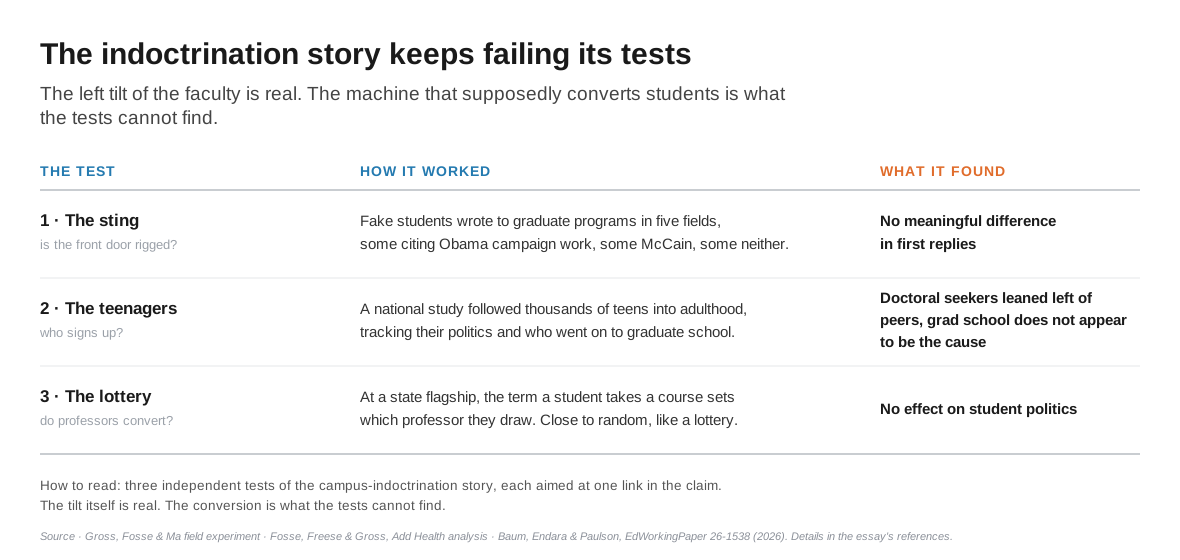
You can watch it happen in the data. One study followed thousands of American teenagers into adulthood. The ones who went on to seek doctorates were more liberal than their peers, and the evidence suggests graduate school was not what made them so.[4]
The front door got tested too, with a sting. Researchers wrote to the people who run graduate programs in five fields, pretending to be students about to apply. Some letters mentioned work on the Obama campaign. Some mentioned work on the McCain campaign. A politically mixed panel of independent judges graded every reply for speed, warmth, and helpfulness. The Obama letters and the McCain letters got no meaningfully different replies. The sting stopped at that first contact, before any admissions decision.[5]
To be clear, nothing here proves the deck is level once you are inside. In a survey of social and personality psychologists published in 2012, more than a third said that, between two equally qualified job candidates, they would favor the liberal.[6]
Once a field tilts far enough, its reputation hardens and the sorting feeds itself. That deserves attention, and I will come back to it. But an amplifier is not an engine. The main engine is self-selection, and self-selection is not a conspiracy. It is people choosing work that fits how they see the world, the same way risk-takers become traders and rule-lovers become auditors.
The conversion the data cannot find
Now the second half, the half about the students. It got its hardest test in a study released in July, the first built to show cause and effect, as far as its authors know.
Three researchers matched voter records to the payrolls of 33 state flagship universities, so they could tell which professors were Democrats and which were Republicans. Then, at one of those flagships, they used the class schedule as a lottery. Most courses run a single section each term, and students take them when their schedule and prerequisites allow, so which professor happens to be teaching that term is close to random.
That randomness is the whole game. If professors convert students, the students who happened to draw Democratic professors should come out more Democratic.[7]
They did not. Students who drew Democratic professors came out no more Democratic than students who drew Republican ones. Students did drift left during college, but they drifted in every major, whichever professors they drew. The study cannot say whether college itself caused the drift, and its authors argue that classmates are a much likelier cause than professors.
The sorting ran the other way. Students tended to pick the courses and topics matching the politics they walked in with, and the liberal content students ended up studying reflected what they wanted to take more than what professors wanted to teach.[7]
The older evidence says the same thing. One study tracked thousands of students at 38 private colleges from their freshman year in 1999 to their senior year in 2003. The colleges with the most liberal faculties were no more likely to move their students left than the rest. Overall, the authors found only a slight shift to the left, and seniors finished with a smaller far-left share than Americans aged 18 to 24.[8]
And two political scientists, a conservative and his wife, whose politics sit well to the left of his, designed a study to settle a bet between them. He assumed professors move their students. Her position, as he tells it, was that “students aren’t sponges.” Their data settled it her way. Student views drifted a little over the semester, and somewhat at random, whichever way the professor leaned, and he said so in print.[9]
Which brings me back to my English class. I sat a few feet from a professor with strong convictions, in a course built around her world, with no map of the terrain in my head. I got a heavy dose under the most favorable conditions, and what it produced was a student with questions. The 2026 study is my classroom measured at scale. Whichever professors the students drew, the professors’ politics did not pull the students their way.
The insult buried in the complaint
Ask what college is for, and catalogs and commencement speeches tend to give the same answer: critical thinking. The indoctrination complaint quietly assumes students cannot think for themselves. It treats students as empty hard drives waiting for whoever loads them first, and it treats exposure to a professor’s worldview as contamination rather than coursework.
Flip the assumption. If we mean what we say about critical thinking, then our strongest students need contact with ideas they did not arrive holding, including progressive ones, the way a muscle needs resistance. The student who hears a case for positions her family never held, and has to decide what she thinks, is doing the exact exercise college exists to assign. My questions in 1980 were not a failure of the class. They were the class.
The 2026 study adds a warning here. Students often end up in courses taught by professors who share their politics, mostly through the electives they pick. That is an argument for putting students in rooms they would not choose on their own. My English class put me in one. It is no argument for thinning out the professors a student might disagree with.
Some students do get swept along. Are there professors who preach instead of teach? Yes, and they fail their students whichever direction they preach in. But those are stories about individuals, and the complaint claims a pattern across the whole system. Every profession includes people who betray its mission. We do not conclude from a bad surgeon that surgery is a scheme against patients.
The quiet cost, and the honest fix
I said I would come back to the tilted deck. A real cost hides in those lopsided numbers, the cost I lived rather than the one on cable news. I was careful with my questions in 1980. Not silenced, and not converted. Careful. A conservative student in one of today’s most tilted departments would know the feeling. In that same survey, conservative psychologists said they feared what would happen if colleagues learned their politics, and the authors concluded they were right to.[6]
The cost of a faculty where nearly everyone votes the same way is not conversion. It is caution, questions framed to fit the room or never asked at all. A field where nearly everyone starts from the same assumptions will miss some of its own mistakes, because the person who would have caught them learned to keep the question to himself.
There is a serious case for hiring more professors who see the world differently. The case is about getting the answers right, and it needs no conversion myth to prop it up.
And when an individual educator does fail, when a classroom becomes a pulpit, name the failure precisely.
In my experience, few people choose teaching for the money or the power. Teaching draws people with a mission, the chance to leave behind a legacy of thinking minds.
A professor who uses the room to install his own politics has failed that mission, and the failure is one every organization knows how to name. It is a hiring problem and a management problem. Somebody hired for the wrong thing, measured the wrong thing, or looked away.
The remedy is the ordinary machinery of any workplace, hiring for the mission, rewarding the teaching of thinking, and correcting the preachers of every persuasion. Checking professors’ politics aims at the wrong thing. The thing worth checking is whether students leave able to think.
My English professor never found out what I thought about the Vietnam War or nuclear power. She never asked me to agree with her, and I never saw a grade bend to politics. What she did was put her world in front of a student one year off the plane and let him ask his careful questions. Forty-six years later, I still remember that class as one of the most interesting and thought-provoking I took outside my field. The agenda never took, and the habit of asking never left.
One student is not a statistic. But the statistics, it turns out, look like that classroom. The professors lean left mostly because of who answers the calling. The students leave with minds of their own because they came with them. American higher education has real problems. I wrote a book about them. The conversion story is not one of them. Let it go, and give the students some credit.
Reference Sources
- Langbert, Mitchell. “Homogenous: The Political Affiliations of Elite Liberal Arts College Faculty.” Academic Questions, vol. 31, no. 2, 2018. Accessed September 24, 2026. Voter registration of 8,688 tenure-track, PhD-holding professors at 51 of the 66 top-ranked liberal arts colleges in the U.S. News 2017 report: 10.4 registered Democrats per registered Republican. At 20 of the 51 colleges (39%), the Republican share was not statistically different from zero, and at two (Bryn Mawr and Soka) he found no Republican-registered faculty. Langbert himself reads the few exceptions to the pattern as a sign that “institutional factors and discrimination might be key reasons” for the imbalance.
- Abrams, Sam, and Amna Khalid. “Are Colleges and Universities Too Liberal? What the Research Says About the Political Composition of Campuses and Campus Climate.” Heterodox Academy, 21 Oct. 2020. Accessed August 13, 2026. Summarizes the HERI Faculty Survey: 60% of faculty liberal or far left versus 12% conservative or far right in 2016-17, against a 2.3:1 liberal-conservative ratio in 1989. The 2016-17 shares match the survey’s own report: Stolzenberg, Ellen Bara, et al. Undergraduate Teaching Faculty: The HERI Faculty Survey 2016–2017. Higher Education Research Institute, UCLA, 2019. Accessed September 25, 2026. It reports 11.6% far left and 48.3% liberal, against 11.7% conservative and 0.4% far right.
- Gross, Neil. Why Are Professors Liberal and Why Do Conservatives Care? Harvard University Press, 2013. Accessed September 24, 2026. The political-typing account: the profession’s liberal reputation, formed early in the twentieth century, does the recruiting.
- Fosse, Ethan, Jeremy Freese, and Neil Gross. “Political Liberalism and Graduate School Attendance: A Longitudinal Analysis.” In Professors and Their Politics, edited by Neil Gross and Solon Simmons. Johns Hopkins University Press, 2014, pp. 53-81. Accessed September 24, 2026. Add Health panel data. In the authors’ earlier version, as reported by Inside Higher Ed in 2011, those seeking doctorates were more liberal than their peers, and the findings cast doubt on graduate school as the cause.
- Jaschik, Scott. “(Liberal) Academic Self-Selection.” Inside Higher Ed, 20 Mar. 2011. Accessed August 13, 2026. Reports the Gross, Fosse, and Ma field experiment: inquiry letters to graduate directors mentioning Obama or McCain campaign work drew responses that independent, politically mixed raters scored for speed, warmth, and helpfulness, with “no statistically or substantively significant evidence of bias.”
- Inbar, Yoel, and Joris Lammers. “Political Diversity in Social and Personality Psychology.” Perspectives on Psychological Science, vol. 7, no. 5, 2012. Accessed August 13, 2026. Full text at the first author’s website, accessed September 26, 2026. Survey of social and personality psychologists: 37.5% would favor the liberal of two equally qualified job candidates, and, in the authors’ words, “conservatives fear negative consequences of revealing their political beliefs to their colleagues” and “they are right to do so.”
- Baum, Micah Y., Joaquín Endara, and Annaliese Paulson. “Do Faculty Affect Student Partisanship?” EdWorkingPaper No. 26-1538, Annenberg Institute at Brown University, July 2026 (PDF). Accessed August 13, 2026. Voter files linked to salary records at 33 state flagships. Transcript-level causal analysis at one flagship using quasi-random instructor assignment finds no effect of faculty partisanship on student partisanship, leftward drift in every major, and course-content exposure driven by student demand. The authors add that their design “does not let us study the global effects of attending colleges,” and that “peers are a much more likely explanation” than faculty for the students’ leftward drift.
- Mariani, Mack D., and Gordon J. Hewitt. “Indoctrination U.? Faculty Ideology and Changes in Student Political Orientation.” PS: Political Science & Politics, vol. 41, no. 4, 2008. As reported in Jaschik, Scott. “Faculty Are Liberal — Who Cares?” Inside Higher Ed, 26 Mar. 2008, and Hamilton College, “Associated Press and InsideHigherEd.com Detail Hewitt Research,” 1 Apr. 2008. Accessed September 24, 2026. Almost 7,000 students at 38 colleges, surveyed as freshmen in 1999 and as seniors in 2003: whether a college was more liberal or more conservative did not correlate with how its students shifted, and seniors were less likely than 18-to-24-year-olds nationally to call themselves far left. Inside Higher Ed’s table of the results is titled “Political Orientations of Private College Students and the General Population.”
- Woessner, Matthew. “Rethinking the Plight of Conservatives in Higher Education.” Academe, Jan.-Feb. 2012. Accessed August 13, 2026. Woessner, a self-described conservative, recounts the study he and April Kelly-Woessner designed “to settle a bet”: student views shifted slightly and “somewhat randomly” (an average 0.06 points on a five-point scale), “irrespective of the professor’s political orientation.”