The University of Michigan said this month that from fall 2027, first-semester grades will stop appearing on transcripts in its College of Literature, Science, and the Arts.[1] The internet had its answer inside a day. Coddling. Participation trophies. One more school going soft.
I read a lot of those replies. A few were genuinely good. Someone had gone and read the actual policy, noticed that students still see their own grades, and asked a sharp question about what that changes. Most were people who had read a headline and typed for eleven seconds.
Here is what I could not stop turning over. Both kinds showed up in the same feed, in the same font, at the same length. There was no way to tell which was which without doing the work yourself. And Michigan, which graduates more than ninety-three percent of the students who enroll and whose median graduate earns about $96,000 four years after finishing,[2] had no cheap way to tell them apart either.
That is not really a story about Michigan. It is a story about what happens to any argument that shows up without a name behind it.
It happens in politics, where the careful objection and the reflexive one get the same eleven seconds. It happens in business, where the memo from the person nobody knows waits longest.
I have been living inside it for years, in a field where I have no standing at all, and I want to explain what I have learned about why good arguments go unread, and what I have decided to do about it anyway.
Why nobody reads the good ones
Start with a used car lot, because that is where the idea I need was first worked out, and it went on to win a Nobel Prize.
In 2001 three economists shared the prize for explaining what happens to a market when one side knows more than the other.[3] George Akerlof, Michael Spence and Joseph Stiglitz. I opened my book with their work, because it explains the college market almost perfectly. The school knows far more about what it actually delivers than the family can see. When the buyer cannot check, the market stops paying for quality. That is why the school that fails to deliver good outcomes to its students and the school that transforms them can charge the same price. There are ways out of that failure, inspections and warranties and names worth protecting, and every one of them costs somebody something. Who pays to make quality visible is the question underneath this whole essay.
I want to point the same idea somewhere else. Not at the market for degrees. At the market for arguments about them.
Akerlof’s example was the car lot. The seller knows whether the car is any good. You do not. You can kick the tires, but you cannot see the transmission. So you do the only sensible thing and offer what an average car is worth. Or you pay for an inspection, or buy the history report, and find out. The information exists. It just costs something to get, and the trick is whether it costs less than the difference between a good car and a bad one.
Mostly you do not pay. Which means the man with a genuinely good car will not sell to you, because your offer insults it. He goes home. The cars left on the lot get worse, your next offer gets lower, and the whole thing slides downhill. The prize announcement described where it ends. A market like that “can contract into an adverse selection of low-quality products.”[3]
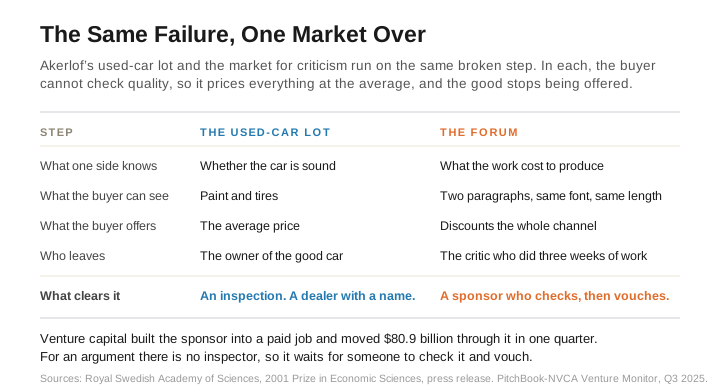
Now put an institution in the buyer’s seat.
One thing does not carry over. A car seller knows what he is selling. A critic mostly does not. Almost everyone who writes a hard critique believes it is a good one, which is its own kind of problem and I will come back to it. What the critic does know is what the work cost him. That is the piece the reader cannot see, and it turns out to be enough to break the market on its own.
Criticism arrives all day and almost none of it costs anything to make. Checking any single piece of it is expensive. There is no history report for an argument. Checking one takes the specialist knowledge the critic is assumed not to have, and it takes hours that were already promised to something else. So the institution does what you did at the car lot. It offers the average price. And the average is low, because typing is free and the cheapest thing anyone can write is that the whole enterprise is a racket.
Then it stops reading, calls the channel uninformed, and gets on with its day.
I want to be careful here, because the easy version of this essay treats that as elitism. I would call it triage, and on the information available it is the right call. An administrator who properly evaluated every critique would never do anything else. Give the institution its arithmetic and this gets harder, which is where it belongs.
And it really is hard. Take the case everyone reaches for when they want to talk about ignored truth.
Galileo is remembered as the man nobody would listen to. He was nothing of the kind. He had some of the best backing in Europe. In 1610 he named the moons of Jupiter after the Medici, the ruling family of Tuscany, and they made him Chief Mathematician and Philosopher to the Grand Duke.[4] Maffeo Barberini was his friend and supporter, and when Barberini became Pope Urban VIII in 1623, that is what gave Galileo the confidence to start writing the book that ruined him.[4]
The book defended the claim that the earth moves around the sun. The Church had warned him in 1616 to stop promoting that idea, and when the book appeared in 1632, he was tried and condemned the following year. And the telescope discoveries the book leaned on, the moons of Jupiter and the phases of Venus, dated from 1610.[4] Sixteen years from the warning to the book, the same sky, and this time a trial.
The book contained a proof that was wrong. Galileo argued that the tides proved the earth moves, and his argument ignores the moon and ties the tides to noon and midnight, while anyone standing at a harbor can see them arrive at a different hour each day. His contemporaries doubted it at the time, and they were right to.[4] Historians still argue about what actually drove the condemnation of 1633.
So picture the people who received that book. It was correct about the biggest question in astronomy and wrong about the mechanism its author offered as the clincher. Telling those apart took work almost nobody in the room could do. The obstacle was the cost of checking, and it still is.
The work nobody can see
Akerlof explains why the buyer stops paying. Spence explains what the seller can do about it, and his answer is the uncomfortable one.
Spence studied how someone who knows more can prove it to someone who knows less. What he found is that it works only when the proof can be seen and costs a pretender more than it costs the real thing.[3] A degree functions as a signal because you cannot get one over a weekend. The cost is the whole point of it.
Good criticism passes half of that test easily. It is genuinely expensive, and nobody can fake it cheaply. You read the policy itself instead of the coverage. You pull the underlying numbers. You go and find out whether the precedent everybody keeps citing was ever actually studied. Days of work, sometimes weeks, and most of it produces nothing you can use.
It fails the other half completely, and this is the part that took me a while to see. None of that cost is visible when the thing lands.
Two paragraphs arrive. One took three weeks. One took ninety seconds. On a screen they are the same size. You cannot tell them apart without redoing the three weeks, which is the exact thing you were trying to avoid. So the expense that makes the criticism worth reading is the same expense that cannot be shown. By Spence’s own test, the signal fails.
Notice what that does to the obvious response. If you are being ignored, working harder feels like the answer. It is not. More rigor makes the piece better without making it any easier to recognize. You end up buying more of the quality nobody can see.
I chose to argue without standing, and this is what it costs
There are three main ways to move a person to your view, and people have known this since Aristotle.[5] You can move them by feeling. You can move them by standing, which is to say by who you are and what you have done. Or you can move them by reasoning. Feeling, standing, reasoning. Aristotle meant the credibility a speaker earns inside the speech itself. I mean the kind a person carries into the room. Most persuasion mixes all three.
I have never trusted the first two as ways to make an argument, and I should explain why, because it is the reason I ended up on this lot.
Feeling I distrust because a story that moves you proves nothing about whether it is typical. One student who was failed by her college is a tragedy. It is not a rate.
Standing I distrust for a more particular reason. Standing does not lower the burden of proof. It only shortens the time anyone spends checking. When a person with a title says something, the room nods faster, and nodding faster is not the same as the claim being more likely to be true. If anything it raises the risk that a mistake gets through, because the arguments that most need checking are the ones nobody feels the need to check. Standing makes a room more confident and less careful at the same time.
When the room is disposed to nod, that is. Galileo had some of the best backing in Europe and Rome still did not nod, in part because by then Rome had decided what it thought.[4] Standing does not make a room agree. It makes a room stop checking, in whichever direction it was already leaning.
So I built on reasoning alone. I claim no virtue for it. Part of it is temperament, I was made this way, and part is that in higher education I have no standing to spend. I have never run a university or sat on a faculty. If I wanted the argument to survive, it had to survive on its own.
That is why the book is five hundred pages. It is not five hundred pages of story or of who I am. It is every four-year college in the federal data that reports enough to be scored, more than sixteen hundred of them, run through the same model, every number sourced, built to withstand the impeachment that any argument this uncomfortable deserves and should get. I wanted a fact base that would still be standing after the people with standing had finished with it.
And that is exactly why it sits on the lot with the lemons. It is not going to be a bestseller. I would like to tell you that is the market and not the book. By my own argument I do not get to know that. Nobody walking past can tell which kind of car it is, and from the inside, neither can I. What I can tell you is what it cost, which is exactly the thing that does not transmit.
I have already published a piece criticizing Michigan’s decision.[6] Same lot. I have never sat on a curriculum committee or been responsible for thousands of first-year students. By any standard Michigan would reasonably apply, I am exactly the correspondent whose letter gets filed.
I think that piece is right. Almost everyone who writes one thinks that.
Which is where Galileo earns his place, and not for the reason people usually bring him up. The useful thing is not that he was silenced. It is that he was certain and partly wrong at the same time, and the people who doubted his tides were doing their jobs properly. No critic gets to assume he is the one being unfairly ignored rather than the one who is mistaken. I do not get to assume it here. You cannot cheaply check this essay either, and all I can do is show the work, which costs what it costs and settles nothing by itself.
What actually clears the market, and why it makes me uneasy
Here is the good news, and there is some.
Markets do not usually just sit in this failure. They climb out, and most of them climb out the same way. When you cannot check the thing itself, you find something else you can check cheaply instead. A warranty. An inspection. A dealer with a name worth protecting.
One market has built serious machinery for this exact problem, and it is worth seeing how much it took.
Venture capital exists to fund things nobody can verify yet. That is the entire business. The industry built an apparatus. The checking done once and shared around. Money released in stages as evidence arrives. A board seat so somebody keeps watching. And syndication, where a lead investor puts their own reputation on the deal so that everyone joining afterward can commit without repeating all of the homework. In the third quarter of 2025 alone, about $80.9 billion moved through that machinery in the United States across some 4,208 deals, according to a report from PitchBook and the National Venture Capital Association.[7]
It still does not work evenly. The same report describes money piling into outsized deals, and a widening gap between the startups drowning in investor interest and the ones struggling to raise money.[7] To me that suggests that even with all that apparatus, being able to signal still counts for a great deal.
But look at what the lead investor is. Someone who stakes their own standing on a thing the rest of the room has not checked. That is a sponsor. Here the word names a job, and people are paid to do it.
Almost nothing with that much machinery exists for an idea. There is one real exception. Academic peer review is machinery for ideas, and it is old and funded. But it is slow, it runs on credentials, and it covers almost nothing written about public policy by people outside a university. Which, in my experience, is most of what gets written, and all of what this essay is about. An editor or a publisher stakes something, but nothing close to the apparatus above. So an idea waits, and what it waits for is a person with an audience willing to put their name on it before the room has checked it.
That is why timing and a receptive ear can matter more than being right, which is an unpleasant thing to learn.
Now I have to say something plainly, because a careful reader will already have noticed it. A sponsor is standing, borrowed. It is exactly the thing I said a section ago that I distrust, the thing that makes a room nod faster and check less. I spent years building an argument that would not need it, and I have just told you the argument cannot travel without it.
I do not think that is a contradiction. I think it is the honest shape of the problem, and it tells you what the sponsor’s job is and what it is not.
The sponsor’s standing buys a hearing. It also, whether anyone intends it or not, makes the room nod faster, which is the defect I described in the last section and I am not going to pretend it away. So the sponsor’s job has two halves. Open the door, and then put the burden of proof back where it was. The way to do the second half is the third name on that prize.
Stiglitz’s half was screening. What the person who knows less can do to pull information out of the person who knows more, instead of waiting to be told.[3] An insurance company offering you a menu of deductibles is not investigating you. The choice you make tells it how much risk you expect to carry. It has built something that makes you reveal yourself.
Anybody holding a microphone can do that, and it is cheap. Ask a writer what would change their mind. Ask what the piece would look like if it turned out to be wrong. Ask where a number came from and see whether they can produce it inside a minute. None of that needs the expertise the critic supposedly lacks. It costs roughly what the worst criticism costs to produce, and it is what puts reasoning back in the room after standing has opened the door.
A sponsor who asks those three questions before vouching is not lending a name. The sponsor is doing what the inspector does at the car lot, checking the thing on the buyer’s behalf and staking something on the result. That is the version I am asking for, and it is the only version worth having.
There is a history report for an argument after all. Not a list of people who agree, which a new argument never has and does not need. It is the list at the bottom, where every load-bearing fact says where it came from, and whether the writer can defend it when asked. When Galileo first reported the moons of Jupiter, nobody had reported them before him, so there was no authority to cite.[4] He could hand you the telescope.
I am not arguing for fewer critics. The bad criticism is the price of the good, and a room with a bouncer is worse than a noisy one. What I am saying is that the people holding the microphones are standing in the one place where this is fixable, and most of them are behaving like buyers when they could be screening.
Why bother
I said I distrust feeling as a way to make an argument. I do. So here is the one place I will let it in, and only now, after the argument is done.
There is no real money in this for me, and no position to protect. I am not selling a program. My daughters are both grown and both fine. What I am doing, mostly, is sitting down before I fully retire and writing out what I learned, for my friends and for anyone who wants it. I spent a career learning how to take a hard problem apart, and it seems a waste not to.
The people this argument most needs to reach are not going to read a five-hundred-page book, and I knew that when I wrote it. They are the families deciding this year, held in place by a story that tells them the question does not need asking. To reach them the argument needs sponsors who check before they vouch. I have spent much of this essay explaining why I distrust the other kind, and I am going to look for the right one anyway.
Because of what is on the other side. Fewer people who paid for a degree and never got what they were told to expect. Fewer graduates in jobs that never needed the degree. More people reaching the work they actually wanted at a price they could carry. More left over for a family to retire on. Fewer people walking around with a grudge they cannot quite name.
That is a better world for my daughters to live in. It seems worth trying to build.
Reference Sources
- University of Michigan College of Literature, Science, and the Arts. “LSA First-Semester Grade Covering Pilot Program.” The pilot, beginning fall 2027, under which LSA first-year students’ first-semester grades appear on their transcripts as pass or no credit.
- U.S. Department of Education. College Scorecard, University of Michigan-Ann Arbor. Accessed August 12, 2026. Graduation rate within eight years of entry for all entering students, including part-time and transfer students, and median earnings four years after graduation for students who received federal aid. Both definitions are in the Scorecard’s change log.
- The Royal Swedish Academy of Sciences. “The Sveriges Riksbank Prize in Economic Sciences in Memory of Alfred Nobel 2001.” Press release, 10 October 2001. Accessed August 12, 2026. Awarded to George A. Akerlof, A. Michael Spence and Joseph E. Stiglitz “for their analyses of markets with asymmetric information.” The release describes Akerlof’s finding that such a market “can contract into an adverse selection of low-quality products,” Spence’s account of costly signaling and the conditions under which it works, and Stiglitz’s account of screening by the less informed party. The Academy’s popular information page gives Akerlof’s used-car example.
- Miller, David Marshall. “Galileo Galilei.” The Stanford Encyclopedia of Philosophy. Accessed August 12, 2026. Medici patronage from 1610 following the Starry Messenger, with the title Chief Mathematician and Philosopher to the Grand Duke. Maffeo Barberini was a supporter and friend before his 1623 election as Urban VIII, and that elevation emboldened Galileo to begin the Dialogue. Also the source for the 1616 admonition, the 1632 to 1633 ban, trial and conviction for vehement suspicion of heresy, the dates of his telescopic discoveries, 1610 to 1613, and the tidal argument, which “has always been skeptically received, even by his contemporaries.”
- Rapp, Christof. “Aristotle’s Rhetoric.” The Stanford Encyclopedia of Philosophy. Accessed September 25, 2026. The three means of persuasion, and Aristotle’s point that the speaker’s credibility must come from the speech itself.
- Shivamber, Leon. “The Measure They Kept.” shivamber.com, August 2026. The companion essay on the Michigan policy itself.
- PitchBook and the National Venture Capital Association. “Q3 2025 PitchBook-NVCA Venture Monitor.” Data as of 30 September 2025. Accessed August 12, 2026. Reports $80.9 billion deployed across an estimated 4,208 deals in the quarter, capital concentration in outsized deals, and a widening bifurcation between startups with strong investor demand and those struggling to attract capital.