Beginning in fall 2027, first-year students in Michigan’s College of Literature, Science, and the Arts, known as LSA, will finish their first semester without letter grades on their transcripts. Every course becomes pass or no credit. The college says the change will help students explore subjects that do not come easily to them, and it claims something larger. In its own words, covering grades will help students “start strong and curb the mental health crisis unfolding among college-aged individuals.”[1]
I want to take the claim seriously, because the distress is real. Students are struggling, and a university that notices is better than a university that looks away. Michigan also thought about the design more carefully than the headlines suggest. Students still receive their grades and their instructors’ feedback exactly as before. Only the external transcript and the grade point average lose them. Coverage applies to everyone rather than by request, and the reasoning there is sound: if covering your grades were optional, choosing to cover them would quickly come to mean you had done badly.[1]
So this is not a story about an institution being careless. It is a story about a careful institution answering the wrong question.
Here is the sentence in Michigan’s announcement that should stop you. “We believe that covering grades will help students start strong and curb the mental health crisis unfolding among college-aged individuals.”[1]
Believe.
On the same page, the college asks whether anyone has tried this before. The answer is yes. MIT since 1968, along with Caltech, Swarthmore, and Wellesley.[1] Fifty-eight years of experience with a covered first semester, cited as precedent, and not one outcome from any of it appears anywhere in the announcement.
Somebody did measure. What they found mostly runs the other way.
The pressure is real. Inflation concentrated it.
Start with the number that keeps turning up in coverage of Michigan. In 2022, roughly seventy-four percent of undergraduate grades were in the A range, up from about fifty-eight percent a decade earlier.[2]
The obvious reading is that grading pressure at Michigan has already been dismantled, so covering grades removes a constraint that stopped binding years ago. I believed that reading until a Michigan student talked me out of it.
Writing in the Michigan Daily last November, nine months before the college announced the pilot, Lucas Feller described his own course selection. He opens Atlas, the university’s course planning tool, and before he reads a course description or checks how the professor is reviewed, he scrolls to the grade median. “If the median is significantly lower, I probably won’t enroll.” He is careful to say he does not do this because he wants to. He does it “out of perceived necessity.”[3]
Follow his logic and the seventy-four percent figure inverts. When three grades in four are A’s, a single grade that is not an A costs far more against your classmates than it once did. The median grade point average of students entering Yale Law and Stanford Law is 3.96.[4] There is no room left. Grade inflation did not relieve the pressure on Michigan students. It concentrated the pressure, by deleting the margin for error that used to exist when B’s were common and one hard course could not sink you.
Which means Michigan has diagnosed the symptom correctly. Feller’s account suggests students really are avoiding intellectual risk. But in his telling the mechanism doing the avoiding is inflation, and the policy leaves inflation entirely intact for the seven semesters that follow.
Feller reached the opposite prescription. He asked for a mandatory grading curve in LSA’s humanities and social sciences courses, which is more friction rather than less.
Friction may matter more than it looks. Four researchers, Jeffrey Denning, Rachel Nesbit, Nolan Pope and Merrill Warnick, studied high school students in Los Angeles and Maryland, following the Maryland students into their early twenties, and found that leniency comes in two kinds, with opposite results. Teachers who graded the same work higher left their students worse off years later: lower test scores, fewer high school diplomas, less college, lower earnings. Teachers who were simply more willing to pass a borderline student did the opposite kind of good: fewer students held back a year, more graduations, and limited effects beyond that. The authors are careful to say they cannot tell you whether the same holds in college. They also say why they think the first kind hurts. A grade is a reason to work, and inflation lets a student study less and land in the same place.[5]
Someone measured a change at the school Michigan cites
MIT changed its own policy in fall 2002. Before then, first-year grades were hidden in both semesters. After, they were hidden in the first semester only. In the second semester, passing grades appeared on the transcript, while a D or an F still left no record. That change created something researchers rarely get. Students on either side of it received identical private feedback in their second semester. What changed in grading was whether the outside world could see the result. The same fall, MIT also began requiring every first-year student to live on campus, so Gregory Harris, the researcher who studied the change, reran his analysis on students who lived on campus under both policies and found the same results, though he calls that check a simple one that may still be biased.
His paper for the Association for Institutional Research’s 2011 annual forum found four things.[6]
Making grades externally visible raised spring grade point averages by nearly a third of a point, about the step from a B to a B-plus. The odds of declaring early sophomore standing, the option that lets a first-year student start on a major with a faculty advisor, rose almost tenfold, with no downside he could find. Declaring had always cost a student their hidden grades, so almost nobody did it. Once spring grades showed anyway, there was little reason left to wait.
Course loads fell by three tenths of a unit in MIT’s counting, where a unit is an hour of weekly coursework and a semester load runs above fifty. That is about twenty minutes a week, a difference he calls “statistically significant” but without “much practical significance.” And students became slightly less likely to take the harder version of second-semester physics, by about one percentage point.
That last number helps Michigan’s case. Hiding grades did move course choice, in the direction Michigan expects. The mechanism is real. Harris is careful about how much weight it carries, and his own reading is that while students may have chosen coursework in small part on whether the grade would show, “the form of grading policy was likely not the primary motivation for this behavior.”[6]
Harris also found a split by preparation, and it runs through both the grade result and the course-choice result. Harris reports the largest gains from visible grades went to the students who arrived with lower test scores and high school grades. Visibility “seemed to encourage better performance among those less well-prepared.” He cannot say whether that gain came from those same students carrying a slightly lighter spring load. But on course choice the same group went the opposite direction. When grades became visible, students with lower pre-college scores became less likely to take the harder course, while the highest-scoring students became more likely to take it.[6]
Put those together and the trade is sharpest for one group. For a student who arrives less prepared, covering grades buys some room to take a harder course and costs measurable performance. For a student who arrives well prepared, the grade effect is smaller, and on course choice the effect runs the other way. Michigan is writing its policy about the first student. The largest gain Harris found went to that same student, and his tentative conclusion, if grades are a fair measure of what students learn, is that first-year students, at least in the second semester, “are better served by having their passing grades appear on the transcript.”[6]
Three limits belong here. Harris measured course load and one physics choice. He says he had no good measure of exploration, and neither is the same as taking a course in an unfamiliar field. And he studied the second semester, not the first. Michigan is covering the first, and MIT, having run the experiment, still covers its own first semester today. In earlier work on two cohorts, he found that a similar spring grade gain did not carry into sophomore year, when both groups’ grades were visible. The evidence does not convict the specific thing Michigan is doing. What it removes is the option of calling the outcome obvious, which is what “we believe” was resting on.
Almost everyone inside the university keeps the grade
Read the policy closely and a pattern appears that the announcement never names.
The registrar keeps first-semester grades for uses that may include athletic eligibility, compliance reporting, degree progress, and academic honors. The Office of Financial Aid has access to all of them, so it can attest to a student’s academic standing and eligibility for aid. Advisers keep them. Scholarship committees keep them. The student keeps them.[1]
Nearly every party inside the institution that has a decision to make retains the measure. The readers who lose it are outside ones, mainly employers and graduate schools.
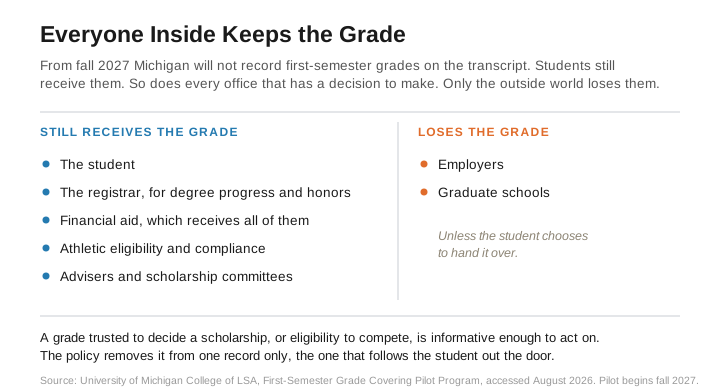
A grade Michigan trusts to decide whether a student keeps a scholarship, or stays eligible to compete, is evidently informative enough to act on. So why are employers and graduate schools the readers who should not see it?
Michigan has an answer available, and it is a decent one. An adviser knows they are looking at a transition semester. An employer three years later does not, and may read a C the way it would read a C from junior year. That is a real argument for supplying context. It is not obviously an argument for removing the grade from the transcript, which is what the policy does.
Derek Peterson, a history professor and former chair of Michigan’s faculty government, put the purpose more plainly than the university did. He supports the policy, he told the Wall Street Journal, because “if we can find ways to open up space for students to experiment while also protecting their future employability, which means protecting the GPAs, I think it is a good idea.”[7]
Protecting the grade point average. When an institution starts managing the indicator rather than the thing the indicator was supposed to track, the indicator stops working, and Michigan already has a former professor on record saying it has. Kenneth Lowande, who taught political science there before moving to Rice, doubts the policy changes much, because inflation already did the damage. “Grades have lost their value as an indication of quality or excellence.”[7]
There is one more turn, and it is Michigan’s own reasoning used on itself. The college makes coverage mandatory precisely so that covering will not signal weakness. Then it explains that the retained grades remain available “for students’ use as they apply for internships, majors outside of LSA, or other academic and professional opportunities.”[1] At the exit, disclosure becomes a choice. By Michigan’s own argument, a choice to disclose means a decision not to disclose starts to mean something. The stigma the college eliminated on campus reappears at the door, and the announcement never addresses it.
The fear belongs to something larger than a transcript line
Which brings me to what these students are actually afraid of.
Michigan has located the fear in the permanence of one line on a transcript. Consider a competing explanation. A student arrives having been told for a decade that this path pays. They are carrying debt, and they have signed up for four years of forgone earnings. Nobody has sat down and walked them through what their specific program returns. And in the first weeks, they encounter work they were never prepared for, and quietly begin to suspect they cannot afford to find out whether they belong.
That fear is about a purchase, and covering the grade does not touch it.
There is a wrinkle here worth naming, because it cuts against something I said earlier. If inflation has drained grades of meaning, how can a first-semester grade be worth keeping? Because inflation does not flatten the scale evenly. It piles grades up at the top. Picture a seminar where nearly everyone gets an A. The A’s tell you almost nothing. The one B in the room tells you something. A grade that is not an A now carries more information than it did when B’s were common, not less. That is exactly the signal the transcript now drops.
We have evidence about what happens when institutions remove a measure that carries this kind of signal. Test-optional admissions spread when testing centers closed during the pandemic, and they stayed for reasons no one should sneer at, to widen access for students without the money for test preparation. Three Dartmouth researchers, Bruce Sacerdote, Douglas Staiger and Michele Tine, studied the college’s admissions and found that for the strongest applicants it was meant to help, the policy worked in the opposite direction. Less advantaged applicants scoring 1420 or above were about three and a half times as likely to be admitted when they reported their scores (the authors put it at 3.6), a jump from 2.9 percent to 10.2 percent. In plain terms, reporting the score got about one applicant in ten admitted, and withholding it got about one in thirty-four. Uncertain whether their numbers were good enough, many withheld them. Admissions officers read scores against the applicant’s own school and neighborhood, which made a high score a stronger signal precisely where high scores are rare.[8]
A measure was removed to protect a group, and the strongest applicants in that group are the ones it went on to cost. Whether the same holds for grade covering is something I have found no one at Michigan testing.
Meanwhile, one campus that stopped using admissions tests has measured what arrived. A working group of faculty and administrators at UC San Diego reported in November that students entering below high school level in mathematics rose nearly thirtyfold between 2020 and 2025. Its corrected report, updated in January, puts roughly one in twelve of the entering class below middle school standards. The group named what the deterioration coincided with, and named four things rather than one: the pandemic, the elimination of standardized testing, grade inflation, and expanded admissions from under-resourced high schools.[9]
That group measured. It published. It corrected an error in its own figure in a footnote, on the record, revising one in eight down to one in twelve.[9]
Michigan’s page says it believes.
I would not claim preparation and return are the only causes of student distress, and Peterson is right to name social media and a harder job market as causes too.[7] The claim is narrower. Of the causes on the table, grading friction is the only one this policy touches, and the evidence I found on grading, which measures performance rather than distress, points the other way.
What Michigan is spending
Two details deserve checking before fall 2027, because they may work against the policy’s own goal.
Michigan justifies the change partly through its Student Success Initiative, where early momentum is the stated priority. The initiative describes its early momentum work as encouraging students to maintain a full credit load during the first year.[10]
Under Michigan’s letter system today, grades from A down to D-minus earn credit. Under the college’s existing pass/fail rules, a pass requires C-minus or better, and anything lower earns no credit at all.[11] MIT draws exactly this line and says so plainly. A pass means C-minus or better, a D or an F becomes No Record, and no credit is earned.[12] Michigan has not said where the new policy sets it. If it lands where the college’s pass/fail rule lands, the cost is concrete. A student scraping by with D’s earns credit toward the degree today and would earn none under the covered semester. The policy would cut the credits a full first-year load actually earns, for exactly the students its rationale is written about.
A second possible cost comes from a rule already on the books. LSA requires a minimum of ninety graded credits out of the hundred and twenty needed to graduate, which leaves each student thirty ungraded credits across an entire degree, about two semesters’ worth.[11] That allowance is what makes the college’s existing pass/fail option usable for exploring. If covered credits count against that allowance the way pass/fail credits do, a covered first semester of twelve to sixteen credits would use up two-fifths to half of it, before the student has chosen anything at all. A policy sold as room to explore may leave students with only half to three-fifths of the room for everything that comes after.
Michigan’s own programs span a wide range. Economics, statistics, and mathematics all pay around $110,000 four years out. Writing at Michigan pays about $44,000. That is two and a half times, and the borrowing barely moves by comparison. The middle half of Michigan’s bachelor’s programs that report debt borrow within a sixteen percent band, and the full range across all of them is less than double.[13] Among recent graduates nationally, underemployment is about twenty-six percent for mathematics majors and fifty-five percent for anthropology majors, two fields LSA teaches.[14]
Every bachelor’s program at Ann Arbor with reported earnings puts its median graduate above the high school earnings baseline, which is not true nationally. That is an earnings comparison and not a return, because it counts neither the cost nor the years given up. My point here is about the spread, not the level.
But two students can leave Michigan and, four years later, be earning about $66,000 a year apart, one having borrowed about $14,000 and the other about $19,000. Nothing in the policy hides that fork from a student, who still sees every grade. What it removes is the stake attached to the first semester. Harris could only measure the second, but he found who responds most when the stake is there. The first semester is the term Michigan has chosen to stop recording, at a university where economics and writing sit two and a half times apart.
Michigan is not being reckless. It is doing what institutions do when a problem is real, the cause is uncomfortable, and one instrument is within reach. Covering the grade will make the first semester feel better. It will not make the bet any better, and it does not touch what I think the student is actually afraid of.
The university kept the measure for nearly every decision it had to make. It took the measure off the one record that follows the student out the door.
Reference Sources
- University of Michigan College of Literature, Science, and the Arts. “LSA First-Semester Grade Covering Pilot Program.” Accessed August 12, 2026. The college announced the pilot on August 5, 2026, as the Michigan Daily reported.
- Belkin, Douglas. “University of Michigan Drops First-Semester Grades to ‘Curb Mental Health Crisis.’” The Wall Street Journal, August 2026, citing an MLive review of Michigan grade data. The same figures appear in Feller’s Michigan Daily column (note 3), which draws on the MLive review and reports nearly seventy-five percent of undergraduate grades in the A range in 2022, up from fifty-eight percent in 2012.
- Feller, Lucas. “Put the humanities and social sciences on a mandatory grading curve.” The Michigan Daily, November 4, 2025. Accessed August 12, 2026.
- American Bar Association Standard 509 Required Disclosures, 2025, retrieved from each school’s own filing. Median undergraduate grade point average of the 2025 entering class: Yale Law School 3.96, Stanford Law School 3.96. Accessed August 12, 2026.
- Denning, Jeffrey T., Rachel Nesbit, Nolan Pope, and Merrill Warnick. “Easy A’s, Less Pay: The Long-Term Effects of Grade Inflation.” March 11, 2026. Accessed August 12, 2026. Administrative high school data from Los Angeles and Maryland, with the Maryland data linked to postsecondary and earnings records. The authors state it is unclear whether their results extend to other levels of schooling, including college.
- Harris, Gregory A. “The Impact of Hidden Grades on Student Decision-Making and Academic Performance: An Examination of a Policy Change at MIT.” AIR Forum 2011, Toronto. ERIC ED531713. Accessed August 12, 2026.
- Belkin, Douglas, op. cit. Quotations from Derek Peterson and Kenneth Lowande.
- Sacerdote, Bruce, Douglas O. Staiger, and Michele Tine. “How Test Optional Policies in College Admissions Disproportionately Harm High-Achieving Applicants from Disadvantaged Backgrounds.” (PDF) NBER Working Paper 33389, January 2025. Accessed August 12, 2026. High achieving is defined in the paper as an SAT of 1420 or above. Published in American Economic Review: Insights 8(3), 2026. Figures here are from the working paper.
- Senate-Administration Working Group on Admissions, University of California San Diego. “Final Report.” November 6, 2025, updated January 8, 2026. Accessed August 12, 2026.
- Teachout, Gregory. “Office of the Provost launches Student Success Initiative.” The University Record, University of Michigan, March 10, 2025. Accessed August 12, 2026. Early momentum described as encouraging students to maintain a full credit load during their first year.
- University of Michigan College of Literature, Science, and the Arts. “Grades and Grading” and “Pass/Fail Grading,” LSA Academic Policies and Procedures. Accessed August 12, 2026.
- Massachusetts Institute of Technology Registrar. “First year grading.” Accessed August 12, 2026. Pass indicates C-minus or better, No Record indicates a D or F, and no credit is earned for a No Record grade.
- Author’s model over U.S. Department of Education College Scorecard field-of-study data, University of Michigan-Ann Arbor bachelor’s programs: median earnings four years after graduation and median debt of program completers who borrowed. Fifty-nine programs report debt. The interquartile range is $16,787 to $19,475 and the full range $13,720 to $23,150. Economics $110,552, statistics $109,466, mathematics $109,146, writing $43,689 (the Scorecard’s “Rhetoric and Composition/Writing Studies” category). Economics, statistics and mathematics are majors on LSA’s “Majors and Minors” list, accessed September 26, 2026. Writing appears there as a minor, and creative writing as part of the Creative Writing and Literature major. No Ann Arbor bachelor’s program with reported earnings leaves its median graduate below the model’s national high school earnings baseline of $32,842. That is not true nationally.
- Federal Reserve Bank of New York. “The Labor Market for Recent College Graduates,” outcomes by major (data workbook). Accessed August 12, 2026. These rates cover recent graduates, ages 22 to 27. The rate across all working graduates, not just recent ones, is closer to a third, and the two are not interchangeable. Mathematics and anthropology are both majors on LSA’s program list, accessed September 26, 2026.