A few months back I spent time with some young lawyers, a couple of years out of school, working at firms whose names you would know. They were good. They were paid well. And they were trying to decide whether to leave.
The reasons came out the way they always do. The hours. The weekends that disappear. A life bent around a billing clock. But the longer they talked, the clearer it got that the hours were the symptom.
What actually bothered them was harder to name. Nobody was teaching them anything. They were doing the work, mountains of it, and learning almost nothing about how to be the thing they had signed up to become. The early years were not a training program. They were a test of who would endure.
Let me tell you why that should worry the firms more than it worries the associates.
The grunt work was the classroom
Everyone treats the junior years as the price of admission. You do the research nobody senior wants to do. You read the documents. You write the first draft that gets torn apart. You bill it, the client pays for it, and you tell yourself it is dues.
But that grunt work doubled as the classroom.
You learned the trade by doing the rote version of it, over and over, next to someone who already had it. You saw how a good partner framed a question, what they worried about, where they looked first. The skill transferred sideways, by proximity, while your hands were busy on the boring part.
The apprenticeship was real. It was just a byproduct. No one designed it. It happened because the work and the people who knew how to do it were in the same room.
And it ran on luck
I learned this in a place that took development seriously. My years at McKinsey spoiled me.
The firm spent real money teaching people at every level, and the skill/will matrix I have written about before, the one that tells a manager whether someone needs a new skill or a new reason to care, I learned in that training, not on the job. And one of the firm’s own, a McKinsey partner named Max Landsberg, wrote the whole thing down in a book.[1] So this was a place that both taught the tool and produced the man who codified it.
I lucked into mentors who saw teaching as part of the work. I also watched good colleagues draw partners who saw it as a tax on their time. Even there, in a firm famous for growing talent, who developed you was an accident of which engagement you landed on.
That was my time there, and I have no idea how much it has changed as the business grew and changed shape. But the lesson held even at the top of the trade: development was rationed by chance.
And chance is expensive. Not every associate who left was running from the hours. Some of the sharpest left in good part because the system never reached them. The professions even have a name for the filter: up or out.
Survival of the fittest sounds like a filter for the best. It is not. It selects for the people who will tolerate the conditions, which is a different group, and a smaller one.
The firm called the departures attrition. A lot of it was talent walking out the door before anyone had bothered to grow it.
The people in charge are not the villains
It would be easy to blame the partners. That is the wrong target. The problem is structural, and it shows up in two flavors.
In most of these fields, in my experience, the people in charge were never trained to manage.
A partner is an expert in law, a lead is an expert in code, and the education that got them there taught the trade and said almost nothing about growing a person, at least as I have seen it. The tool for it is not even exotic. The idea of matching how you manage someone to their skill and their will has been around for half a century, since the management researchers Paul Hersey and Ken Blanchard.[2] But among the people I know, few lawyers or engineers met it in law school or a computer science degree, and the managers who did pass through business school mostly met it as a slide in one intro course, not a habit they built.
But knowledge was not the binding constraint. At a firm like the McKinsey of my day, the tool was handed out and practiced. Partners sat through the same training I did. And some of them still did not develop anyone, because billings and advancement were what the firm counted, and growing people was not.
Training is necessary. It is nowhere near sufficient. Put the matrix in a partner’s hands and reward them only for revenue, and you have built a person who knows exactly how to develop talent and has no reason to.
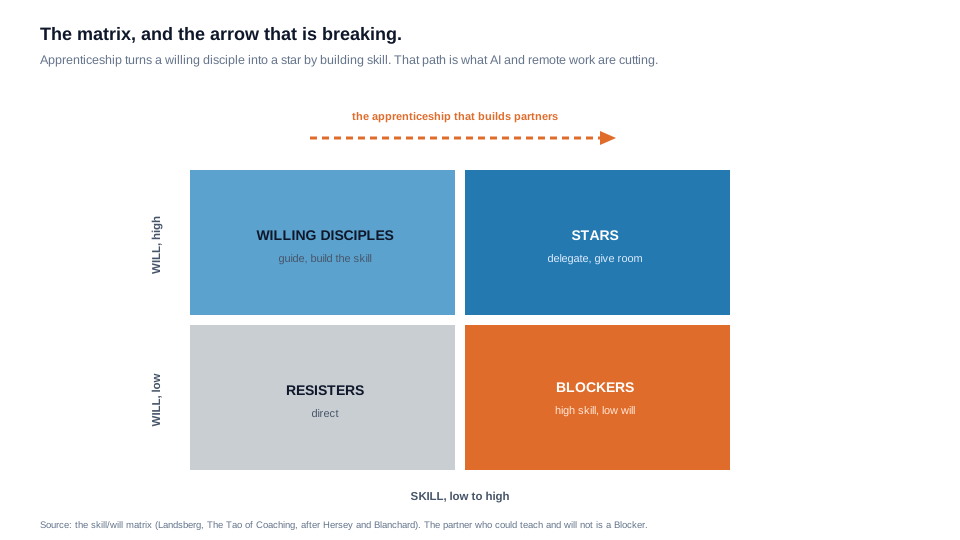
There is a quiet irony in that. In the matrix as I learned it, the person who can do something but will not is a Blocker, high skill, low will. The partners who refuse to develop the next generation are Blockers on the one task that builds the firm’s future. They have the skill. Nothing rewards the will. So the damage compounds. The associates they never developed become partners with no model for developing anyone, and pass the gap down again.
The classroom and the teacher, both going
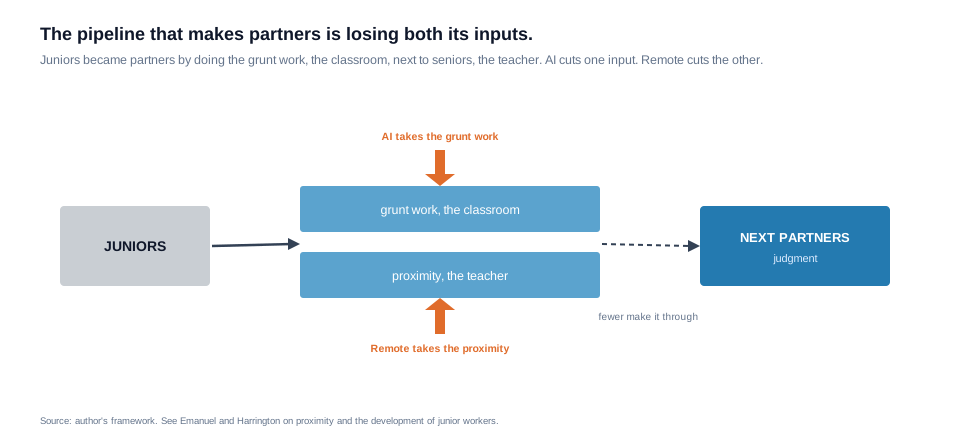
The accidental apprenticeship needed two things to work: the grunt work to learn from, and the proximity to learn by. Both are being pulled out from under it at the same moment.
Artificial intelligence is taking more and more of the grunt work. The mechanical research, the document review, the first draft, the tasks the junior learned the trade by grinding through, are the tasks the model is now absorbing.[3]
Remote and hybrid work is taking the proximity. The overheard call, the quick correction, the senior glance at a screen, the channel the rest of the learning traveled through, thins out over a calendar of video meetings.[4][5]
The same shape shows up in software engineering, where employment for workers aged 22 to 25 has fallen substantially since late 2022,[6] and I expect it to reach management consulting, where the entry rung is where judgment gets built. The classroom and the teacher are both being removed, and in my experience few firms are treating it as a loss, because on a spreadsheet it reads as savings.
The question the spreadsheet never asks
Firms are starting to hire fewer juniors[3][6] and calling it efficiency. Be careful with the causes. AI gets named in these decisions, and at some firms the thinning may be old-fashioned over-hiring being corrected under a fashionable banner. But the Stanford researchers who documented the drop, Erik Brynjolfsson, Bharat Chandar and Ruyu Chen, found it holds even outside tech firms and computer jobs, so it is more than a tech hiring hangover.
Some of each is likely true, and the distinction changes nothing here. The classroom closes either way. The logic is simple. The model does the junior work cheaper, so you need fewer juniors. On this year’s budget it is obviously right.
But the juniors were never only cheap labor. They were partners in training.
The grunt work was the tuition they paid in to learn the trade. Cut the training ground and you stop manufacturing the thing the firm actually sells, which is judgment, the senior judgment clients pay a premium for and machines cannot yet supply.
I made the longer case in a recent piece: the prompt missing from every replace-the-consultants list is the one that asks whether any of the output is wrong, and the checking still has to be human. This is where the checkers were supposed to come from. The bill for that does not arrive this year. It arrives in a decade, when the bench that should be full of partners is thin, and the firm cannot work out where its seniors went.
You might expect the market to sort this out. A shortage of seniors should push firms to train more. But the firm that trains is not the firm that keeps the result. Grow an associate into a star and a competitor can hire her away the day she becomes one. Cheaper to let someone else do the raising and poach what they grew. So everyone waits for everyone else, the training no single firm is rewarded for doing gets done less and less, and the shortage builds while each firm keeps making the choice that makes sense for itself.
So here is the question the efficiency case never asks. Who becomes the next partner?
The fix is not to protect the grunt work
Making juniors keep doing the rote work a machine does better is nostalgia, and it loses.
What would work is to stop pretending apprenticeship is automatic, and design the thing that used to happen by accident. Medicine did that on purpose. A residency is a designed apprenticeship, built so that learning depends less on which supervising doctor you happen to draw.
Start with incentives. Training closes the knowledge gap for the firms that never taught the tool. But a tool no one is rewarded for using stays in the drawer, which is how even the firms that did teach it left development to chance. Make developing people count toward partnership the way revenue does. A partner who builds three associates into stars should advance on that, not despite it.
Then use the machine as the teacher instead of only the replacement. If the model does the grunt research, the junior can spend that time on the judgment the research used to bury, under a senior who reviews the call. Used deliberately, AI lets a junior practice judgment earlier than the old grind allowed. Used lazily, it just deletes the junior.
And aim the effort where it pays. The development worth doing is for the willing disciples, the ones with the will and not yet the skill, because those are the people who can become stars. Not the resisters. The old system at least stumbled into a few of the willing ones. A designed one would find the talent the accident missed, the people who never drew the right partner, never tested into the right room, and were filtered out before anyone saw what they had.
None of this is exotic. Some firms I have known did it once and let it erode as they grew and chased scale. Few that I know of are doing it now, at the exact moment the old accident is breaking down.
The fight over working from home and the fight over AI both get framed as questions of cost and headcount. They are bigger than that. Judgment is the moat, but judgment is built, slowly, by people standing close to other people who already have it. We are quietly tearing down the workshop. And the people holding the saw are not asking who is supposed to come out of it.
Reference Sources
- Landsberg, Max. The Tao of Coaching: Boost Your Effectiveness at Work by Inspiring and Developing Those Around You. HarperCollins, 1996 (Profile Books edition 2003). The source of the skill/will matrix, developed from Landsberg’s years as a partner at McKinsey and other consulting firms. The author reads it as a practitioner refinement of Hersey and Blanchard’s situational leadership. The quadrant names used in this essay, star, willing disciple, Blocker and resister, are the author’s working labels from his training and an earlier essay. Landsberg’s published labels name the coaching responses, Direct, Guide, Excite, and Delegate.
- Hersey, Paul, and Ken Blanchard. “Life Cycle Theory of Leadership.” Training and Development Journal, vol. 23, no. 5, 1969, and Management of Organizational Behavior, Prentice Hall, later editions. The situational leadership model, matching a manager’s style to a person’s ability and willingness, as Raza and Sikandar (2018) summarize it. The author reads it as the root of the skill/will matrix.
- Contreras, Russell. “AI Threatens Big Law’s Talent Pipeline.” Axios, 2 May 2026. Accessed June 26, 2026. On AI taking over more and more of the research, document review and drafting that trains junior associates, and the pressure that puts on the large junior-class model.
- Emanuel, Natalia, and Emma Harrington. “Working Remotely? Selection, Treatment, and the Market for Remote Work.” American Economic Journal: Applied Economics, vol. 16, no. 4, 2024, pp. 528-559. Accessed June 26, 2026. Among call-answering workers at a Fortune 500 firm, remote work lowered call quality and promotion rates for those who had been on site before offices closed.
- Emanuel, Natalia, Emma Harrington, and Amanda Pallais. “The Power of Proximity to Coworkers.” NBER Working Paper 31880, 2023, revised June 2026. Accessed September 25, 2026. Software engineers at a Fortune 500 firm who sat near teammates received more feedback, concentrated in feedback given by senior engineers to junior ones.
- Brynjolfsson, Erik, Bharat Chandar, and Ruyu Chen. “Canaries in the Coal Mine? Six Facts about the Recent Employment Effects of Artificial Intelligence.” Stanford Digital Economy Lab, 2025, revised August 2026. Accessed September 25, 2026. Employment for workers aged 22 to 25 in the most AI-exposed jobs, software engineering among them, has fallen substantially since late 2022.