Every metric was on my side
I had every metric on my side. I was an executive leading a transformation, and we had outsourced the management of all our indirect procurement, the travel, office services and other things a company buys that have nothing to do with what it sells. The outside firm got paid only if it beat how we’d done the work ourselves on every measure. It did, as we got started.
But one successful division head was unhappy, and so was his team, who used to do this work. They were still part of the process, and when managers had to approve documents or purchases, they delayed. We spent hours showing them the evidence. Every metric was better, even with the delays. At a break, the division’s head of finance pulled me aside. No matter how much evidence we showed him, he said, he wouldn’t support the program. And he had the division head behind him.
I could go over both of them to the CEO, or I could back off. Indirect procurement was about 10 percent of our purchasing, and this program’s impact would be small. The same division was eagerly supporting several of our other efforts. I shut the program down and canceled the contract. Progress on those other efforts mattered more than being right on this one.
I can’t prove that was the right call. The division may have learned that stalling works, and I never saw what going to the CEO would have done. But no rule told me what to do, and no metric could. It took everything arriving at once, and someone who had to commit without knowing how it would turn out.
Business schools exist partly to prepare people for calls like that. Chris Marquis, a professor at the University of Cambridge’s Judge Business School, spent a decade at Harvard Business School (HBS) and wrote dozens of its cases. In an October guest essay in the New York Times, he said business schools should be abolished. He later told NPR he meant a fundamental redesign and recreation of the ones we have.[1][2]
Part of Marquis’s complaint is the case method. A business case is the story of a real decision, written up to stop just before the manager chooses, so students have to argue what they’d do.
Marquis has taught one case many times. Its subject, Rob Parson, is a star banker at Morgan Stanley with strong numbers and an abrasive style that has cost him allies all over the firm. Should his manager promote Parson, hold him back, or show him the door? Marquis worries that when students sit in the manager’s seat, the deeper questions, like whether the culture of investment banking made Parson who he is, rarely come up.[1] Marquis’s deeper charge is that the classroom ends up “overestimating the importance of individual decision makers.”[1]
I’ll call that classroom exercise the seat, and the real job, where the decision counts, the chair. I take Marquis at his word that many cases are flawed. He wrote dozens of them. But my story cuts against his deeper charge. The person in the chair mattered, and no rule could stand in.
Data and rules can tell you what worked somewhere else. They can’t make your call, because they can’t tell you whether you’re in the same place or after the same goal. So keep training people to decide, but change how. Don’t have them study one company’s story at a time. Have them set two stories side by side and ask what the stories share. In the closest tests I found, that’s what helped people use a lesson in a new situation.
That matters even if you never set foot in a business school. You work under someone who decides, or you are that someone. In short, someone always decides, rules can’t do it for them, and the fix doesn’t need the schools closed.
Closing a classroom doesn’t close the chair
Look at what Marquis would put in the schools’ place. He points to Martin Parker’s idea of schools for organizing, which would study co-ops, unions and social movements alongside corporations.[1] But a union’s leaders still have to decide whether to recommend an offer. A co-op’s managers still have to decide what to put to a vote about a money-losing store. The vote can be shared. Someone still has to frame it and carry it out.
Closing a classroom doesn’t close the chair.
The study Marquis cites shows the chair at work. Take Danish firms that got the same kind of windfall: orders from abroad jumped, and profits rose. Managers without business degrees passed part of that gain to their workers in pay. Managers with business degrees didn’t.[3] Same windfall, different call, and the people in the chair made it. Marquis reads that as the training changing the call, and the study’s authors lean the same way. Then the real question is what managers are taught to weigh, which is where this piece goes. I took up that study, by Daron Acemoglu of MIT and two coauthors, in They Can’t Both Be Right.
Marquis’s best questions belong inside the decision, not in place of it. Who’s missing from this story? What don’t we know? How could this be wrong? A good decider asks those before acting. The culture question about Parson is real, and Parson’s manager still has to act while it stays open.
So the decider can’t be wished away. Someone will decide either way. The question is how to prepare them.
A rule can’t tell you where you are, or what you’re after
The strongest reply is to give managers good rules instead. Nicholas Bloom and his colleagues ran an experiment on large Indian textile firms, 28 plants across 17 firms. Randomly chosen plants got free consulting on practices like machine maintenance, quality records and inventory control. Productivity rose 17 percent in the first year. And the owners’ own judgment had been part of the trouble. Many knew about preventive maintenance and thought it wasn’t worth doing, so they ran their machines until they broke.[4]
Rules likely worked there because a factory floor is predictable, so a rule can be tested and checked. Daniel Kahneman and Gary Klein make a related point about judgment. Whether to trust it depends on how predictable the setting is and whether the person has had a chance to learn it.[5] Think of a weather forecaster, who finds out tomorrow whether they were right, thousands of times. A CEO makes a handful of big calls and may never learn which ones were right. A weaving shed is closer to the forecaster’s world. Defects and stock levels show up in the records.
But there’s a catch. The same idea can do different things in different places, and what counts as working depends on the goal. Bloom’s factory rules drew on Toyota’s lean manufacturing. The goal on that floor was output, and output went up.
The study Marquis cites names a business school doctrine of reengineering and lean corporations among its leading suspects. At the firms in that study, CEOs with business degrees raised returns on assets, and American stock returns rose, with no measurable change in output or productivity, while pay grew more slowly.[3] So on average, the gain came from a different split, not a bigger pie. Those firms tended to pay above average, and the authors say the slower pay growth may have brought them closer to what similar firms pay. By the goal American boards set, shareholder value, those CEOs delivered. Weigh workers’ pay more heavily, and the same results get a different grade.
Pairing Bloom’s study with the CEO study is my idea, not either study’s. The CEO study measured how much CEOs’ filings talked about lean, not whether any firm adopted lean practices, so treat the pairing as an illustration.
Full disclosure: I went to Baruch, and I chair the Baruch College Fund Campaign Committee. I earned an MBA at Indiana University, worked at McKinsey, and have been a public-company executive and a CEO. I’m not a neutral party.
My own record reads differently from Marquis’s verdict. It’s experience, and it has the same winners problem Marquis sees in cases, so take it as a reason to look at how the work was done, not as proof. I’ve spent my career leading transformations, and reengineering and lean were often part of the work. In every case but one, which I write about in Making Better Felt, coming soon, the company’s performance and growth sped up, and it hired more people as a result. With another client, we moved production from an underperforming Midwest plant to one in the Southwest. Staffing didn’t change, costs fell, and output, quality and sales all rose.
One case shows what an average can miss. A market-leading technology client in the Midwest made components in the United States, sent them to Mexico for more work, then brought them back for finishing and distribution. To hold off low-cost competitors, it planned to automate in the United States, which would have cut jobs in both countries. We showed it a different answer that cut costs, avoided a large capital outlay and gave it far more flexibility to offer customers different products. It closed the US plant and moved all production to Mexico. The American workers lost their jobs, and with our help, all of them found new ones. Staffing in Mexico rose, and so did sales, profits and new products.
The study’s US data cover only American workplaces, which fits its question, since those are the workers whose pay fell behind.[3] Seen that way, this firm’s American payroll fell while its sales grew, so its labor share dropped. The Mexican jobs, and whether the move saved the company, don’t show. Marquis calls the study’s result “wealth transfer,” value moved from workers to profits, shareholders and executives.[1] That’s a fair reading of the average. But an average can’t tell work done well from work done badly.
A medicine that cures one patient can do nothing for the next. A rule can tell you what worked somewhere. It can’t tell you whether you’re there, or whether you want what it delivers.
One case at a time hides the pattern
So how do you train the judgment rules can’t supply? I believe the seat helped me, and I’ve watched it help others. But Kahneman and Klein conclude that how sure a judgment feels is no reliable sign that it’s right.[5] I looked for a study that follows case-taught managers into real jobs and compares their decisions with managers taught another way. I didn’t find one, for or against.[6]
I also know how my defense sounds. You had to be there is what CEOs tend to say, and it’s also how power avoids scrutiny. The outsider can’t feel the chair, but the outsider can count what the chair did. That’s what Acemoglu and his coauthors did, and we need both views.
The closest evidence is a pair of experiments, and the first is worth telling as a story. Leigh Thompson, Dedre Gentner and Jeffrey Loewenstein gave management students two short cases. In the first, a store buyer and an overseas seller argue over whether a shipment by boat will arrive before a trade ban. In the second, two brothers who inherit a farm argue over whether crop prices will rise. Both stories end the same way. Instead of splitting the difference, the two sides make a bet, a deal that pays off for whoever turns out to be right.
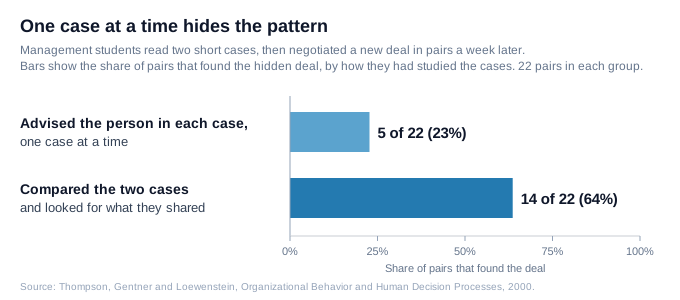
Every student read both stories. Half were asked to advise the main character in each one, one story at a time, the nearest lab version of the seat. The other half read the two together and were asked what they had in common. Not one student in the advice group mentioned the first story when advising on the second.
A week later, the students negotiated a new deal face to face, in pairs, with both partners from the same group. One played a theater manager, the other a Broadway producer. The producer expected sold-out shows and the manager didn’t, so the same kind of bet was open to them: tie the profit split to ticket sales. About one advice pair in four found that deal. Nearly two comparison pairs in three did.[7]
A second experiment, with MBA students and sales managers, pointed the same way. Teams that studied the two cases separately did no better than teams with no training.[7] These were brief cases and one negotiation technique, so they don’t test a two-year program. But the pattern shows up beyond these labs. A review of 57 experiments across many fields found that comparing cases generally beat single cases and traditional instruction.[8]
The comparison finding also points to a gap in how business cases are taught. When David Garvin of HBS wrote about the method in 2003, HBS students normally got one case per class, while law instructors usually assigned several that seemed to conflict. He also warned that the method rewards decisiveness more than caution.[9] By his account and Marquis’s, cases were business school’s main teaching method by the mid-1930s, long before the shareholder-value and lean ideas took hold, and they didn’t stop those ideas. One case at a time doesn’t invite a comparison. Several might, though no one has tested whether they’d hold off a doctrine.
So why not drop the seat and teach comparison alone? Because seeing a situation clearly doesn’t decide it. My procurement team saw ours clearly, and every metric said keep going. The call still took someone weighing what the metrics couldn’t hold and committing to it. A classroom can’t reproduce all of that. It can make a student commit out loud without knowing the ending, and comparison alone leaves that out. No study I found tests that part. It’s my judgment, for the reasons above.
Don’t just judge cases. Set them side by side, then decide.
Fix the cases, and Marquis is right about much of it
Marquis reports that companies held final approval over the cases he wrote, that events reflecting poorly on them got softened or dropped, and that cases almost always feature winners.[1] One HBS case record I checked confirms approval by a company designate before publication.[10] If the seat is practice, a case with the bad news edited out is practice on a world that didn’t exist. Marquis adds that at least five HBS cases praised Enron’s business model before its fraud came out.[1]
My experience runs the other way, and I’ll label it as experience. Steve Kaufman, my former boss and mentor, became CEO of Arrow Electronics in 1986 and later taught at Harvard Business School. Arrow has been the subject of several HBS cases, and in the ones I know, Steve didn’t hold back. One, “Delivery Problems at Arrow Electronics,” describes a dramatic drop in on-time shipments and asks students to find the root cause.[11] A case was also written about my own work at Harris, for the University of Virginia’s Darden School, and the company was forthcoming with what the case needed. A company can have good reasons to leave out material that’s damaging or could end up in court. That isn’t the same as editing out mistakes. Still, a few cases aren’t a count. They show Marquis’s experience isn’t the only one, not which is more common.
So here’s the repair I’d try:
- A success set beside a failure: two firms facing the same kind of call, with students asked to compare them.
- Fewer company-approved facts, more public records.
- The workers, regulators and communities Marquis says rarely get equal standing, in the room.
- The decision followed past the point where the case now stops, into what happened next.
The experiments paired cases with the same lesson. Pairing a success with a failure is my extension.
Show students the ending after they’ve decided, not before. A teacher who says what they’d have done, knowing how it came out, replaces the student’s judgment with hindsight. The teacher knows the ending. The person in the seat didn’t.
Will schools do it? Nothing pays them to, and that’s where Marquis’s point that the problem is “not repairable misalignment but the design itself” may come back.[1] But a teacher can pair two cases and pull the public record next term without asking anyone. None of it needs the schools closed.
Someone sits in that chair on Monday
You don’t need a business school to use this. Here’s my suggestion: before your team’s next big call, set one decision that worked beside one that didn’t, and ask what they share and what separates them. Then decide, knowing the answer won’t come with the ending attached.
And here’s a test that could prove me wrong. The study’s US data include each CEO’s school and degree, and the authors plan a companion paper on what business schools impart.[3] Sort those CEOs by how case-heavy their programs were. If CEOs from case-heavy programs held pay down less, the seat earns some credit. If they held it down just as much, the seat isn’t what matters here. If they held it down more, Marquis is closer to right about the seat than I am, and I’d have to say so. That reads one outcome, pay, and the seat as it’s run now, not a repaired one. People don’t land in those programs at random, so one run wouldn’t settle it, but it would be more than I’ve been able to find.
Close the schools or keep them. Someone sits in that chair on Monday.
Reference Sources
- Marquis, Christopher. “I Teach at a Business School. It’s Time to Shut Them Down.” The New York Times, Opinion, guest essay, October 18, 2026 (print: “Let’s Abolish Business Schools,” Section SR, Page 6). Read from an archived copy of October 19, 2026. Source for his decade at HBS and the dozens of cases he wrote, the Rob Parson description and his account of teaching it, Martin Parker’s schools for organizing, company approval and softening, the winners claim, the five Enron cases, and his statement that the problem is the design, not repairable misalignment.
- National Public Radio. “Is it time to abolish the MBA?” The Indicator from Planet Money, October 28, 2026, and its transcript. Accessed November 1, 2026. Marquis says that by abolish he means a fundamental redesign and recreation of the existing schools.
- Acemoglu, Daron, Alex Xi He, and Daniel le Maire. “Eclipse of Rent-Sharing: The Effects of Managers’ Business Education on Wages and the Labor Share in the US and Denmark.” June 2025 version (SSRN 4059303). Source for the export-demand test in Denmark, the lean doctrine among the leading explanations, slower wage growth with no detected response in output or productivity, the rise in return on assets and in US stock returns, above-average pay at firms that hire business managers, the scoring of lean-thinking language in annual filings, the use of BoardEx data on each US CEO’s school and degree, and the planned companion paper. Also the source for the authors’ earlier evidence that selection doesn’t explain the results, and for the doctrines’ sources, including Hammer and Champy (1993). US firm data come from the Census Longitudinal Business Database, which covers establishments in the United States only, and worker earnings from LEHD records in 22 states and Washington, D.C. I set out the study’s numbers in They Can’t Both Be Right.
- Bloom, Nicholas, Benn Eifert, Aprajit Mahajan, David McKenzie, and John Roberts. “Does Management Matter? Evidence from India.” The Quarterly Journal of Economics 128, no. 1 (February 2013). Accessed November 1, 2026. Journal version, which reports 17 percent. An earlier working paper (NBER 16658) reports 11 percent and isn’t used here. The authors call their small sample the experiment’s main challenge and address it with permutation tests.
- Kahneman, Daniel, and Gary Klein. “Conditions for Intuitive Expertise: A Failure to Disagree.” American Psychologist 64, no. 6 (September 2009). Accessed November 1, 2026. Abstract only.
- What I found instead, all from abstracts. Mesny, Anne. “Taking Stock of the Century-long Utilization of the Case Method in Management Education.” Canadian Journal of Administrative Sciences, 2013. One of its four proposals is empirical research on the method’s learning impacts. Bayona, Jaime A., and William F. Durán. “A meta-analysis of the influence of case method and lecture teaching on cognitive and affective learning outcomes.” The International Journal of Management Education 22, no. 1 (2024). Across 22 investigations, cases beat lectures for knowledge and skills, not for motivation and attitudes. Thistlethwaite, Jill, et al. “The effectiveness of case-based learning in health professional education. A BEME systematic review: BEME Guide No. 23.” Medical Teacher 34, no. 6 (2012). Across 104 papers, students enjoy case-based learning, and the evidence on learning is inconclusive. None of the three follows managers into real decisions. I couldn’t read every journal, so this is none found, not none exists.
- Thompson, Leigh, Dedre Gentner, and Jeffrey Loewenstein. “Avoiding Missed Opportunities in Managerial Life: Analogical Training More Powerful Than Individual Case Training.” Organizational Behavior and Human Decision Processes 82, no. 1 (2000). Accessed November 1, 2026. Masters of Management students. The two training cases are in its Appendix 1. Contingency contracts: 5 of 22 pairs (23 percent) in the Advice condition, 14 of 22 (64 percent) in the Comparison condition. The second experiment is Loewenstein, Jeffrey, Leigh Thompson, and Dedre Gentner. “Analogical Learning in Negotiation Teams: Comparing Cases Promotes Learning and Transfer.” Academy of Management Learning & Education 2, no. 2 (2003), archived copy: 270 MBA students and middle-level sales managers in training. Teams that analyzed two cases separately did no better than untrained negotiators (8 of 37, or 22 percent, against 50 of 213, or 23 percent). Comparison teams reached 24 of 60 (40 percent). The direct contrast of comparison against separate cases is marginal (p = .06).
- Alfieri, Louis, Timothy J. Nokes-Malach, and Christian D. Schunn. “Learning Through Case Comparisons: A Meta-Analytic Review.” Educational Psychologist 48, no. 2 (2013). Archived copy. 57 experiments, 336 tests, d = .50. Pooled across many fields, not specific to management.
- Garvin, David A. “Making the Case.” Harvard Magazine, September-October 2003. Accessed November 1, 2026. Garvin was a professor at Harvard Business School, and the article rests on interviews and class visits at Harvard’s law, business and medical schools. It isn’t a controlled study. Source for one case per class at HBS against several conflicting cases in law, the method’s weakness on caution, and cases as the dominant mode of instruction by the mid-1930s.
- Groysberg, Boris, Sarah L. Abbott, and Annelena Lobb. “Cowen Inc.: Leveraging Data.” Harvard Business School case, as recorded by Bookshare. Accessed November 1, 2026. The record’s synopsis carries the approval statement.
- Arrow Electronics. “History.” Accessed November 10, 2026. Source for Kaufman becoming CEO in 1986. The Conference Board. “Steve Kaufman.” Accessed November 10, 2026. A secondary source for his title at Harvard Business School, senior lecturer of business administration. Herman, Kerry. “Delivery Problems at Arrow Electronics, Inc. (A).” Harvard Business School case 601131, February 22, 2001, as listed by the HBR Store. Accessed November 10, 2026. The listing calls it a rewritten version of an earlier case. The store also lists the (B) case and Kaufman’s own “Arrow Electronics–The Apollo Acquistion” [sic], published August 25, 2006. Haskins, Mark. “Harris Corporation: Financial Benchmarking.” University of Virginia Darden School of Business case UVA-C-2289, published October 14, 2008, as listed by Darden Business Publishing, revised March 22, 2012. Accessed October 31, 2026. The case is about my work at Harris, and the passage here is my account, not a quote from it.