Picture a student in Queens, New York, the first in her family to go to college, deciding whether to major in business at a public college a subway ride from home.
For as long as she can remember, the system, meaning the groups that speak for colleges, has told her a degree pays. The number it uses is $1.2 million, the gap in median lifetime earnings between people with a bachelor’s degree and people with only a high school diploma.[1]
Then, on October 18, the New York Times published a guest essay by Chris Marquis, a professor at the University of Cambridge’s Judge Business School, under the headline “I Teach at a Business School. It’s Time to Shut Them Down.” Marquis notes that “nearly one in five American undergraduates majors in business,” and his conclusion is blunt: “We need to abolish them.”[2]
The way the $1.2 million gets used says a degree is a good bet for anyone who earns one. If every degree is a good bet, why abolish the schools that award nearly one in five of them?[3]
They can’t both be right. They can both be wrong, and they’re wrong in the same way.
I’ve said for years that bad research isn’t the main problem. It exists, and some of it is built to mislead. The more common problem is decent research read from too high up, where a true number turns into a verdict about everyone and the details a real person needs fall away. Both verdicts this student is hearing were made from that height. Many students like her have already paid for the first, the $1.2 million heard as a promise. Students like her stand to pay for the second if the schools that teach them business close.
What follows takes it in order: the promise, the indictment, what the study behind the indictment can’t reach, and who pays.
The promise, read from too high up
Start with the $1.2 million. It’s a careful number. It compares the median lifetime earnings of bachelor’s degree holders with those of people with only a high school diploma.[1] It’s also gross, and it describes the middle of a group, not any one person.
It counts what graduates earn, not what they paid to earn it, not the years of wages they gave up while enrolled, and not the students who started and never finished. I’ve taken it apart before, in The Doubt Everyone Explained Away.
Nobody writes the $1.2 million as a promise. Heard as one, it did quiet damage. A family with savings could absorb a bet that didn’t pay. A family that borrowed for college couldn’t, and the median never told either family how its bet would turn out.
A number about everyone became a promise to anyone.
The indictment, read from too high up
Now the other verdict. Most of Marquis’s essay argues from his own experience: how the case method teaches, and how companies shape the cases. Those arguments deserve their own answer.
The one study he cites on what business-educated managers actually do is by Daron Acemoglu of MIT, Alex He of the University of Maryland, and Daniel le Maire of the University of Copenhagen.[4] Acemoglu shared the 2024 Nobel Memorial Prize in Economic Sciences.[5] His MIT page lists the paper as forthcoming in the American Economic Review.[4]
The researchers linked government records of individual workers to the firms that employed them, in both the United States and Denmark. Then they tracked what happened when a company’s chief executive changed from someone without a business degree to someone with one, compared with similar firms in the same industry and year. They looked separately at cases where the change was triggered by the old chief executive retiring or, in Denmark, dying, rather than by a board unhappy with results. Those cases gave similar results, though noisier in the United States.
And when one chief executive without a business degree replaced another, pay showed no such change. A new face alone doesn’t move pay. Something about the business-degree hires does.
Five years after the switch, workers who stayed at the firm were earning 8.4 percent less than their counterparts at comparable firms in the United States, and 2.7 percent less in Denmark. Labor’s share of the firm’s income, the part paid out to workers, fell by about 5 percentage points in the United States and about 3 in Denmark. Return on assets, the firm’s profit for each dollar it owns, rose by about 1.5 points in both countries. Payouts to shareholders went up, and so did American stock returns.[4]
Compared with similar firms, sales, output, employment, investment, and productivity showed no measurable change. Paychecks generally didn’t shrink either. In the researchers’ words, the firms “do not typically exhibit nominal wage cuts.” The difference was slower pay growth.[4]
That is strong work. It is also a narrower finding than the one Marquis draws from it.
A smaller role for workers isn’t automatically a harm. In 1870, a little more than half of American workers farmed. In 2022, on-farm jobs were 1.2 percent of U.S. employment, and the country fed a far larger population.[6] Farming’s share of jobs shrank because each farmer produced far more.
That is the test, for jobs or for pay: did each worker produce more? In this study, there’s no sign of it, though the estimates are too rough to rule out a real gain or loss, especially in the United States.
So on the best estimates here, a smaller share for workers is a transfer: the same work, with less of the money going to the people doing it and more going to the people who own the firm.
Who gets the money is still a different question from whether anything went wrong. The owners who gained include retirement savers, and they include foreign investors. At the end of 2022, domestic retirement accounts held about a third of publicly traded U.S. stock, and foreign investors held the same share. The estimate comes from Steven Rosenthal and Livia Mucciolo of the Tax Policy Center, built on Federal Reserve data.[7] The study doesn’t measure how much of the gain reached either group.
It does report something the essay leaves out. Firms that hired business-degree chief executives tended to be paying more than the average for their industry, region, and size. The authors write that holding pay down “may bring these firms closer to the average pay of other firms.”[4]
Set the findings side by side and read them twice (Table 1).
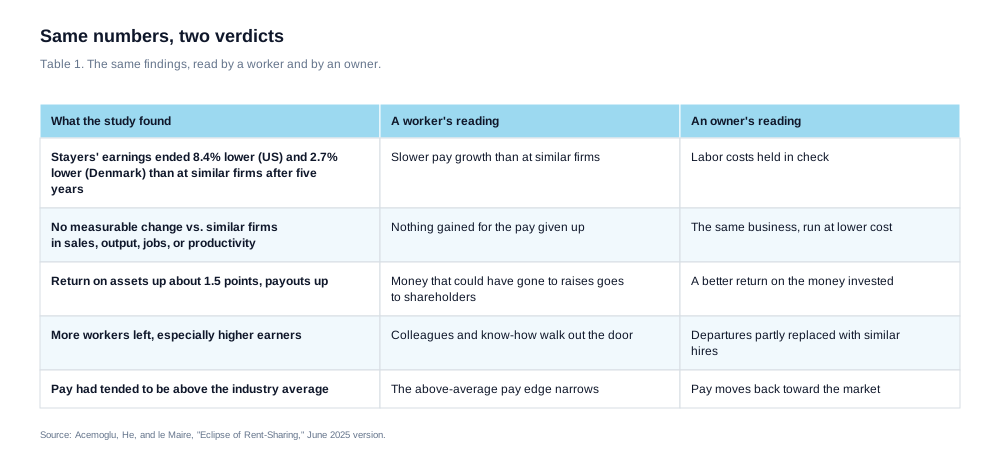
Source: Acemoglu, He, and le Maire, “Eclipse of Rent-Sharing,” June 2025 version.[4]
Both columns are true to the data. Which one is the right verdict depends on whose gains you count, and the numbers can’t settle that.
Marquis settles it in one sentence. “What registers as managerial acumen turns out to be wealth transfer,” he writes, “value moved away from workers and toward profits, shareholders and executives.”[2] The first half is a judgment. The second half is the study’s finding. Then he takes one more step the study never takes.
A finding about who gets paid at established firms became part of the case for closing the schools that award nearly one in five bachelor’s degrees.
What the study can’t reach
The study looked at firms run by chief executives at American public companies and at Danish firms. It counts any business-school degree, bachelor’s and executive programs included. So when Marquis writes that it “shows what tends to happen when you put an M.B.A. in charge,” he pins on the MBA a result the study measured across all business degrees.[2][4] In Denmark, where the paper can separate the two, the pattern shows up for managers with business bachelor’s degrees as well as for those with business master’s degrees.[4]
Abolishing business schools on the strength of this study makes sense only if three things hold. Any harm to workers under business-trained chief executives has to outweigh what the schools do for everyone else they train, compared with what would replace the schools. The transfer has to count as a harm. And the schools have to cause the behavior. Take them in order.
The first condition starts with what the study can show, and whether it supports Marquis’s “tends to happen.”[2]
Like any study of its kind, this one reports an average effect. Its averages give the largest employers the most weight, so the result tells us more about the average worker at these firms than about the average chief executive.
Split by firm size, the picture differs by country. In the United States, where every firm in the sample is a public company, the authors find the effects “most pronounced for the top two size quintiles,” with “large negative effects for wages” in the smallest fifth too. In the second and third fifths, the pay estimates are near zero and point slightly the other way. In Denmark, where the data include private firms, they find negative effects “for most of the size quintiles.”[4]
Those middle estimates are noisy, so they don’t prove those firms behaved differently. And when the authors reweight the American sample to match the size mix of all American firms, they get a similar result, a sign the findings “do not just apply to the largest firms.”[4] So the study supports “tends” for the firms it measured. It measures what follows when a chief executive with a business degree takes over from one without. It says nothing about the far larger number of business students who will never become chief executives, and closing the schools would reach them too. On its own, it can’t carry the case for closing every business school.
The second condition is the question Table 1 left open: whether the transfer counts as a harm depends on whose gains you count.
The third is whether the schools cause the behavior, and here the authors lean toward yes. An earlier version of the paper, they note, “presented evidence suggesting that selection cannot explain our results,” and in Denmark, chief executives with economics or engineering degrees don’t show the same pattern. Still, they call it “an important question” whether their estimates reflect business education “rather than the selection of different types of individuals into business degrees,” and they leave a fuller test to a companion paper.[4]
One clue is timing. In Denmark, five years after a chief executive with a business degree took over, earnings per worker, a broader measure than stayers’ pay, ended 3.6 percent below comparable firms when the degree came after 1980, against 1.1 percent when it came before. The authors say the results in the United States are similar but don’t report them because of disclosure restrictions, and they call the gap consistent with business schools’ emphasis on shareholder value, which spread after 1980.[4] That fits teaching as a cause, since degrees earned before that emphasis spread showed a smaller effect. Timing alone can’t rule out a change in who enrolled, or a difference between older and younger chief executives.
People who join a running club are faster than people who don’t, and the club deserves only part of the credit. If the pattern comes mostly from who enrolls, closing the schools changes where those people study, not how they think.
Marquis has his own evidence that the school does it. He has watched students drop their plans to do good, and he writes that “this change can take place in a single semester.”[2] He may be right. But that is one teacher’s view, and the study he cites doesn’t settle the question either.
The authors are candid about the mechanism, too. “Our methodology is silent on exactly what practices business managers are changing and how these impact wages,” they write.[4]
The study shows the result, and one pattern behind it. In Denmark, when a surge in export demand raised a firm’s profits, chief executives without business degrees shared the gain with workers. Chief executives with business degrees did not. It doesn’t show which practices produce it. The essay fills that gap with an indictment.
The data reach less far than the essay implies. The American pay figures are annual earnings for workers in 22 states and Washington, D.C. Without hours or a breakdown of pay, they can’t separate a lower rate of pay from fewer hours or smaller bonuses. In Denmark, where hours are recorded, hourly wages fell about as much as earnings, so fewer hours don’t explain it there, but the Danish effect on stayers is about a third the American size.[4]
The study tells us what happened inside established firms after a new boss arrived. It never met the student in Queens.
That matters because closing a school is a trade-off. On one side is what it does for the many students who will never run a company. On the other is what a few graduates do when they do. The study measures only the second.
Who pays, and who stands to
The student at the margin, the one for whom the choice could go either way, hears both verdicts. The first let her hear a median as a promise. The second tells her the school she’s choosing is the problem. Neither was made with her in view.
Most business degrees aren’t MBAs. In 2021-22, American colleges awarded about 375,000 bachelor’s degrees in business, against about 206,000 master’s degrees in the field.[3] The argument over MBAs at Harvard and Wharton sets the terms for students at schools nothing like them.
Consider Baruch College, part of the City University of New York, which awarded 2,729 bachelor’s degrees in business in 2023.[8] Raj Chetty and his colleagues publish a measure of mobility for each college. On it, 12.9 percent of the Baruch students born in 1980 to 1982, business majors and everyone else, climbed from the poorest fifth of families to the highest-paid fifth. At Penn, home of Wharton, the figure was 2.1 percent.[9]
Most of that gap is access. About 28 percent of Baruch’s students came from the poorest fifth, against 3.5 percent at Penn, whose few students from poor families reached the top even more often. The measure records where students ended up, not how much of the climb the school caused.
Marquis has taught in business schools at Harvard, Cornell and Cambridge, and the students he describes are in rooms like those. He writes of a required course at Cambridge “filled with future bankers, consultants and tech executives.”[2] Largely from classrooms like that, and from a study of chief executives, he reaches a verdict on every business school. It’s the same mistake again: a view from one kind of room stretched over every kind of school.
Most business graduates work below the top. They keep the books, manage the stores and staff the firms, working for chief executives with business degrees and for those without one. The study sorted firms by one person’s degree, the chief executive’s, and it says nothing about what the business graduates working under that person add.
His prescription reaches well past rooms like those, to the undergraduates who earn most business degrees.[3] Their backgrounds vary widely. Among students born in 1980 to 1982, those from the poorest fifth of families made up 28 percent of Baruch’s undergraduates, against 3 percent at Harvard and 5 percent at Cornell, two of the universities where he has taught. Students from the richest 1 percent made up under 1 percent at Baruch, against 15 and 9 percent.[9] In the latest federal data, about 57 percent of Baruch’s undergraduates receive Pell Grants, against 16 percent at Harvard and 18 percent at Cornell.[10] These figures describe undergraduates, not the students in his business-school classrooms, but they show how differently placed Baruch’s students are.
Full disclosure: I went to Baruch, and I chair the Baruch College Fund Campaign Committee. I also earned an MBA at Indiana University and worked at McKinsey, so I’m not a neutral party on business education. The Baruch figures come from public data, not from me.
Marquis would replace business schools with cross-disciplinary programs, and he writes that abolition “cannot mean abandoning the people in them.”[2] Still, trading the business programs at a college with Baruch’s record for a design built from scratch is a large bet when the one study he cites on what business-educated managers do measured chief executives, not students.
There’s a better target in the study itself. The authors’ leading explanation is two ideas taught in business education: that a company exists to maximize shareholder value, and that a good manager runs a lean firm. “The dual emphasis on shareholder value and corporate leanness may have made managers unwilling to share rents with their workers,” they write.[4] That points at what gets taught, and what gets taught can change.
Marquis has watched reform efforts fall short from the inside and rejects that path. “Tinkering at the margins with a class on corporate responsibility or ethics is not going to help,” he writes.[2] But the study he cites points at the doctrine.
The ideas don’t live only in classrooms, either. The authors name management consulting as “the other major nexus for these ideas,” and they suspect the same practices spread to chief executives who never went to business school.[4] Close the schools and the ideas would likely stay in circulation.
I’ve written about a close cousin of the urge to abolish, blaming a whole institution when the failure sits in one part of it, in Making Better Felt, coming soon.
And Marquis takes evidence from two high-income economies and applies it to business schools in general.[2] Where management is weak, better management can matter a great deal.
In a randomized experiment, the economist Nicholas Bloom and four colleagues gave free management consulting to some large Indian textile plants and not others. Adopting the practices “raised productivity by 17% in the first year.”[11] That isn’t evidence about business schools. It is evidence that good management, the subject business schools exist to teach, paid off where it was missing.
The student at the margin paid once for a median that oversold. She stands to pay again for an indictment that overreaches.
Come down to where the student is
The two verdicts share one mistake. Each takes a finding about one group and turns it into a verdict on people the finding never measured. The $1.2 million describes the middle of two large groups, not the student deciding whether to enroll. The Acemoglu study describes what happened at established firms under new chief executives, not the student choosing a major.
The fix runs the same way in both directions. Bring the question down to the program and the student, where either verdict would have to show its work.
From that height the research isn’t wrong. It just can’t see anyone.
Reference Sources
- Association of Public and Land-grant Universities. “How does a college degree improve graduates’ employment and earnings potential?”: “Median lifetime earnings are $1.2 million higher for bachelor’s degree holders.” I take the figure apart in The Doubt Everyone Explained Away.
- Marquis, Christopher. “I Teach at a Business School. It’s Time to Shut Them Down.” The New York Times, Opinion, guest essay, October 18, 2026 (print: “Let’s Abolish Business Schools,” Section SR, Page 6). Read from an archived copy of October 19, 2026. Quoted passages: “nearly one in five American undergraduates majors in business,” “We need to abolish them,” “What registers as managerial acumen turns out to be wealth transfer,” “value moved away from workers and toward profits, shareholders and executives,” “shows what tends to happen when you put an M.B.A. in charge,” “cannot mean abandoning the people in them,” “this change can take place in a single semester,” “filled with future bankers, consultants and tech executives,” and “Tinkering at the margins….”
- National Center for Education Statistics. “Undergraduate Degree Fields.” and “Graduate Degree Fields.” Condition of Education. Accessed October 20, 2026. In 2021-22, business accounted for 375,400 of 2.0 million bachelor’s degrees and 205,800 of 880,200 master’s degrees.
- Acemoglu, Daron, Alex Xi He, and Daniel le Maire. “Eclipse of Rent-Sharing: The Effects of Managers’ Business Education on Wages and the Labor Share in the US and Denmark.” June 2025 version (SSRN 4059303). Circulated as NBER Working Paper 29874 (March 2022). Listed as “forthcoming, American Economic Review” on Acemoglu’s MIT publications page, accessed October 20, 2026. Business managers are CEOs with any degree from a business school, including bachelor’s, master’s, and executive programs. US results: Census LEHD and LBD data for public firms, with worker-level earnings from 22 states and the District of Columbia, including bonuses, stock options, and profit distributions, and employer 401(k) contributions in some states, and no hours. Danish results: Statistics Denmark registers for public and private firms, with hourly wages. Five years after a switch to a business manager, stayers’ earnings are 8.4 percent lower (US) and 2.7 percent lower (Denmark), the labor share falls about 5 percentage points (US, the value-added equivalent of a 1.7-point fall in the wage bill’s share of sales) and about 3 points (Denmark), and return on assets rises about 1.5 points. No measurable change in revenue, employment, investment, or productivity relative to comparison firms (Figures 3 and 5). By firm size (Appendix Table A9, static estimates, log earnings per worker, smallest to largest fifth): US −6.6, +1.1, +1.9, −1.7, −4.2 log points. Denmark +0.8, −2.9, −2.0, −2.6, −2.3. Labor share, static estimates in percentage points (US: wage bill over sales. Denmark: wage bill over value added): US −0.4, −0.2, +0.8, −1.4, −1.6. Denmark +2.5, −1.5, −1.3, +0.9, −2.7. The main estimates (Figures 3 and 5) are weighted by employment. Danish stayers’ hourly wages: −2.9 percent (standard error 1.1) against −2.7 percent for annual earnings (Figure 5, panels a and b, five-year estimates). The authors find US effects “most pronounced for the top two size quintiles,” and a reweighting to the size mix of all US firms gives similar results (Appendix Figure A17). The cohort comparison (degrees before and after 1980, Denmark) is in Section 4.8 and Appendix Figure A40. Switches between two non-business managers show no effect (Figure 7). Retirements and deaths: Figures 8 and 9 (“very similar” in Denmark, “noisier but quantitatively similar” in the US). Business bachelor’s and master’s in Denmark: Appendix Figure A33. Export-demand shocks: Section 5. Treated firms tended to pay above-average wages beforehand (Section 4.3). Footnote 1 on selection, footnote 12 on nominal wage cuts. Conclusion: selection versus education as “an important question” for a companion paper, “silent on exactly what practices,” and management consulting as “the other major nexus.” The researchers worked inside the Census Bureau’s secure research centers, so the underlying records can’t be shared publicly.
- The Royal Swedish Academy of Sciences. “The Prize in Economic Sciences 2024: Press release.” October 14, 2024. Daron Acemoglu, Simon Johnson, and James A. Robinson, “for studies of how institutions are formed and affect prosperity.”
- U.S. Bureau of the Census. “Table 2. Relation of Labor Force in Agriculture to Total Labor Force and to Total Population of the United States, Census Years: 1820 to 1954.” 1954 Census of Agriculture, Farm Labor, p. 237 (archived copy, February 17, 2025, since the Cornell address no longer resolves). Gainful workers 10 years old and over: 6,849,772 of 12,924,951 in agricultural pursuits in 1870, 53.0 percent. Kassel, Kathleen. “Agriculture and its related industries provide 10.4 percent of U.S. employment.” USDA Economic Research Service, November 3, 2023: “Direct on-farm employment accounted for about 2.6 million of these jobs, or 1.2 percent of U.S. employment” in 2022. USDA Economic Research Service. “Agricultural Productivity in the United States, Summary of Recent Findings.” Updated August 25, 2026, accessed October 20, 2026. Covering 1948 to 2023: “The level of U.S. farm output was nearly three times its 1948 level in 2023,” while aggregate input use increased “modestly at 0.12 percent annually.”
- Rosenthal, Steven M., and Livia Mucciolo. “Who’s Left to Tax? Grappling With a Dwindling Shareholder Tax Base.” TaxVox, Tax Policy Center, April 8, 2024. From Federal Reserve financial accounts data, at the end of 2022: “foreign investors held the largest single block, 42 percent, of total outstanding US stock (and 34 percent of publicly traded stock).” “Domestic retirement accounts are the next largest holder of US stock, accounting for 27 percent of the total and 34 percent of publicly-traded shares.”
- Data USA, IPEDS completions, business (CIP 52), 2023: CUNY Bernard M. Baruch College awarded 2,729 bachelor’s degrees in business.
- Chetty, Raj, John N. Friedman, Emmanuel Saez, Nicholas Turner, and Danny Yagan. “Mobility Report Cards: The Role of Colleges in Intergenerational Mobility.” NBER Working Paper 23618 (2017), published as QJE 135(3) (2020), and its college-level mobility table, mrc_table2. Mobility rate: the share of a school’s students from the bottom fifth of parental income multiplied by the share of those students who reach the top fifth of earnings. Students born 1980 to 1982, earnings measured in 2014, per the full paper. Baruch 12.9 percent, Penn 2.1 percent. Share of students from the poorest fifth and from the richest 1 percent of parental income (par_q1 and par_top1pc): Baruch 27.6 and 0.6 percent, Penn 3.5 and 15.7 percent, Harvard 3.0 and 15.4 percent, Cornell 4.9 and 9.1 percent. Raw shares, not causal effects.
- U.S. Department of Education. College Scorecard data, institution file, March 23, 2026 release. Share of undergraduates receiving Pell Grants (PCTPELL): Baruch College 56.9 percent, Harvard University 16.4 percent, Cornell University 18.4 percent. Accessed October 26, 2026.
- Bloom, Nicholas, Benn Eifert, Aprajit Mahajan, David McKenzie, and John Roberts. “Does Management Matter? Evidence from India.” The Quarterly Journal of Economics 128(1) (2013): 1-51. Abstract: free consulting on management practices for randomly chosen plants of large Indian textile firms “raised productivity by 17% in the first year through improved quality and efficiency and reduced inventory.” The earlier NBER working-paper version reported 11 percent. The published figure is used here.