Belmont 66, South Florida 69.
That’s what the record says about the November 6 women’s game at Belmont.[1] Read it the next morning and you learn who won and by how much. That’s true, and it’s almost none of what happened.
I went to two Belmont games in early November, the men on Thursday, November 5, and the women the next night.[1][2] The scores don’t show how the teams greeted each other before the game started, or the comeback. And they can’t show the hardest thing to see, which was what nobody did.
Before anyone keeps score
On Thursday the Belmont men played Centre College, a small but proud school from Danville, Kentucky.[2][3] Centre plays in Division III, where schools don’t offer athletic scholarships. Belmont, a university in Nashville, plays in Division I, the NCAA’s top level.[3][4] Centre has a loyal following. Many parents and supporters drove down to follow their team, and they made a big crowd behind the Centre bench, loud and boisterous all night.
Belmont opens its home games with an invocation and the national anthem. The prayer asks for the safety of the players, the referees, and everyone in the building, and for good sportsmanship.
Then come the introductions. After each starting player is introduced, he walks over and fist-bumps the three referees and the other team’s coach or an assistant. Belmont’s starters fist-bump the other team’s players too. It’s a nice touch, and I’d love to see the women’s teams do it as well.
A couple of Centre’s players grew up in Nashville.[5] When they stepped on the floor, the home crowd applauded. When they scored, the applause got louder.
Belmont started slowly, pulled ahead before halftime, and pulled away in the second half, winning 75-45.[2] After the game, the teams and coaches lined up and walked past each other, with hand taps and the occasional embrace, and each team went to celebrate with its fans. They do that whatever the result. It’s a game, it’s entertainment, and they gave their all.
The competition was real, and so was the respect. The score keeps only the competition.
The final hides a comeback
On Friday the Belmont women hosted South Florida, of the American Conference, in a new event that brought teams from four conferences, or leagues, to Belmont.[6] My wife, Leslie, and I went with two friends we know through Indiana University alumni. South Florida got off to a good start. By the end of the first quarter Belmont had pulled back to trail 16-14.
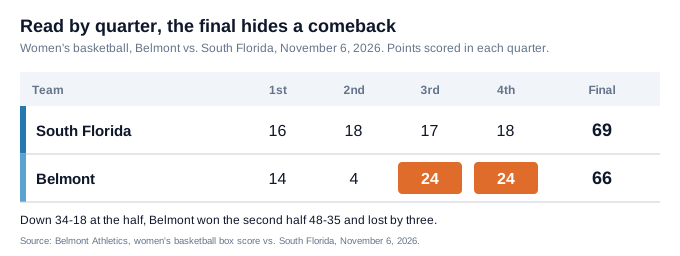
Then Belmont struggled. It scored 4 points in the second quarter to South Florida’s 18 and went into the half down 34-18.[1]
During halftime, the Belmont players came out early and practiced their shots on the court. We guessed the coach thought the shooting mattered more than a pep talk, and that the players knew what to do and only needed to tune up their shooting form.
Whatever the reason, Belmont won the third quarter 24-17 and the fourth 24-18.[1]
The fourth quarter was a barn burner, tense and exciting to the end. With 5.5 seconds left, Kate McGinnis, a sophomore, took a pass from Chelby Jordan, a terrific freshman, and hit a long three-pointer to tie the game at 66.[1][6]
South Florida got the ball back. Amourie Porter scored on a layup, a short shot close to the basket, and was fouled on the play. The basket counted two points, and the foul gave Porter one free throw, an unguarded shot worth one more point. Basketball calls that an and-one. Porter made the free throw with 1.4 seconds left, and South Florida led 69-66.[1][6][7]
Belmont had no timeout left, and it needed one to move the ball up the floor for a last shot.[6] Under the rules, a timeout that late would have let it throw the ball in much closer to the basket it was shooting at. Without one, it had to throw the ball in from the far end of the court, with 1.4 seconds to get a shot off.[6][7]
Belmont won the second half 48-35 and lost by three.[1][6]
Read only the final and you’d think it was close all night. Read it by quarter and you see a team that came back from 16 points down and fell one three-pointer short of a tie.[1]
What nobody did
It was a hard game for the players and the coaches. I thought the officiating was inconsistent.
One mark of sportsmanship is getting a call against you for something you know didn’t happen and not taking it out on the referees. That goes for the coaches too.
A coach can challenge certain calls and send them to video review, but a failed challenge costs the team a timeout.[8] Late in a close game, a timeout is worth a great deal. Belmont had none left in the last seconds.[6] And the cameras don’t catch every angle, so you can be right and still be unable to prove it.
Belmont won one review and got a call reversed. South Florida lost a challenge. Through all the rest, you could feel the coaches’ frustration as they bottled it up, and you could see it in the players’ faces. But no one made a show of it to turn the crowd against the referees.
The box score is the game’s official sheet of numbers, and it backs that up in the only way it can. Referees can call a technical foul for misconduct rather than contact, such as speaking disrespectfully to an official.[7] The box score has a line for technical fouls, and it reads “none” for both teams.[1] It counts outbursts, not the effort of holding one in.
The winning basket was a layup.[1][6] A foul was called on the play, and the free throw put South Florida up by three. Then the players and coaches congratulated each other, thanked the crowd, and went back to the locker room.
How you act when you think the call was wrong is the best test of sportsmanship I know.
The box score has no column for that.
The players forget, so the crowd remembers
Watching the players, I could see they play the next possession (the next trip down the court), not the scoreboard. Coaches push players to forget the mistakes and focus on what they’ve learned and what’s working. When the game ends, the players have to let all of it go and focus on the next one. They put away the courage, the sportsmanship, the moments of joy and hurt, so the next play can start on its own.
So the crowd carries it out of the building. It was entertaining, it was dramatic, it was gritty excellence. You had to be there, and I’m glad I was.
The score line carries the result and almost none of the story.
Why you won’t see it on the national news
National news leans toward what goes wrong: the brawl, the ejection, the coach screaming at a referee. At games like Belmont’s, two teams that compete as hard as they can and treat each other well are the ordinary case, and the ordinary case doesn’t travel. Even the two schools’ own recaps of Friday’s game had the tying three-pointer and the and-one, and not a word about how the teams treated the officials or each other.[6][9]
It’s a game. It’s also life, drama, a moment of enjoyment, and a community. This is the America I enjoy, where people compete respectfully and communities come together across the competition. It’s a rich feeling you won’t get watching at home.
On Friday a team lost on an and-one with 1.4 seconds left.[6] Then it lined up, shook hands with the team that beat it, and thanked the crowd.
Reference Sources
- Belmont Athletics, “Women’s Basketball vs South Florida on 11/6/2026 – Box Score”, November 6, 2026. Score by quarter: South Florida 16, 18, 17, 18 (69). Belmont 14, 4, 24, 24 (66).
- Belmont Athletics, “Men’s Basketball vs Centre on 11/5/2026 – Box Score”, November 5, 2026. Score by half: Centre 26, 19 (45). Belmont 33, 42 (75).
- Centre College Athletics, “Sports Information”: Danville, Ky., NCAA Division III, Southern Athletic Association.
- NCAA, “NCAA Division III Initial Eligibility Requirements”: “Division III schools do not offer athletics scholarships.” NCAA, “NCAA Division I”: “the highest level of NCAA competition.” Belmont University, “Belmont at a Glance”: “A private Christian university in Nashville, Tennessee,” with “18 NCAA Division I athletic teams.”
- Centre College Athletics, “2026-27 Men’s Basketball Roster”: two players list Nashville, Tenn., as their hometown.
- Belmont Athletics, “Women’s Basketball Comes Up Just Short Against South Florida Friday Night at the Curb”, November 6, 2026. On McGinnis’s tying three “with 5.5 seconds left,” Porter’s and-one “with 1.4 seconds remaining,” Belmont having no timeout left, and the event, “a new cross-conference event” with teams from the Missouri Valley, American, Atlantic 10, and Ivy League conferences. Belmont’s play-by-play in note 1 logs the tying three at 0:10 and the and-one at 0:03.
- NCAA, “2025-26 and 2026-27 NCAA Women’s Basketball Rules”. Rule 5-1: a basket from inside the three-point line counts two points, one from beyond it three, and a free throw one. Rule 8-1.1: a free throw is “an unhindered try for goal” from behind the free-throw line. Rule 5-14.2: a team granted a timeout in the last 59.9 seconds may throw the ball in from its frontcourt, 28 feet from the end line. Rule 7-4.6: after a made basket or free throw, the other team throws the ball in “from the end of the court where the goal was made.” Rule 10-12.1: “A technical foul is a non-contact foul of a behavioral nature.” One example the rules give is “Disrespectfully addressing an official.”
- NCAA, “2025-26 and 2026-27 Women’s Basketball Rules Changes”, Rule 11-4: “Unsuccessful appeals result in a charged timeout to the team.” The NCAA calls it a coaches’ appeal. A team with no timeouts left that loses one is charged a technical foul.
- South Florida Athletics, “South Florida Women’s Basketball Tops Belmont on Porter’s Game-Winning And-One”, November 7, 2026.