By the time Apple announced Apple Intelligence in June 2024,[1] Microsoft had already pushed Copilot across Windows and Office.[2] A year later its Copilot family passed 100 million monthly users.[2] The verdict I kept reading was simple. Apple was late, distracted, and falling further behind.
The skepticism had a sharp edge to it. Craig Moffett of MoffettNathanson cut his Apple price target to $141 in April 2025 and kept his sell rating, a hundred dollars under the Street’s average target.[3] His case was mostly about tariffs and the trade war with China.[3]
The chip story I kept reading ran the same way. Qualcomm was closing the gap. Intel had a roadmap. The advantage of Apple’s own M-series chips, once undeniable, was temporary.
Here is the problem with that verdict. In my experience, traders and speculators drive the daily price, working off short news cycles. The long-term decision-maker works below the radar, building or trimming positions without causing a ripple. So the market story gets written by whoever is loudest, not whoever is most informed.
We move from hype cycle to hype cycle until the evidence becomes undeniable. Then much of the market recognizes the new reality at once, and the stock moves sharply to catch up.
In my view, Apple has been misread for as long as I have followed it. Its AI story is just the latest example.
I have been making this argument for a long time. In 2013, in The Secret of Apple’s Success, I wrote that “everyday some analyst or pundit questions their strategy and predicts their imminent demise.” The same year, in Why Are Facts Irrelevant To Online Analysts?, I took apart a tech-site article, built on an infographic, that declared Samsung was “winning every way but one,” when by my count Samsung won two of the infographic’s six comparisons at best. I complained that “the internet is awash with data” and that much of it “is poorly analysed and is presented as insight.” In 2019 it was a Goldman Sachs price cut, in Is Apple Stock Overvalued?.[4] More recently it was tariffs, and then India. The subject changes. The mistake does not. The loudest voices keep reading Apple off the surface.
That verdict is wrong. Not slightly wrong. Structurally wrong. And the data shows it once you stop watching the press releases and start watching what ships, and into what.
So that is what I did. I went back and analyzed the shipping dates for the major releases since 2023, Apple’s, Qualcomm’s, and Intel’s. The pattern is not the one I expected. Apple ships new silicon more often than Qualcomm. Intel, counting every refresh and tier, ships even more releases than Apple, and on the count that matters most, how often a genuinely new generation arrives, its laptop line keeps pace. The moat is somewhere else, and finding it took me longer than the chart did.
This isn’t a story about smarter engineers, though Apple’s engineers built every piece of it, over a decade of being second-guessed. It is a story about two structural advantages that feed each other, and a third that multiplies both. First, organizational velocity: who decides the day a finished chip reaches a product, and which products it goes into. Second, architectural efficiency: how the chips themselves work. Separately, these are advantages. Together, they create what I call a Compound Moat. It’s not a moat of software features. It’s a moat of silicon and of how a company is put together. No competitor can cross it by simply catching up on specs.
Here is the path. What actually shipped, and what the count does and does not prove. Why Apple decides the day its chips reach its products and its rivals cannot. Why a chip Apple built for speed and battery life turned out to suit AI. How Apple’s place near the front of the factory line multiplies both. What would break all of it. And what it means if you are an investor, a competitor, or a strategist.
What Shipped, and When
Forget the product announcements. Look at what is shipping.
Two terms first, because they run through everything below. TSMC is the Taiwanese company that manufactures the most advanced chips for Apple, Qualcomm, and many other chip designers. And when you see 3nm or 2nm, read it as a generation of manufacturing. The smaller number is the newer one, and it makes a chip that does more work on less power. The industry calls each of those generations a node. Each node also comes in improved versions over the years, and the count below treats each new version as its own step.
Apple’s M-series chips, from Apple’s own release dates:
- M2 Pro/Max: January 2023
- M2 Ultra: June 2023 (5 months later)
- M3/Pro/Max: October 2023 (4 months later)
- M4: May 2024 (7 months later)
- M4 Pro/Max: October 2024 (5 months later)
- M3 Ultra: March 2025 (5 months later)
- M5: October 2025, shipped at once in the MacBook Pro, iPad Pro, and Vision Pro (7 months later)
- M5 Pro/Max: March 2026 (5 months later)
- M5 Ultra and M6: announced August 2026 on the same day and shipped September 22, the M6 on 2nm (6 months later, counting to the ship date)
That is ten releases into shipping products in about 44 months.[5] A new release every four to seven months.
Now look at Qualcomm’s Snapdragon X line for Windows laptops:
- Snapdragon X Elite: announced October 2023
- First devices available: June 2024 (8 months after the announcement)
- Snapdragon X Plus 8-core: a smaller tier of the same generation, available September 2024[6]
- Snapdragon X: a smaller tier again, shipping from January 2025[6]
- Snapdragon X2: announced September 2025, devices reached retail in April 2026
That is two generations in the window, twenty-two months apart at retail.[6][7] Two smaller tiers of the first generation reached laptops later, the X Plus 8-core in September 2024 and the Snapdragon X in January 2025, so Qualcomm has four releases I could date.[6] Qualcomm also announced a lower tier of the X2, the X2 Plus, in January 2026 for the first half of the year. I could not find a ship date for it on Qualcomm’s own pages, so it is not counted here.[8]
Stop and absorb that. Apple shipped chips from five generations of silicon in that window, M2 to M6, and four of those generations were new. Qualcomm moved through two, and its second generation reached stores nearly two years after its first. However you count it, Apple is moving faster than Qualcomm, and by releases reaching products, at least twice as often.
The reason is Qualcomm’s business model, as I’ll show.
Intel’s record is the one that surprised me, and it does not fit the story I set out to tell.
On the desktop, Intel moves slowly. Arrow Lake reached stores in October 2024,[9] and a refresh followed in March 2026.[10] Nova Lake, the true next generation, is not due until late 2026 into 2027.[10] That is two years or more per real generational leap.
But Intel’s laptop line is a different business:
- 13th Gen mobile: a refresh, thirty-two chips at the start of 2023[11]
- Meteor Lake: on shelves December 14, 2023. The first chip sold as Core Ultra, built on Intel’s own process, with the company’s first built-in neural engine, the part of a chip made for AI math[12]
- 14th Gen HX: a refresh for high-end laptops, on sale January 8, 2024[11]
- Lunar Lake: September 24, 2024, built at TSMC on 3nm[13]
- Arrow Lake for laptops: first quarter of 2025, also on TSMC’s 3nm[14]
- Panther Lake: reached customers January 27, 2026, the first chip on 18A, which is Intel’s name for its newest manufacturing process, made in Intel’s own factories rather than at TSMC[15]
Now count all three companies the same way. A new generation here means a new chip design on a new manufacturing node, counted within each product line, since a laptop chip and a desktop chip reach different buyers. A refresh, or a larger or smaller version of an existing design that reaches products on a later date, counts as a release and not as a generation. By that rule, Intel’s count also takes in the 14th Gen refresh, on desktops in October 2023 and in high-end laptops and the rest of the desktop line in January 2024,[11] and Arrow Lake’s 65-watt desktop chips in January 2025.[14] Intel’s total is a floor, because a few more of its tiers may count and I could not find their on-sale dates.
| Releases into products | New generations in the window | Months between new generations | |
|---|---|---|---|
| Apple | 10 | 4 | about 11.7 |
| Intel, laptop line | 6 | 3 | about 12.5 |
| Intel, laptop and desktop | at least 11 | 4 | n/a |
| Qualcomm | 4 | 2 | 22 |
Apple’s fifth generation in the chart, the M2, arrived before the window opened. Only its larger versions shipped inside it, so it counts as a release here and not as a new generation. Intel’s fifth is the same case, the 13th Gen refresh at the start of 2023. And Arrow Lake for laptops arrived on the very same version of TSMC’s 3nm process as Lunar Lake, so it too counts as a release. Apple’s M4 and M5 each moved to a newer version of that process, which Apple calls second- and third-generation 3-nanometer technology, so each counts as a new generation.[5] That is why Intel’s laptop line shows three new generations and its two lines together show four, with the desktop’s Arrow Lake as the fourth.
Count every release reaching a product, and Intel leads: at least eleven to Apple’s ten to Qualcomm’s four. Count new generations, and Intel’s laptop line shipped three to Apple’s four, with the desktop’s Arrow Lake a fourth across both lines. Measure the months between new generations, and Apple’s pace is just under twelve months to Intel’s twelve and a half.
That is not several times faster. That is roughly even.
So the chart below is not the proof I thought it was when I first drew it. Apple ships fewer releases than Intel and at least twice as many as Qualcomm, and every one of them ships into a product line Apple controls. That last part is where the advantage lives, and it is the subject of the next section.
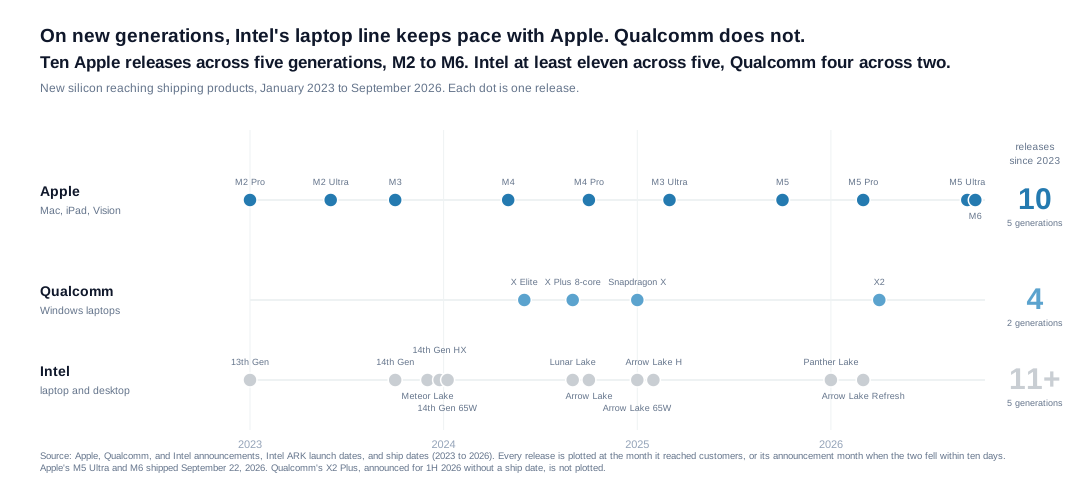
The prevailing narrative says competitors are catching up. Against Qualcomm, the timelines say the opposite. Against Intel’s laptop line, the narrative has a point, and I would rather say so than draw a chart that hides it.
Most analysts I’ve read focus on benchmark comparisons, chip-to-chip performance at a single point in time. That framing misses the compounding dynamic, because the question isn’t who wins a benchmark today. It’s who decides when the next chip reaches buyers, and the one after that.
So why does Apple’s cadence turn into an advantage when Intel’s does not?
The Fragmentation Tax: Why a Finished Chip Waits
When Apple designs a chip like the M5, it’s designing for:
- MacBook Air
- MacBook Pro
- iPad Pro
- Vision Pro
All running Apple’s own operating systems. One company. One approval process. Apple picks the day it ships.
When Qualcomm designs a chip like the Snapdragon X Elite or X2, it depends on each of these to build around it:[6][7]
- Microsoft (for Windows integration and certification)
- Lenovo (for the ThinkPad line)
- Dell (for XPS and Latitude)
- HP (for OmniBook and EliteBook)
- Samsung (for Galaxy Book)
- ASUS (for Vivobook and Zenbook)
Every one of those companies builds a differently shaped laptop with different cooling. Each needs its own drivers and its own testing, and that takes longer at some makers than at others. And each has its own launch calendar. Say Lenovo wants the second quarter and Samsung wants the first, and wants it exclusively.
Think of a chef who owns the restaurant. When she perfects a new dish, it is on every table tonight. Now think of a company that makes a sauce and sells it to a dozen restaurants. The sauce can be finished in March. It reaches diners when each of twelve kitchens has rewritten its menu, retrained its cooks, and picked its launch night. Qualcomm and Intel sell the sauce. Apple owns the restaurant.
Qualcomm’s chip reaches buyers only as each laptop maker gets its design ready. The first X2 laptops reached stores in April 2026. Samsung’s reached U.S. buyers in June, almost nine months after Qualcomm announced the chip.[7]
This is the constraint Alex Katouzian, who runs Qualcomm’s mobile, compute, and XR (headset) group, described at Computex in 2025. He said a platform like the Snapdragon X needs more than nine months to become mature across multiple laptop designs and configurations.[16]
Read that as a business strategy, because that is what it is. Qualcomm’s laptop line moves slowly on purpose. As I read it, Qualcomm would rather not ask its many partner companies to retool every year. Close to two years between generations lets each maker build differentiated products. If Qualcomm brought out a new generation about every year the way Apple does, those partners would be retooling nearly twice as often.
My read is that Qualcomm made a choice: margin stability and partner satisfaction over innovation speed. That’s a reasonable business decision when you’re serving the entire industry. But it means Qualcomm’s laptop line, run this way, will not match Apple’s pace. Intel, selling to the same laptop makers, brings out a new laptop generation about every year.
In transformation work, I’ve seen this dynamic repeatedly. The constraint is rarely ability. It’s integration. It’s the coordination overhead that accumulates when a launch depends on a dozen companies. Each of them controls its own piece of the calendar.
The bottleneck is the ecosystem, and you cannot engineer your way out of an ecosystem problem. The organizations that succeed don’t fix the coordination. They eliminate the need for it.
Intel faces a similar constraint for a different reason. It runs separate lines for desktops, laptops, and servers, and they cannot move in lockstep. A desktop refresh doesn’t help laptop buyers. A new laptop chip reaches stores in the first laptops within weeks of launch, and more designs follow over the months after, as Dell, HP, Lenovo and the others finish their own.[15] Then corporate IT departments managing thousands of devices decide when to take it. So each Intel laptop reaches buyers on its maker’s clock. On the desktop, a real new generation takes two years or more.
Apple has none of these constraints. It moves fast because it only serves itself. Intel can design a new generation about as fast as Apple, and lately it has. What it cannot do is decide the day its chip reaches the products. Apple shipped the M5 into the MacBook Pro, the iPad Pro, and the Vision Pro at once. That is the velocity that compounds.
This is the first part of the moat: organizational velocity. It is built into how Apple is put together, and no rival can buy its way out of its own org chart.
The Architecture Advantage: Why Efficiency Compounds
The second part of the moat is harder to see, and it compounds the first. It is about how Apple’s chips themselves work, and why that architecture turned out to suit the AI era so well.
To understand this, we need to look back at why Apple dumped Intel in the first place.
The Fork in the Road
For decades, the computing world ran on Intel’s model. You had a powerful central processing unit, the CPU, that acted as the brain. It did the heavy thinking. If you wanted to play games or render video, you added a separate graphics processing unit, the GPU, from Nvidia or AMD. The CPU would hand off tasks to the GPU. This worked fine for traditional software.
But in the late 2010s, Apple hit a wall. It wanted its laptops thinner, lighter, and longer-lasting. Intel’s chips weren’t delivering. The Intel Macs I used ran hot. They sucked battery. They needed loud fans.
So Apple did something radical. It took the architecture from the iPhone, built on Arm, the low-power chip design inside nearly every smartphone, and scaled it up to the Mac. It designed a system on a chip, with the CPU and the GPU on one piece of silicon and the memory packaged right beside them.[5]
Plenty of people doubted that a phone chip could handle real work.
It could.
The Accidental AI Supercomputer
The workload of computing was changing. Traditional software handles logic, the if-this-then-that kind of rules. CPUs are great at that. But AI is different.
AI doesn’t do logic in the traditional sense. It does vector multiplication.
Think of it this way. When ChatGPT predicts the next word in a sentence, it isn’t looking up a rule. It is multiplying huge tables of numbers, called matrices and vectors, to calculate probabilities. It does this billions of times for every single response.
CPU cores are bad at this, because they are designed to do complex tasks one at a time. GPU cores are great at it. They are designed to do simple tasks, like calculating the color of a single pixel, thousands of times at once.
This is a big part of why Nvidia’s data-center business brought in $89 billion in the quarter it reported in August.[17] Nvidia saw that its graphics chips suited the parallel math needed for AI training.
Apple didn’t set out to build an AI supercomputer. It set out to build a thinner laptop. It did plan for machine learning, with a Neural Engine in the M1 from day one. The part that looks lucky now is the shared pool of memory, built for speed and battery life, which turned out to suit today’s large models.
Apple’s Unified Memory
When Apple designed the M1, it promised two things at once, “up to 15x faster machine learning” and “battery life up to 2x longer.”[5] It wanted a chip that sipped power, ran cool, and fit inside a device thin enough to matter. To do that, it bet the whole chip on a unified memory architecture.
In a PC with a separate graphics card, the CPU has its RAM, and the GPU has its own memory, called VRAM. To run AI, you have to copy data back and forth between them. This copying burns power and takes time. Apple eliminated the copying.
It built a single pool of memory. The CPU, the GPU, and the Neural Engine, Apple’s name for the part of the chip made for AI math, all read the same data without copying it.
The result: an M-series MacBook has a powerful GPU and a dedicated Neural Engine sitting right next to the memory. It can run the massive vector multiplications needed for AI without the heat of a separate graphics card.
The part of the chip built for AI keeps growing. The M6 and the A20 Pro each carry a dual sixteen-core Neural Engine, double what the A19 Pro had a year earlier.[18][19]
The Strategic Split: Cloud vs. Edge
As I read it, Apple cannot compete with Nvidia in the cloud for the largest AI workloads. Training a frontier model takes huge numbers of the most powerful data-center GPUs. No laptop can do that.
But Apple doesn’t need to. It can split the work between the cloud, meaning big servers somewhere else, and the edge, meaning the device in your hand.
Work that belongs in the cloud, where Apple can use anyone’s servers:
- Training large models, which it can leave to Google, OpenAI, or Anthropic
- Complex reasoning that needs the largest models, far too big for a phone today
- Tasks that benefit from massive scale, such as analyzing billions of web pages
For requests that are private but too big for the device, Apple built Private Cloud Compute, its own servers designed to handle them without keeping the data.[1] For the rest it can partner with any cloud provider. It doesn’t need to own this layer to win.
Work that belongs on the device, where Apple’s architecture is the advantage:
- Real-time translation, where every round trip to a server adds a delay the listener can hear
- Object identification, because the camera needs to recognize things as you point
- Location-based services such as directions while driving, which are both private and urgent
- Simple requests such as “Set a timer” or “Turn on Do Not Disturb,” which are wasteful to send to a server
- Photo and video processing, which users expect to work on a plane with no Wi-Fi
For these workloads, local execution wins on speed, on reliability because it works offline, and on cost because there are no server fees per query. Privacy is the bonus, not the whole case.
And the edge is moving up. The Mac Studio Apple announced in August takes up to 512 gigabytes of unified memory. Apple’s own description is that it runs enormous language models entirely on the machine, and that several of the machines linked together can load the largest open-weight models, the kind anyone can download and run.[20] That is a desktop, not a laptop, so it does not change what a phone can do. But it moves the line between what needs a server and what does not. It moves it in Apple’s direction.
Why This Matters Strategically
Apple’s low-power, high-speed architecture gives it choices. It can:
- Run many everyday AI tasks locally (no cloud cost, instant response)
- Offload complex tasks to Private Cloud Compute (privacy-preserving)
- Partner with any cloud provider for remaining workloads (no lock-in)
PCs built the traditional way, with a separate graphics card and its own memory, have fewer choices:
- They can run less AI locally before battery and heat bite
- They lean on the cloud for more of it, with its ongoing costs, privacy exposure, and need for a connection
- They are tied to a cloud provider’s stack, Windows to Microsoft’s
This is why I don’t see Nvidia’s win in the data center as a threat to Apple. If anything, it supports Apple’s bet. Nvidia proved that an architecture built for parallel math beats one built to do tasks one at a time. Apple is doing the same thing, but optimized for the constraints of edge devices (battery, heat, size).
And because Apple controls the hardware and the software, it can optimize the split between edge and cloud better than rivals who split the chip and the software between two companies. A Qualcomm chip in a Windows laptop runs the AI features Microsoft builds into Windows.[6] Apple’s Neural Engine runs Apple Intelligence’s on-device models, which Apple tunes for that silicon.
This is the second part of the moat. The architecture is efficient. It is tuned for a split between edge and cloud. Rivals can copy pieces of it. Intel’s Lunar Lake put the memory on the chip package too,[13] and Copilot+ PCs run some AI on the device.[6] What they have not copied is the pairing, because in a Windows laptop the chip and the software come from two companies.
The Multiplier Effect: Near the Front of the Line at the Fab
Now for what multiplies the two. A newer node makes the same chip design more efficient, which stretches what it can run on a battery. That feeds the architecture advantage. And Apple’s organization decides the day that newer chip reaches its products. That feeds the velocity advantage. So getting each new node early hands Apple both advantages sooner, every cycle.
And there is a bottleneck. As I said earlier, TSMC makes the most advanced chips for Apple, Qualcomm, and many other chip designers, and the smaller the number, the newer the node. More transistors fit on the chip, and each one takes less power to switch.
But TSMC cannot make enough of the most advanced chips for everyone. In late 2025, TSMC started volume production of 2nm chips, TSMC’s newest, smallest, most efficient process.[21] It can only make a limited number, because building a new leading-edge fab, a chip factory, takes years and billions of dollars.
So there’s a queue. And Apple is one of the first in line.[21] Why?
- Volume commitment: Apple orders chips for well over 200 million devices a year. IDC forecast 2025 iPhone shipments alone at about 247 million.[22] That is a very large order to plan a factory around.
- Early adoption: Apple was an early customer for 3nm (the A17 Pro and the M3),[21] proving the technology worked. My read is that TSMC rewards early adopters.
That is why, against most of the other companies in that queue, Apple’s products reach each new node early. The rest wait.
Here is how that compounds, using what has happened rather than what I predict will.
Start with Apple. TSMC began 2nm volume production in late 2025. Apple was among the first TSMC customers on it, the way it was for 3nm before it.[21] Less than a year later Apple announced the M6, its first chip on 2nm, in a Mac mini that reviewers had on their desks a week early and customers had on September 22.[18] On September 9, two weeks after the M6, it announced the A20 Pro for the iPhone 18 Pro, also on 2nm, and that phone reached stores on September 18.[19]
Now Qualcomm. Its newest laptop chip, the Snapdragon X2, reached stores in April 2026. It is built on 3nm, the same class of process Apple has shipped since the M3 in 2023.[23] Qualcomm stands near the front of the 2nm queue with Apple,[21] but it has spent that place on phones. Its first 2nm chips are phone chips, not laptop chips.[23]
Within a month of announcing it, Apple had 2nm silicon on store shelves in both a phone and a Mac, and Qualcomm’s freshest laptop silicon is a full manufacturing node behind the M6 in Apple’s new Mac mini. And I expect that by the time Qualcomm brings a 2nm laptop chip to market, Apple will already be moving to whatever TSMC builds next.
Intel and Samsung, which I come to below, are the exceptions. Intel’s recent laptop chips have split between TSMC’s 3nm, where Apple went first,[21] and its own 18A process, where Intel does not wait at all. Panther Lake put 18A into shipping laptops in January 2026, about eight months before Apple’s first 2nm Mac.[15] A company with its own leading-edge fab can beat Apple to a node. The queue at TSMC is a moat against most of TSMC’s other customers. It is not a moat against Intel.
It may not need to be. Since late 2025, the supply-chain analyst Ming-Chi Kuo has reported, as Tom’s Hardware relays it, that Apple is evaluating Intel’s 18A as a second source for its entry-level M-series chips, with production penciled in for 2027 and the flagships staying at TSMC. In June 2026 President Trump announced a deal, and neither company confirmed it at the time. In July 2026 the Wall Street Journal reported that Apple plans to have Intel make some chips for Mac laptops and iPhones, with no timeline.[24] If it holds, a fab that has beaten Apple to a node will spend part of its capacity making Apple’s chips.
This is why I expect the gap with Qualcomm to stay open. Say Qualcomm designed a chip that matched the M5 on paper today. By the time it shipped in volume across its laptop partners, Apple would likely be a node ahead again. The architectural efficiency gives Apple more work for each unit of battery. The velocity shows in the calendar. Each of Qualcomm’s two laptop generations reached stores six to eight months after Qualcomm announced it,[6][7] while the M6 reached buyers four weeks after Apple announced it.[18] On the manufacturing node, I expect the gap to be wider.
A bigger R&D budget would not solve this. The constraint is that Qualcomm does not make the laptops.
The whole moat fits in one view. None of it lives in a product feature.
| Layer of the moat | What it is | Why competitors have not matched it |
|---|---|---|
| Organizational velocity | Apple serves only itself, so it decides the day a finished chip ships. | Qualcomm and Intel ship through their laptop partners, so each laptop maker decides when its laptop ships. |
| Chip architecture | One shared pool of memory, built for speed and battery life, that turned out to suit on-device AI. | Intel put the memory on the chip package too. In a Windows laptop the chip and the software still come from two companies. |
| Manufacturing access | Among the first in line at TSMC for its newest nodes. | A moat against most other TSMC customers. Intel and Samsung own fabs, and both have reached a node before Apple. Neither has the organization above it. |
| The compound effect | The fab queue multiplies the other two. | The gap with Qualcomm stays open. Intel matches the chip and still cannot cross the layer above it. |
What Would Break This Moat
The moat can break. Beyond a shock to Taiwan that would hit every TSMC customer at once, four things could do it:
1. A Rival Puts a Leading-Edge Fab Under an Organization That Serves Only Itself
Intel has fabs, and its own 18A process reached laptops in January 2026, ahead of Apple’s 2nm.[15] Which means on this layer, Intel has already broken through. What it has not broken is the organizational layer above it. And the reported Apple deal points the other way. Intel’s fab is more likely to end up as Apple’s second kitchen than as a rival’s weapon, because a foundry makes the customer’s design and does not set the customer’s ship date.
Buying a fab is the shortcut, and there is little on the shelf. GlobalFoundries gave up on the leading edge in 2018. Rapidus in Japan opened a 2nm pilot line in 2025 and does not plan mass production before 2027. Samsung’s fab is a division of Samsung, which said in 2024 it has no interest in spinning it off. Intel now has the United States government as a shareholder, at nearly ten percent. A buyer gets a factory that is years behind, not yet in production, or not for sale.[25]
Samsung is the case that should worry Apple most, and it shows why a fab alone is not enough. On paper Samsung has all three pieces: a fab, its own Exynos chips, and the Galaxy phones and laptops to put them in. It even reached 2nm in a phone before Apple did. In practice the pieces act like three companies. Its phone division shops for chips the way any outside customer would. The Galaxy S25, S25 Plus, and S25 Ultra used Qualcomm’s chip worldwide. The S26 put Samsung’s own 2nm Exynos in the base phones for most of the world, but not in the United States, China, or Japan, and not in the Ultra anywhere. Its newest laptops run on Intel and Qualcomm chips. The phones run Google’s Android and the laptops run Microsoft’s Windows. Samsung owns a kitchen and a dining room and still buys the sauce. A fab breaks the moat only when the same company designs the chip, ships the product, and writes the software, and decides all of it in one room.[26]
Likelihood that a rival puts a leading-edge fab under an organization that serves only its own products: low in the next 5 to 10 years.
2. Regulatory Forced Interoperability
The EU’s Digital Markets Act already requires Apple to open parts of iOS to outside devices, under two Commission decisions from March 2025, and it could force Apple to open more. So far the chips have kept their pace. If the rules reached into how Apple’s chips and software are built to work together, they could fracture Apple’s organizational simplicity, and Apple would have to coordinate more with outside companies.
Likelihood: already under way for software, and slow to reach the silicon. In my estimate, that would take 3 to 5 years or more, and courts could block it.
3. Qualcomm Spins Off an Apple-Like Entity
Consider if Qualcomm created a division that made chips only for Microsoft Surface devices. No other OEMs, the outside companies that build and brand the laptops. Just one partner, one OS, vertical integration. That could match Apple’s velocity.
Likelihood: Near zero. It would put Qualcomm’s existing partnerships at risk. I suspect antitrust regulators would look hard at it too.
4. Apple’s Organization Breaks Down
If Apple’s chip team experiences massive turnover, or if regulatory compliance slows its cadence, the velocity advantage could erode.
Likelihood: low on the evidence so far. The chip team has kept its cadence through the M6.
Bottom line: Based on current structural constraints, and assuming no catastrophic geopolitical shifts, this moat likely persists for 5 to 10 years. I’m confident in that timeframe because the constraints are built into factories and organizations. Factories take years to build. Partnerships take years to forge. Technological gaps can close quickly. Organizational physics changes slowly.
I’ll be honest about where this analysis gets shakier. I don’t have visibility into Apple’s internal roadmap beyond what’s publicly reported. The M6 was announced in August on 2nm and shipped on September 22. The next test is whether the M7 lands on TSMC’s next node at the same pace. If the chip team hits delays, or if that node’s yields disappoint, meaning too few of the chips on each wafer come out working, the compounding advantage narrows. I’m treating the pattern as durable, but patterns break.
What This Means
Remember the $141 sell rating from the opening. In September 2025 that same shop dropped the sell call and moved to neutral.[27] A few months later, in early 2026, it raised its target to $270.[28] One of the last bears on Wall Street gave up. His notes, as reported, cited tariffs, China, valuation and Apple’s place in the AI trade, not Apple’s silicon, and in September 2025 he still called the stock too rich. In my experience, this is how it tends to go with a company that keeps shipping while the analysts argue. Sooner or later, I think, the price catches up with what was true, whatever reasons the analysts give at the time.
I traced the same analyst’s short-termism on Apple’s supply chain in Apple’s India Strategy: Outsmarting Short-Term Skeptics. There, the $141 target left out the manufacturing logic the way it left out the silicon.
If you’re an investor, this changes the thesis. Apple’s premium pricing looks durable to me. Intel’s laptop line is already at rough parity on generation cadence, and its 18A node arrived first. That node may soon be making Apple’s chips. I have not seen that compress Apple’s premium, which tells me the premium was never resting on the cadence. It rests on the whole machine: chip, memory, operating system, and product, shipping as one thing. Apple can maintain pricing power because it sells that whole machine across a phone, a tablet, and a computer.
The velocity advantage creates another strategic option. Apple can keep putting previous-generation chips (M4 or M5 now that M6 has launched) into lower-priced products to compete in price-sensitive segments. Competitors would see older Apple silicon competing against their newest chips. But because Apple’s previous-generation chips sit on the same node class as Qualcomm’s newest laptop chips, they stay competitive. Apple protects its margin (as I understand it, a mature node turns out more working chips per wafer, so each chip costs less) while expanding market coverage. Competitors who move slowly have less room for it.
If you’re a competitor, matching Apple’s chip cadence is possible. Intel has. It does not get you the moat, because the moat is the thing around the chip. You compete by:
- Targeting different markets (Qualcomm’s home turf is the Android phone)
- Offering lower prices in segments Apple ignores
- Using regulatory leverage to force interoperability
- Building different form factors (foldables, gaming devices)
If you’re a strategist, this is a case study in how business model structure creates competitive moats. It’s not that Apple hired smarter people. It’s that Apple’s people were allowed to build a simpler system, one that lets Apple decide the day a chip moves, and then compounded it with access to scarce manufacturing capacity. The talent built the structure. The structure is what a competitor cannot hire.
This matters beyond Apple’s stock price. The most durable advantages come from what a company doesn’t have to do. Apple doesn’t have to negotiate with OEMs. It doesn’t have to maintain backward compatibility across a fragmented ecosystem. It waits near the front of the manufacturing queue, not the back. Most of the constraints its competitors live with are taxes Apple doesn’t pay.
For Apple’s competitors, the problem is not the chip. Qualcomm has chosen a slower laptop rhythm to suit its partners. Intel can match Apple’s cadence, and did, and still has to ship every laptop generation through its laptop partners, on their schedules, not its own. Neither decides the day a new chip reaches its launch lineup, because neither makes the products. Neither owns the restaurant.
Reference Sources
- Apple. “Introducing Apple Intelligence for iPhone, iPad, and Mac.” Apple Newsroom, 10 June 2024. Accessed June 15, 2026.
- Microsoft. “Microsoft Fiscal Year 2025 Fourth Quarter Earnings Conference Call.” Microsoft Investor Relations, 30 July 2025. Accessed September 22, 2026. Satya Nadella’s prepared remarks: “Our family of Copilot apps has surpassed 100 million monthly active users across commercial and consumer.” Thirteen months after the Apple Intelligence announcement. The 2023 rollout: Yusuf Mehdi, “Announcing Microsoft Copilot, Your Everyday AI Companion.” Official Microsoft Blog, 21 Sept. 2023, accessed September 24, 2026: “Copilot will begin to roll out in its early form as part of our free update to Windows 11, starting Sept. 26,” and “Microsoft 365 Copilot will be generally available for enterprise customers on Nov. 1, 2023.”
- CNBC. “Apple shares to tumble nearly 30% as earnings take tariff hit, Moffett Nathanson predicts.” 21 Apr. 2025. Accessed September 22, 2026. Moffett “reiterated a sell rating on Apple on Monday, slashing his price target to $141 per share from $184,” and “The average Wall Street analyst’s price target stands at $241, according to FactSet data.”
- Publication dates for the three earlier pieces are from each post’s own metadata as captured by the Internet Archive, since the live pages show later update dates: The Secret of Apple’s Success, published May 24, 2013, captured Sept. 7, 2013. Why Are Facts Irrelevant To Online Analysts?, published March 8, 2013, captured Oct. 14, 2013. Is Apple Stock Overvalued?, published Sept. 15, 2019, captured Oct. 18, 2019. The lines quoted above appear in the 2013 captures. Accessed September 22, 2026.
- Apple. Apple Newsroom releases, one for each chip, accessed September 24, 2026. Before the window: “Apple unleashes M1.” 10 Nov. 2020. “Apple unveils M2, taking the breakthrough performance and capabilities of M1 even further.” 6 June 2022. In the window: “Apple unveils M2 Pro and M2 Max: next-generation chips for next-level workflows.” 17 Jan. 2023. “Apple introduces M2 Ultra.” 5 June 2023. “Apple unveils M3, M3 Pro, and M3 Max, the most advanced chips for a personal computer.” 30 Oct. 2023, “the first personal computer chips built using the industry-leading 3-nanometer process technology.” “Apple introduces M4 chip.” 7 May 2024, with M4 “built using a second-generation 3-nanometer technology.” “Apple introduces M4 Pro and M4 Max.” 30 Oct. 2024. “Apple reveals M3 Ultra, taking Apple silicon to a new extreme.” 5 Mar. 2025. “Apple unleashes M5, the next big leap in AI performance for Apple silicon.” 15 Oct. 2025, which brings M5 “to the new 14-inch MacBook Pro, iPad Pro, and Apple Vision Pro.” Of M5 it says, “Built using third-generation 3-nanometer technology.” “Apple debuts M5 Pro and M5 Max to supercharge the most demanding pro workflows.” 3 Mar. 2026. The M6 and M5 Ultra releases of August 25, 2026 are in notes 18 and 20. The three M5 product releases of October 15, 2025 each give availability beginning “Wednesday, October 22”: “Apple unveils new 14-inch MacBook Pro powered by the M5 chip, delivering the next big leap in AI for the Mac,” accessed September 24, 2026, “Apple introduces the powerful new iPad Pro with the M5 chip,” and “Apple Vision Pro upgraded with the powerful M5 chip and comfortable Dual Knit Band,” both accessed September 28, 2026. On Arm in phones: Arm, “Smartphones.” Arm, accessed September 28, 2026: “99% of all smartphones powered by Arm.”
- Qualcomm. “Qualcomm Unleashes Snapdragon X Elite: The AI Super-Charged Platform to Revolutionize the PC.” Qualcomm, 24 Oct. 2023. Accessed June 15, 2026. The first devices and the laptop makers behind them: Yusuf Mehdi, “Introducing Copilot+ PCs.” Official Microsoft Blog, 20 May 2024, accessed September 24, 2026: devices “from Microsoft Surface and our OEM partners Acer, ASUS, Dell, HP, Lenovo and Samsung, with pre-orders beginning today and availability starting on June 18,” among them Dell’s XPS 13 and Latitude 7455, HP’s OmniBook X and EliteBook Ultra, Lenovo’s ThinkPad T14s, and the ASUS Vivobook S 15. On the software, the post says “Windows now has the best implementation of apps on the fastest chip, starting with Qualcomm,” and that the new AI experiences use “several of Microsoft’s world-class SLMs.” Qualcomm’s smaller tiers: Athima Chansanchai, “IFA 2024: Qualcomm Expands Snapdragon X Series, Bringing Copilot+ PC Experiences to Mainstream Devices.” Windows Experience Blog, 4 Sept. 2024, accessed September 27, 2026: “Watch for select PCs powered by the Snapdragon X Plus 8-core platform, as they’re now available.” Daniel Rubino, “Qualcomm’s Latest Snapdragon X Shakes Up the $600 Windows Laptop Market, Brings AI to Everyone — Here’s Why Intel Should Be Worried.” Windows Central, 6 Jan. 2025, accessed September 27, 2026: “some Snapdragon X laptops start shipping in January 2025.”
- Qualcomm. “New Snapdragon X2 Elite Extreme and Snapdragon X2 Elite Are the Fastest and Most Efficient Processors for Windows PCs.” Qualcomm, 24 Sept. 2025. Accessed June 15, 2026. Qualcomm’s release promised devices in the first half of 2026. The retail date is from TechSpot, “Snapdragon X2 laptops launch with up to 18 cores, 5.0GHz clocks, and 80 TOPS NPU,” 8 Apr. 2026, accessed September 22, 2026: “Qualcomm’s Snapdragon X2 laptop rollout has now reached retail, with Best Buy listing the Asus Zenbook A16.” Samsung’s X2 laptop: Samsung, “Galaxy Book6 Edge Now Available: Next-Generation AI Performance Meets Premium Portability.” Samsung Newsroom U.S., 15 June 2026, accessed September 24, 2026, on the Galaxy Book6 Edge, powered by Snapdragon X2 Elite.
- Qualcomm. “Empowering Professionals and Aspiring Creators, Snapdragon X2 Plus Delivers Multi-day Battery Life, Fast Performance and Advanced AI.” Qualcomm, 5 Jan. 2026. Accessed September 12, 2026. Availability stated as “select devices from leading OEMs available for purchase in 1H26.”
- Intel. “Intel Core Ultra Processors (Series 2),” press kit. Intel Newsroom, 10 Oct. 2024. Accessed September 12, 2026. Core Ultra 200S desktop processors “starting October 24.”
- Jon Martindale. “Intel Confirms Arrow Lake Refresh Set for 2026, Nova Lake Later That Year.” Tom’s Hardware, 10 Sept. 2025. Accessed June 15, 2026. The refresh itself: Ben Wilson, “Intel Core Ultra 200S Plus Delivers Arrow Lake Refresh CPUs.” Windows Central, 11 Mar. 2026, accessed September 24, 2026: the chips reach “Intel’s retail partners, starting on March 26, 2026.”
- Intel. “13th Gen Intel Core Processors.” Intel Newsroom resources. Accessed September 12, 2026. Thirty-two 13th Gen mobile processors introduced at CES on January 3, 2023, on the same performance hybrid architecture as the prior generation. The 14th Gen refresh: Intel, “Intel Launches Intel Core 14th Gen Desktop Processors for Enthusiasts.” Intel Newsroom, 16 Oct. 2023, accessed September 27, 2026: the chips “will be available at retail outlets and via OEM partner systems starting Oct. 17, 2023.” Intel, “CES 2024: Intel Delivers New High-Level Compute Solutions in Mobile, Desktop and Edge.” Intel, 8 Jan. 2024, accessed September 27, 2026: “Enthusiasts on-the-go can now enjoy the best mobile experience available today with our HX-series processors,” with “the full Intel Core 14th Gen desktop processor lineup now available online and in stores.”
- Intel. “Intel Core Ultra Ushers in the Age of the AI PC.” Intel Newsroom, 14 Dec. 2023. Accessed September 12, 2026. “Available globally” starting that day. Built on Intel 4. Mobile processors only. On the neural engine: Devindra Hardawar, “Intel’s Core Ultra ‘Meteor Lake’ Chips Arrive on December 14.” Engadget, 19 Sept. 2023, accessed September 24, 2026: “They’re Intel’s first processors to integrate an NPU for AI acceleration.”
- Intel. “New Core Ultra Processors Deliver Breakthrough Performance, Efficiency for the AI PC Age.” Intel Newsroom, 3 Sept. 2024. Accessed September 12, 2026. Systems “available globally on-shelf and online at over 30 global retailers starting Sept. 24.” On the node: “Intel Announces Core Ultra 200V Series Lunar Lake Laptop Processors.” GSMArena, 4 Sept. 2024, accessed September 24, 2026: the chips are manufactured by TSMC, “using the N3B (3nm) process for the compute tile.” On the memory, GSMArena names “the memory on package RAM,” and adds, “Intel claims the built-in RAM approach allows for greater power efficiency and lower power consumption.”
- Intel. Core Ultra 9 Processor 285H, product specifications. Intel ARK. Accessed September 12, 2026. Launch date Q1 2025, vertical segment mobile, lithography TSMC N3B, Core Ultra Series 2. Intel’s CES 2025 announcement of 6 Jan. 2025, accessed September 24, 2026, gave February 2025 for the first 200H systems: “Intel Core Ultra 200H and U series-powered systems will follow with availability starting in February 2025.” The same release gives the Core Ultra 200S 65-watt and 35-watt desktop chips, available “beginning Jan. 13, 2025.”
- Intel. “CES 2026: Intel Core Ultra Series 3 Debut as First Built on Intel 18A.” Intel Newsroom, 5 Jan. 2026. Accessed September 12, 2026. “The first compute platform built on Intel 18A.” Availability: “Systems will be available globally starting Jan. 27, 2026, with additional designs coming throughout the first half of the year.” Performance comparisons in the release are against Lunar Lake, the prior generation.
- Cale Hunt. “Qualcomm Likely Won’t Drop New Snapdragon X Chips Until 2026.” Windows Central, reporting on Alex Katouzian’s Computex 2025 remarks on platform maturity, 27 May 2025. Accessed June 15, 2026.
- NVIDIA. “NVIDIA Announces Financial Results for Second Quarter Fiscal 2027.” NVIDIA Newsroom, 26 Aug. 2026. Accessed September 12, 2026. “Data Center revenue of $89.0 billion, up 117% from a year ago,” out of total revenue of $96.2 billion.
- Apple. “Apple introduces M6 and M5 Ultra for a big leap in performance and AI compute.” Apple Newsroom, 25 Aug. 2026. Accessed September 12, 2026. The M6 is described as “Apple’s first state-of-the-art 2-nanometer chip.” The M6 carries a dual 16-core Neural Engine, and the M5 Ultra a 32-core Neural Engine. The companion Mac mini release gives September 22, 2026 availability. Reviewers had the machine before that date: Chance Miller, “M6 Mac mini review: Apple’s most versatile Mac continues to shine.” 9to5Mac, 21 Sept. 2026. Accessed September 21, 2026. “I’ve spent the last week using the M6 Mac mini.”
- Apple. “Apple debuts iPhone 18 Pro and iPhone 18 Pro Max.” Apple Newsroom, 9 Sept. 2026. Accessed September 12, 2026. A20 Pro is “built using the latest 2-nanometer process technology,” with a dual 16-core Neural Engine described as double the AI processing power of A19 Pro. Availability September 18, 2026, confirmed by Apple’s September 18 newsroom post, “The latest iPhone, Apple Watch, and AirPods lineups arrive in stores worldwide”, accessed September 21, 2026.
- Apple. “Apple introduces new Mac Studio with M5 Max and M5 Ultra.” Apple Newsroom, 25 Aug. 2026. Accessed September 12, 2026. Up to 512GB of unified memory. Apple states the machine can “run enormous LLMs entirely on device,” and that several linked together can load “the largest and most demanding frontier-class open-weight models available today.” Availability September 22, 2026.
- “TSMC Officially Begins 2nm Chip Volume Production.” Focus Taiwan, 30 Dec. 2025. Accessed June 15, 2026. On Apple’s place in the queue, as reported from supply-chain sources, all accessed September 24, 2026: Tim Hardwick, “Apple Secures Half of TSMC’s 2nm Production Capacity for iPhone 18.” MacRumors, 28 Aug. 2025, citing DigiTimes: “Apple has ordered almost half of TSMC’s initial 2nm production capacity,” with “Apple leading the charge alongside Qualcomm for the largest allocations.” “Apple Secures Over Half of TSMC’s 2nm 2026 Capacity, Adopts Advanced WMCM Packaging.” TechNode, 21 Sept. 2025: capacity “for the iPhone 18 series’ A20/A20 Pro processors, MacBook Pro’s M6 chips, and the next-generation Vision Pro R2 chips.” For 3nm, Tim Hardwick, “Apple Orders Entire Supply of TSMC’s 3nm Chips for iPhone 15 Pro and M3 Macs.” MacRumors, 22 Feb. 2023: “Apple has procured 100% of the initial N3 supply.” Apple called the A17 Pro “the industry’s first 3-nanometer chip” in “Apple unveils iPhone 15 Pro and iPhone 15 Pro Max” (12 Sept. 2023), and the M3 family the first personal computer chips on 3-nanometer (note 5).
- IDC. “Worldwide Smartphone Market to Grow 1.5% in 2025, Boosted by Record Apple Shipments in 2025 of 247.4 Million Units and 6.1% YoY Growth, according to IDC.” IDC, 2 Dec. 2025. Accessed September 12, 2026. “Apple is set to have a record year in 2025 with shipments forecast to cross 247 million units.” Published with one month of the year remaining, so a near-final forecast rather than a closed count.
- Andrew E. Freedman. “Qualcomm’s New Snapdragon X2 Elite Extreme and Elite Chips for PCs Stretch Up to a Record 5 GHz.” Tom’s Hardware, on the X2 shipping on a 3nm process, 24 Sept. 2025. Accessed June 15, 2026. Qualcomm’s first 2nm chips: Omar Sohail, “Snapdragon 8 Elite Extreme Gen 6 & Snapdragon 8 Elite Gen 6 Go Official As Qualcomm’s First 2nm Chipsets.” Wccftech, 22 Sept. 2026, accessed September 24, 2026: “Qualcomm’s first 2nm chipsets are here.” They are phone chips: Abner Li, “Qualcomm Announces the Snapdragon 8 Elite Gen 6 and 8 Elite Extreme Gen 6.” 9to5Google, 22 Sept. 2026, accessed September 24, 2026: the pair will “power the next generation of Android smartphones.”
- Luke James. “Intel Moves Closer to Building Apple’s Entry-Level M-Series Chips on 18A From 2027.” Tom’s Hardware, 30 Nov. 2025. Accessed September 22, 2026. Reports analyst Ming-Chi Kuo’s finding that Apple signed an NDA, took Intel’s 18A-P design kit, and could see Intel “begin shipping production silicon in the second or third quarter of 2027” for the base M-series chip in the MacBook Air and iPad Pro, 15 to 20 million units a year, with flagships staying at TSMC. The June 2026 announcement and the absence of confirmation: Luke James, “Trump Says Apple Has Agreed to ‘Build’ Chips With Intel.” Tom’s Hardware, 18 June 2026, accessed September 22, 2026: “neither has issued a statement acknowledging a finalized deal.” The Wall Street Journal’s reporting on the agreement and the tariff talks is paywalled. It is summarized by Tim Hardwick, “Report: Apple Agreed to Intel Chips Amid White House Tariff Talks.” MacRumors, 13 July 2026, accessed September 22, 2026.
- On the fabs a buyer could reach for: Samuel K. Moore, “GlobalFoundries Halts 7-Nanometer Chip Development.” IEEE Spectrum, 28 Aug. 2018, accessed September 22, 2026: “all those plans are now on indefinite hold,” leaving “only three companies reaching for the highest rungs of the Moore’s Law ladder: Intel, Samsung, and TSMC.” Kazuaki Nagata, “Rapidus Begins Pilot Production of 2-Nanometer Chips in Hokkaido.” The Japan Times, 2 Apr. 2025, accessed September 22, 2026: “Rapidus aims to mass produce those semiconductors… in 2027.” “Samsung Confirms There Are No Plans to Sell Foundry Business, Issues Apology Over Missed Profits.” TechSpot, 8 Oct. 2024, accessed September 22, 2026: “the company is not interested in spinning off its contract chip manufacturing business.” Intel, “Intel and Trump Administration Reach Historic Agreement.” 22 Aug. 2025, accessed September 22, 2026: 433.3 million shares, “equivalent to a 9.9 percent stake in the company.”
- On Samsung’s three pieces: Qualcomm, “Qualcomm and Samsung Redefine Premium Performance by Bringing the Most Powerful Mobile Platform to the Galaxy S25 Series Globally.” 22 Jan. 2025, accessed September 22, 2026: the Snapdragon 8 Elite for Galaxy was customized “to power the Galaxy S25, S25 Plus, and S25 Ultra globally.” “Samsung Announces Exynos 2600, the World’s First 2nm Mobile Chip.” GSMArena, 19 Dec. 2025, accessed September 22, 2026: “Built on Samsung Foundry’s 2nm GAA process, the Exynos 2600 is the world’s first 2nm smartphone chip.” Apple’s first 2nm phone chip, the A20 Pro, reached stores September 18, 2026 (note 19). “Galaxy S26 Chip Split Explained: Snapdragon vs Exynos by Region.” SamMobile, 26 Feb. 2026, accessed September 22, 2026: “The Galaxy S26 and Galaxy S26+ are powered by the Exynos 2600 in most markets around the world. However, customers in the United States, China, and Japan will get the Snapdragon 8 Elite Gen 5 instead,” and “the Galaxy S26 Ultra uses the Snapdragon 8 Elite Gen 5 in all markets.” “Samsung’s Galaxy Book 6 Series Launches at CES With Intel’s Newest Chips.” Engadget, 5 Jan. 2026, accessed September 22, 2026: “the whole Galaxy Book 6 series features new Panther Lake chips.” The Galaxy Book6 Edge, added in June 2026, runs Snapdragon X2 Elite (note 7).
- CNBC. “One of the few analysts with a sell rating on Apple just threw in the towel after rally.” CNBC, 4 Sept. 2025. Accessed September 22, 2026. MoffettNathanson upgraded Apple to neutral from sell with a $225 target. “The firm was one of the few with a rare ‘sell’ rating. According to FactSet, there are now at least two sell ratings left on the company.”
- “MoffettNathanson Raises Apple Stock Price Target to $270 on Valuation.” Investing.com, reporting MoffettNathanson’s raised target, from $241, with a maintained Neutral rating, 25 Feb. 2026. Accessed June 15, 2026.
Part of a series, Underneath the Model, on one idea: in the age of AI the real moat is not the model. It is the industrial and human capital underneath it, the manufacturing, the chip architecture, and the engineering judgment that AI makes more valuable rather than less. This essay opens the series. The other three follow.
- The Compound Moat: Apple’s AI lead is structural, built on organizational velocity, chip architecture, and early access to the newest manufacturing, not features.
- The AI Paradox: why AI raises the premium on elite engineering talent instead of erasing it.
- But What About AI: a clear answer to the question every strategy now has to face, what AI changes and what it does not.
- Why AI Vendors Are Building the Wrong Products: why so much of the AI industry is solving the seller’s problem instead of the buyer’s.
Two companion essays on the human advantage in the age of AI are also on the way: “Smart People Are Not Enough. Find Transformative Leaders,” on why transformative capacity beats generic intelligence, and What McKinsey Gets Wrong About Talent Leadership, on the human work that develops people’s other skills.