The pitch
Let me offer you an investment.
Put in some money now and you will earn about $1.2 million more over your working life than you would have otherwise. This is not a fringe idea. Millions of people have already taken the deal, and there is published research behind the number.
Before you say yes, what would you want to know?
I think I can guess, because everyone asks the same things. You would want to know what it costs. You would want to know when the money arrives and in what form, one payment at the end or a little at a time. You would want to know whether the $1.2 million is before or after taxes, because those are very different offers. You would want to know whether it is guaranteed, and if it is not, you would want the range, and you would want to know how often people land at the bottom of that range instead of the top.
And then you would look hard at me. Who am I, what is my record, and can I show you the times this went badly as well as the times it went well?
You would not sign until you had all of it. You would be right not to.
The answers
Now here are those same questions, asked about a four-year college degree, with the answers.
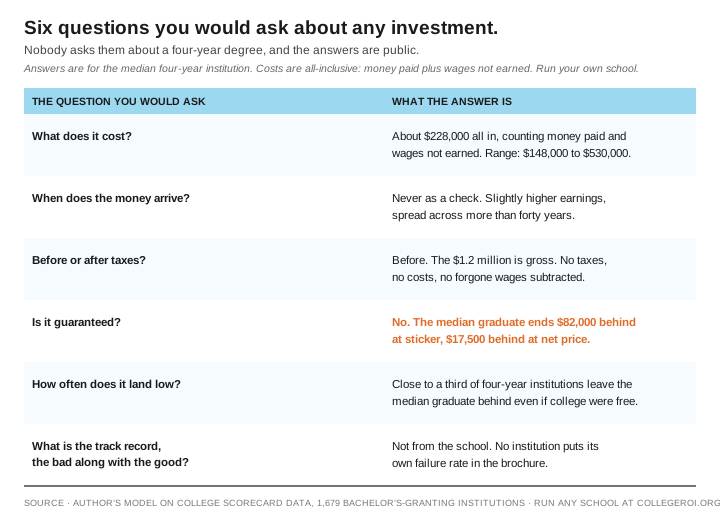
What does it cost? About $228,000 at the median school, counting both what you pay and the wages you do not earn while enrolled.[1] All-inclusive costs, at the net price families pay, run from about $148,000 to about $440,000 depending on the school. The wages you give up, four years of them, almost never appear in a college’s own numbers.[1]
When does the money arrive, and how? Not as a check. It arrives as higher earnings spread across a working life of more than forty years, which is why the rate you use to compare future dollars to today’s dollars matters so much.[2]
Is the $1.2 million before or after taxes? Before. It is a gross number. It does not subtract taxes, it does not subtract what the degree cost, and it does not subtract the wages given up while sitting in the classroom.[3]
Is it guaranteed? No. At the median four-year institution, the median graduate who paid full sticker finishes about $82,000 behind the person who skipped college and went straight to work, counted in today’s dollars, and still about $17,500 behind at the median net price families actually pay.[1]
How often does it land at the bottom of the range? Often enough that the price tag alone cannot explain it. Make college completely free, tuition and living costs included, and about 30 percent of four-year institutions still leave their median graduate behind the high school path.[1]
And the track record, the bad along with the good? Not from the school. Completion and earnings data sit in a federal database, the College Scorecard,[1] and in my experience no school puts its own failure rate in the brochure. The graduates it worked for are on the website and at the reunion. The ones it did not work for are not there to ask.
Six questions. In an investment pitch, most of those answers would stop you cold.
Our part
So why does almost nobody get all six answers before deciding?
Not because they are secret. Every input is public. The reason is simpler and closer to home. Nothing in the process requires anyone to hand over all six, and something else arrives instead, faster and warmer and much more persuasive.
Testimony.
That is our part, those of us for whom college worked. We are the ones at the graduation party and the kitchen table and the church basement, telling a seventeen-year-old that it was the best decision we ever made, that it opened every door, that it will be worth it. And if pressed, we can produce a study. We know the $1.2 million number. We repeat it with total confidence and no examination, because it matches what we saw happen to us.
We would never accept that standard of evidence for our own money. Almost none of us would put $228,000 into an investment on the strength of somebody saying it went well for them. But we hand exactly that to a family with less room for error than we ever had, and we do it with real affection, which is what makes it so effective.
In skipping the questions ourselves, we quietly excuse them from asking. That is the harm. Not bad advice, exactly. A missing step, skipped on behalf of someone who will carry the whole risk of it.
But nobody promised anything
Here is the fair objection. Nobody actually promises $1.2 million. It is the gap between two medians across millions of people, not an offer made to any particular student, and no one who cites it is lying.
All true, and it misses what happens in the room. A number like that, said out loud to a family deciding, is heard as a promise. That is not a failure of their reading comprehension. It is how a number works when it arrives without a range attached, from someone they trust, about a decision they are frightened of.
The correction takes one sentence: that number is a gross gap between two medians, and your own result could land well below it. In my experience, almost nobody says it.
And the objection I hear most is not about the money at all. College is more than an investment. It forms citizens, it makes people more curious and more capable, and some of what it gives you never shows up in a paycheck. I agree with all of that, and none of it is in dispute here.
But a family taking on debt is not choosing between money and meaning. They are being asked to pay a specific price, in cash they do not have, for a specific outcome no one in the process will quantify for them. You can believe every word about what college does for the soul and still want to know the price and the odds. Those questions are not in competition. Only one of them can bankrupt you.
Who carries it
The consequences do not land evenly. A family with savings can absorb a disappointing degree. A family without them cannot.
Even families with savings reach for money meant for their own old age. In the 2024-25 school year, about one in six families paid for college partly by pulling money out of retirement savings, about $5,350 on average, and some borrowed against retirement accounts to do it.[4]
And the debt does not always shrink the way people expect. Among borrowers who started college and did not finish, four years into repayment, the group collectively owed six percent more than it originally borrowed. Borrowers who finished owed six percent less.[5] For the people college failed, the balance was moving the wrong way.
Let me be careful about what this argument is and is not. Great college choices lift families out of poverty. That happens often, and I believe it is one of the most reliable routes out that this country has. Bad ones dig the hole deeper. Both kinds are real, and the question is never whether college works. It is whether this one, at this price, for this student, works. By assuming only the good kind exists, we make room for far too many of the other kind.
And notice who absorbs that assumption. Not the institution, which is paid either way. Not the graduate giving the testimony, whose bet already paid. The family with the least margin.
The fix
The fix is not complicated, and it is not a policy. It is six questions.
Ask what it costs, in total, at this school. Ask when the money comes back and what it is worth in today’s dollars. Ask whether the number is before or after tax. Ask whether it is guaranteed, and what the range looks like beyond the middle. Ask how often it lands below the alternative. And ask to see the record of the people it did not work for.
Anyone can get those answers now. I put my own version at collegeroi.org so a family can look up a school and see them in a few minutes, though I am not the only source and you should not need me.
If you are one of us, the ones it worked for, there is one more thing. When a young person asks whether they should go, resist the urge to answer with your own life. Give them the questions instead.
It worked for me. That is exactly why you should not take my word for it.
Reference Sources
- Author’s model, built on U.S. Department of Education College Scorecard data covering 1,679 bachelor’s-granting institutions. Net present value against the high school path, after costs, federal income and payroll taxes, forgone earnings, and a 7.8 percent discount rate. All-inclusive four-year cost, out-of-pocket plus opportunity cost, ranges from about $148,000 to about $440,000 at net price, with a median of about $228,000. The cost of attendance a college publishes follows the federal definition, which lists tuition, fees, books, supplies, transportation, housing, food and personal expenses, and has no line for earnings given up. The median institution’s graduate finishes about $82,000 behind the high school path at full sticker and about $17,500 behind at the median net price. About 30 percent of four-year institutions leave their median graduate behind even at zero cost. Any school can be run at https://collegeroi.org.
- On why the discount rate decides the comparison, see the standalone defense of the 7.8 percent rate used here, “A Degree Is Not a Treasury Bond.” collegeroi.org, August 17, 2026.
- Gross lifetime-earnings gap. Association of Public and Land-grant Universities. “How does a college degree improve graduates’ employment and earnings potential?” APLU, Public University Values. Accessed September 13, 2026. “Median lifetime earnings are $1.2 million higher for bachelor’s degree holders.” Georgetown University Center on Education and the Workforce. “The College Payoff: More Education Doesn’t Always Mean More Earnings.” CEW Georgetown, October 6, 2021. Accessed September 13, 2026. Median lifetime earnings of $2.8 million for bachelor’s degree holders against $1.6 million for a high school diploma, both for full-time, full-year workers aged 25 to 64. Both are gross figures: no adjustment for who enrolls, no netting of costs, and, per the full report, no discounting to present value. The earnings are the Census Bureau’s American Community Survey measure, which counts pay before income taxes.
- Sallie Mae. “How America Pays for College 2025.” Sallie Mae, national study of college students and parents, conducted by Ipsos, 2025. Figures are for the 2024-25 academic year. Accessed August 4, 2026, and September 13, 2026. Retirement savings withdrawals were used by 17 percent of families, averaging $5,350, and 7 percent of families used a retirement account loan.
- Itzkowitz, Michael. “The College Completion Crisis Fuels the Student Debt Crisis.” The HEA Group, January 31, 2024. An analysis of U.S. Department of Education College Scorecard data covering 3.9 million student loan borrowers at 1,949 institutions, who borrowed in 2013 to 2015 and were measured four years later in 2017 to 2019. Borrowers who did not complete owed $918 million, about 6 percent, more than they originally borrowed. Borrowers who completed owed $3.2 billion, about 6 percent, less. The figures cover undergraduate borrowers at all types of institutions, including those that mostly award associate degrees or certificates. At four-year institutions, non-completers owed 6 percent more and completers 8 percent less. Accessed August 4, 2026.