The Quality Control Tell
I spent years as an operations consultant, most of them on transformations, which is the trade’s word for fixing an operation that has stopped working well.
Walk into the receiving area of most of the manufacturers I have worked with and you will see a station where inspectors check incoming parts from suppliers against a spec sheet. Good parts move on. Bad parts get set aside, counted, and sent back. The station works. It catches real defects, and it keeps them from creeping into everything built downstream. Everyone at that station is doing their job.
I learned to read that station as a message. If a client had a department whose whole function was inspecting for errors, I knew before the first meeting how the place thought.
The inspection told everyone which parts failed. It never asked why the supplier kept shipping failing parts, and as long as the station kept catching them, nobody had to ask. The function that looks most like quality is often the surest sign the quality problem has not been touched.
W. Edwards Deming, a pioneer of modern quality management, put the principle third on his famous list of fourteen: “Cease dependence on inspection to achieve quality.”[1] He made that argument four decades ago. The idea is not new. It is an idea that does not travel.
Here is the truth underneath it. You cannot fix a problem you have not traced to its cause.
Everyone nods at the sentence. In my experience, almost no organization behaves as if it were true, because tracing a cause is uncomfortable and inspecting for symptoms feels like diligence.
So the useful question, for a factory or for a sector, is never whether it says it wants root causes. It is whether the machinery it built could ever find one.
Where root causes actually live
In transformation work I leaned on two habits, both learned from people better at the trade than I was.
The first was to go back to raw data, as close to the source as I could get.
Interpreted data carries the filters of whoever prepared it, and the most common filter is not a lie. It is an average. The moment someone aggregates, they have decided which differences matter and which ones disappear, and the differences that disappear are usually where the cause is hiding. An average is an interpretation wearing the costume of a fact.
The second was to find the skeptics.
Every operation has them, and every operation has already told you what it thinks of them. They are the negative ones, the ones with a chip on the shoulder, the ones resistant to change. Some of that was often true. It did not matter. When I asked them to walk me through what they had seen, the attitude fell away and the observations remained, and the observations were frequently the closest thing to a map of the root cause anyone in the building possessed.
They were being ignored, and being ignored is what kept their information out of every official account.
I learned, after enough humbling, not to bring a client a fix the skeptics had not shot at first.
Most organizations I worked with push the other way. Dissent reads as friction, and friction gets managed out. The people most useful to an organization that wants to improve are the ones it is under the most pressure to remove.
Nothing in my career took more discipline than treating skepticism as signal, because every incentive in the room says to treat it as noise.
Now hold the two habits and the tell in your hand, and look at how higher education has responded to the loss of public confidence in it.
The sector looks like it is doing the work
Higher education and the foundations around it poll the public constantly. Its universities commission committees on trust. It operates a formal quality assurance system with the word accreditation on it. From a distance, the diagnostic machinery appears to be running.
None of these instruments is dishonest. Each does its actual job, and mostly does it well.
The problem is that each one stands in for a discipline it does not perform. The survey stands in for hearing the skeptics. The committee stands in for tracing the cause. Accreditation stands in for quality control. And because the stand-ins exist, the sector gets to mark the root-cause search complete without ever having run it.
Surveys that ask around the verdict
Start with the listening.
The confidence numbers everyone quotes come from polls of the general public. Gallup’s confidence measure surveyed 1,402 American adults by phone in June 2025.[2] The results get split by education level, graduates against non-graduates, and the split is treated as depth.
But think about who is inside a sample like that. A graduate whose degree paid off handsomely. A parent who never got the chance to go and wants it desperately for their kid. A borrower still paying for a degree that never produced the job. A retiree who paid for a year of it with a summer job. Four different relationships to the product, four different kinds of evidence, one approval rating.
I wrote in The Doubt Everyone Explained Away that a survey cannot tell the wounded from the worried. The deeper problem is upstream of that.
No confidence poll I have seen is even built to separate a judgment formed by experience from a judgment formed by what people have heard about college. The averaging deletes the first distinction a diagnostician would need.
To its credit, one major survey program is aimed at the right people. The Gallup and Lumina Foundation State of Higher Education study reaches thousands of adults who started college and stopped, 5,012 of them in its 2024 edition.[3] These are the people the line took in and did not finish, the closest thing the sector has to a room full of skeptics with direct observations.
Read Gallup’s headline findings, though, and you can see what the study was built to learn. Cost was an important reason for not being enrolled for 87 percent. Work conflicts mattered for 81 percent. About three quarters had thought about coming back within the past two years. It is a careful study of why customers lapse and what might win them back, produced with a foundation whose stated goal is that 75 percent of the American labor force hold degrees or credentials of value by 2040.
In Gallup’s write-up of those findings, the non-completer enters the data as a lapsed customer to be recovered, not as a witness to be questioned.
And when the program’s newest wave published an answer to the worth question, the answer came from the other end of the pipeline. The worth-the-cost results came from current students and graduates.[4]
The direct question has already been asked, by the federal government, and the answer is sitting in public view.
The Federal Reserve’s household survey for 2022 asked adults who went to college whether the lifetime financial benefits of their education exceeded the costs. Among those with a bachelor’s degree or more, 68 percent said yes. Among those with an associate degree, 42 percent. Among those who started and did not finish, 30 percent.[5] Three in ten.
And before anyone waves that answer away because these people did not finish, remember what they were sold. Finishing was part of the product. Completion rates vary school by school, and I think at least part of that variation belongs to the institution rather than purely to the customer.
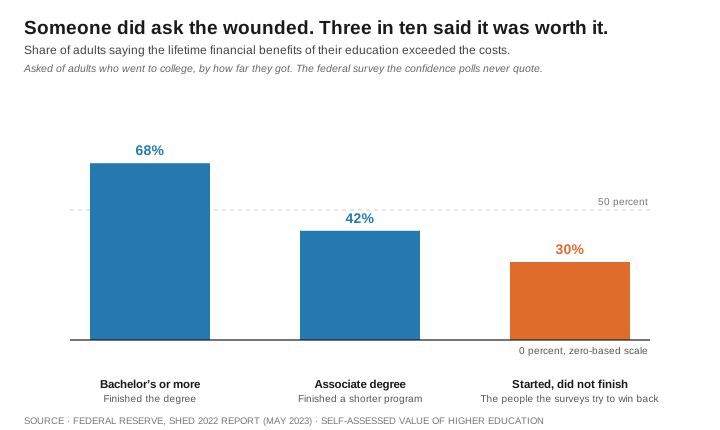
The people the system enrolled and did not carry to a degree have rendered their verdict on the product, in a federal report anyone can read, and, in my reading, the consulting reports I examined in The Doubt Everyone Explained Away still treat the doubt as a mood to fix with a better message.
The skeptics answered. Nobody built the meeting where their answer gets heard.
The winners examine the winners
Next, the diagnosis.
In April 2026, Yale released a report from its Committee on Trust in Higher Education, commissioned by its president to examine why public confidence in the sector has declined.[6] I am not going to argue with the report’s conclusions here. The question for this piece sits upstream of the contents. Who was asked to find the cause, and what did they treat as evidence?
Let me be fair about the method. The committee did not sit in a room and theorize. Its members spent a year in one-on-one and small-group conversations with hundreds of people, and they went outside the walls, interviewing politicians, journalists, policymakers, activists, and critics of higher education who hold very different views. By the standards of a university self-study, this was diligent work. From a distance it looks exactly like seeking out the skeptics.
Now look closer at who was in the room and what counted as evidence. All ten members of the committee are Yale professors, people the system promoted, which is to say people for whom the system worked. The report notes that early public comments raised the same doubt.
The outsiders the report lists are politicians, journalists, scholars, policymakers, activists, critics, and members of community organizations, mostly people who argue about higher education in public. Nowhere does the list name the people higher education failed.
In a report of more than fifty pages there is not one word about the millions who enrolled and never finished.
What the committee gathered is conversations, polling, and published research, without a single graduate earnings figure offered in evidence. When return on investment comes up in its recommendations, the report grants that such measures “have real value as a form of accountability,” then moves on inside the same paragraph.
The skeptical voices were heard. The national outcome data got one paragraph, on loan defaults. The paragraph calls a default “often less a story of personal failure than an indictment of an educational system” that “too often fails to deliver,” and then the report turns to admissions.
The selection runs deeper than the panel. Yale itself is the corner of higher education where the product visibly performs. Nearly everyone who enrolls finishes, 96 percent within six years. The subsidy is enormous: about one in five undergraduates attends “on a full ride, paying nothing for four years.”[6] The students arrived among the best prepared in the country, with the middle half of entering students who sent SAT scores landing between 1480 and 1560.
The forces that drive the bad half of the sector’s outcomes are missing from the place. In an experiment, Yale would be the control group. Asking it to diagnose the sector is convening the plant’s one zero-defect line and asking it to explain the factory’s failure rate by reflecting on its own practices.
The committee fulfilled its charge honestly. An honest committee, working diligently from that vantage, produces a report on trust. What it cannot produce, with that membership and that evidence, is a root cause that lives outside its own experience.
A quality seal that never priced the product
Then there is the machinery with quality in its very name.
Accreditation is the sector’s formal quality assurance system, the gate between an institution and federal student aid. Take one accreditor’s rulebook. The Higher Learning Commission’s reviews run to governance, finances, faculty credentials, how the school checks its own work, and, in fairness, how many of its students finish, measured against peer schools.[7]
What those criteria never require is the outcome families borrow against. Whether the graduates of a program earn enough to justify what they borrowed is not a test the Higher Learning Commission sets for an institution to keep its seal.
Measure the machinery against the factory floor and the comparison is unkind. The receiving dock at least examines the parts. That rulebook examines the factory’s paperwork and its completion counts. Deming’s complaint was that manufacturers depended on inspecting the product instead of building quality in. For that outcome, the Higher Learning Commission’s quality system never even reached the level Deming criticized.
The first earnings test with consequences applied to degree programs across the board arrived on July 1, 2026, and the sector did not build it. Congress did. The law, passed a year earlier, requires that an undergraduate program’s graduates earn at least as much as young high school workers in the school’s state, and failing programs lose access to federal loans.[8]
It took an act of Congress to put one inspector at the end of the line, which, as I read it, tells you where the sector’s own quality machinery was pointed. And read that law through Deming’s eyes and you will notice what it is. It is inspection. It catches failing programs after they have already failed their students, the way the receiving dock catches bad parts after the supplier has already made them.
Useful, overdue, and still not the fix. The root-cause work, asking why a program costs what it costs and pays what it pays, remains exactly where it has always been. Undone.
The sector does run true inspection stations. It calls them remedial courses, where colleges check the parts arriving from their supplier, the K-12 system, catch the ones below spec, and rework them at the student’s expense, and nothing in the transaction obliges the supplier to change.
Employers I have worked with run another one, using the degree itself as the first screen, before anyone examines actual capability. The whole pipeline is dotted with stations that catch and sort and route.
That is the tell, the same one I learned to read at the receiving dock. Inspection everywhere. Tracing nowhere.
What the two habits find
Which leaves the obvious question. If the stand-ins cannot find the root cause, what do the real disciplines turn up? I have spent the last several years running them on this sector, and the results are not hidden.
Go back to the raw data means setting aside the famous number, the $1.2 million lifetime premium ($2.8 million for a bachelor’s degree against $1.6 million for a high school diploma), and reading school-by-school rows instead. The rows show a distribution, and they count what the famous number leaves out: the price, taxes, the earnings given up while in school, and the lower value of dollars that arrive years later.
At the median four-year institution, priced at full cost, the graduate ends up about $82,000 behind the person who went straight to work, and still about $17,500 behind at the median net price. And about 30 percent of four-year institutions leave their median graduate behind the high school path even when the price is set to zero.[9]
The headline number is an interpretation. The rows are far less aggregated, and the rows say the product fails at a large share of the schools selling it. I walked one of Georgetown’s own tables, from its underemployment report, row by row in The $24,000 Row.
Seek out the skeptics means reading the loss of confidence as observation instead of mood. That is the argument of The Doubt Everyone Explained Away, and I will not repeat it here. The short version is that the doubt was treated as noise when part of it was the signal, the sound of people at the bottom of the distribution reporting their own results and being told they had misread their own lives.
Two habits, applied once, and the problem stops hiding. The product varies enormously, a large share of it does not pay, and the three instruments the sector points at the crisis are aimed somewhere else.
Notice, too, who built the two federal instruments named above that do touch the outcome. The survey that asked whether the benefits beat the costs belongs to a bank regulator. The earnings test belongs to Congress. Both of those gauges were installed from outside the building.
The skeptics get the last look
I want to end with the habit I found hardest, because this piece’s companion went through it. Before publishing The Doubt Everyone Explained Away, I sent the analysis to the two consulting firms it criticizes and invited them to tell me where it was wrong. Not because anything required it. Because the discipline I am describing is worthless as advice and only means something as practice, and the practice says no solution goes forward until the skeptics have had their shot at it. The strongest skeptics of that analysis were the people whose reports it questioned. They got the first read.
That is what the missing discipline looks like, applied to oneself. It is available to anyone, including a sector with far more analysts than I will ever have.
When an industry loses the confidence of the people it serves and answers with polls that cannot tell the wounded from the worried, a committee of its most successful members, and an accreditor’s rulebook that never tests the outcome families borrow against, you are looking at the receiving dock.
The parts keep failing. The stations keep catching them. And the question that would actually fix it sits one step upstream, unasked, which is where it has been the whole time.
Companion Pieces
Reference Sources
- Deming, W. Edwards. Out of the Crisis. MIT Center for Advanced Engineering Study, 1986, pp. 23–24 (reissued by MIT Press, 2000). Point 3 of Deming’s fourteen points for management: “Cease dependence on inspection to achieve quality. Eliminate the need for inspection on a mass basis by building quality into the product in the first place.” Wording as given by the W. Edwards Deming Institute, “Deming’s 14 Points for Management.” Accessed July 30, 2026.
- Gallup (Lumina Foundation-Gallup survey). “U.S. Public Trust in Higher Ed Rises From Recent Low.” July 15, 2025. Telephone survey of 1,402 U.S. adults aged 18 and older, conducted June 2 to 26, 2025. Results are reported by educational attainment (bachelor’s degree holders against those without a four-year degree). Accessed July 30, 2026.
- Lumina Foundation and Gallup. “The State of Higher Education 2024.” Web surveys conducted October 9 to November 16, 2023, with 14,032 U.S. adults aged 18 to 59 who have not completed a college degree, including 5,012 adults previously enrolled in postsecondary education who left without a degree. Barrier figures for stopped-out adults (cost a very or moderately important reason for 87 percent, work conflicts for 81 percent, roughly three quarters having considered re-enrolling within the past two years) as reported in Gallup, “Cost Leading Reason College Students Are Stopping Out,” June 18, 2024. Lumina Foundation’s stated goal is that 75 percent of adults in the U.S. labor force hold college degrees or other credentials of value by 2040. Accessed July 30, 2026.
- Gallup and Lumina Foundation. “College Students, Grads See Strong Career Value in Degree.” February 23, 2026. Current students (3,801 enrolled in associate or bachelor’s programs, from the 2026 State of Higher Education Study’s web survey of 6,010 U.S. adults aged 18 to 59 without a degree, October 2 to 31, 2025) and graduates (5,933, from a related Lumina Foundation-Gallup alumni survey, November 10 to December 1, 2025) were asked whether they agree their degree is worth the cost. Accessed July 30, 2026.
- Board of Governors of the Federal Reserve System. “Economic Well-Being of U.S. Households in 2022,” May 2023, Higher Education and Student Loans section. Share of adults saying the lifetime financial benefits of their higher education exceeded the financial costs: 68 percent of those with at least a bachelor’s degree, 42 percent of those with an associate degree, and 30 percent of those who attended college but did not complete at least an associate degree. Accessed July 30, 2026.
- Yale University. “Report of the Yale Committee on Trust in Higher Education.” Report dated April 10, 2026, released by the Office of the President April 15, 2026. Commissioned by President Maurie McInnis in April 2025 to examine declining trust in higher education. Committee membership, consultation methods, the full-ride figure, and the return-on-investment passage as given in the report’s letter, appendix, discussion of cost, and recommendation 8. Accessed July 30, 2026.
- Higher Learning Commission. “Criteria for Accreditation.” The criteria cover mission, integrity, teaching and learning for student success (including assessment of student learning, program review, and student success outcomes benchmarked against peer institutions), and institutional sustainability. No criterion requires review of graduate earnings, debt relative to earnings, or program-level financial return. Accessed July 30, 2026.
- P.L. 119-21, the 2025 budget reconciliation law, enacted July 4, 2025. Congressional Research Service, “Amendments to the Higher Education Act Made by P.L. 119-21, the FY2025 Budget Reconciliation Law” (R48727). Effective July 1, 2026, undergraduate degree programs whose completers’ median earnings, measured four years after completion, fall below the median earnings of working adults aged 25 to 34 in the state (or nationally, if fewer than half the school’s students live in the state) holding only a high school credential, in two of three consecutive years, lose eligibility for federal student loans. The test governs Direct Loan eligibility. Accessed July 30, 2026.
- Author’s model, built on U.S. Department of Education College Scorecard data, 1,679 bachelor’s-granting institutions, net present value against the high school path after costs, federal income and payroll taxes, forgone earnings, and a 7.8 percent discount rate. At full sticker price the median institution’s graduate ends about $82,000 behind the high school path (about $17,500 behind at the median net price), and about 30 percent of four-year institutions leave their median graduate behind even at zero cost. Full methodology and any school’s result at https://collegeroi.org.