The education crisis arrives on a schedule now.
Reading scores fall to a new low, and state legislatures pass laws requiring phonics-based instruction.
Math scores sit stubbornly below their pre-pandemic line, and districts re-fight the math wars, the old argument over drilling procedures versus teaching for understanding.
Writing has stopped being a subject and become a question: who wrote this, the student or the machine?
Scores, villains, mandates. The three Rs, in permanent triage.
There is a fourth R. It is the one that makes the other three worth having, and it almost never appears in the crisis coverage.
Reasoning.
Notice something about the famous three. Reading, writing, arithmetic. Only one of them actually starts with an R. The R that never made the list is the fourth. The omission is roughly two hundred years old.[1]
The list is what remained after the cut
For centuries, the core of formal schooling was the seven liberal arts, and the gateway three were called the trivium: grammar, logic, rhetoric. Decoding language, reasoning correctly, persuading honestly. Beyond the gate sat the quadrivium, four more arts led by arithmetic. Logic was the art of thinking itself. The other six put it to work.[2]
Then came the slogan. Somewhere in the early 1800s, “the three Rs” entered the language. From the gateway it kept reading and writing, the work of grammar, and dropped logic. From the four arts beyond it kept only arithmetic, the art of the ledger. A practical list, built for the shop and the letter, and the art of thinking did not make it. Nobody struck logic from a syllabus in 1824. The slogan named what ordinary schools taught. Laid beside the old core, though, the gap is plain.
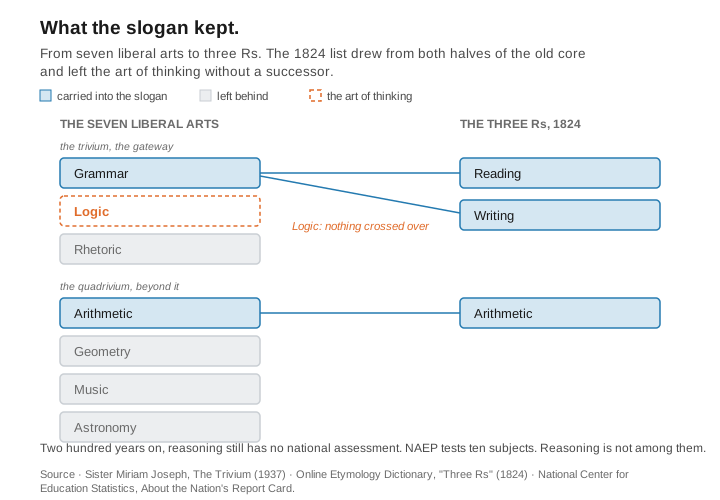
This is not a case that old schooling was better. For most children, old schooling barely existed at all, and I would not trade the reach of the modern system for the rigor of a medieval one that taught almost nobody. It is an observation about the frame.
The slogan that still organizes every education crisis is what remained after reasoning was cut. That solves the puzzle I started with, why reasoning almost never comes up. Nobody is overlooking it. Every fight about reading, writing, or math is a fight about the three items that survived the cut, so there was never a place in it for the one that did not. Reasoning is not missing from the conversation. The conversation is what remained after it was removed.
No score, no crisis
Why does a two-hundred-year-old omission still hold? Because the machinery that decides what counts as an education crisis runs on scores, and reasoning does not have a national one.
Watch the machinery work. A reading score falls. The fall is a story. The story finds a villain, a curriculum, a method, a screen. The villain produces a mandate, and legislatures pass laws about phonics. Whatever you think of the particular fixes, the machinery itself works: measured decline in, public correction out.
Reasoning has no entry point of its own into that machine. The National Assessment of Educational Progress, the federal test known as the Nation’s Report Card, has tracked reading and math for half a century, and tests science, writing, civics, U.S. history, geography, economics, the arts, and technology besides. Reasoning is not on the list.[3]
Arguably the closest thing the country ever had to a national reasoning score was the SAT, a college admissions test that from 1993 to 2016 carried the words Reasoning Test in its official name.[4] And for a while its scores fed the machinery exactly as described. When they fell through the 1960s and 1970s, the decline became a national story. The commission that wrote A Nation at Risk, the 1983 federal report that declared the schools in crisis, cited it among the warning signs, and reform efforts followed. The same report also listed a shortfall in what it called “higher order” intellectual skills: nearly 40 percent of 17-year-olds could not draw inferences from written material, and only one-third could solve a mathematics problem requiring several steps. That is reasoning, caught sideways through reading and math, and it did not get a score of its own.
Then the score narrowed back to its admissions role. The word came off the name in 2016, and over the past decade many colleges made the test optional, a change that, at Dartmouth at least, ended up working against the very students it was meant to help. The closest chart we had to a reasoning score was retired from that job, not replaced.
No chart, so no fall. No fall, so no story. No story, so no villain, no mandate, no funding, no reform. I wrote recently, about markets and about AI, that without a scoreboard, nothing gets settled.[5] Education coverage may be the cleanest case.
And when researchers did point an instrument built for reasoning at college students, the reading was grim. In a 2011 book, two scholars, Richard Arum of New York University and Josipa Roksa of the University of Virginia, reported tracking more than 2,300 students at twenty-four colleges with a test built to measure critical thinking, complex reasoning, and writing. Roughly 45 percent showed no significant improvement over two years of college.[6]
The book was called Academically Adrift, and it earned a wave of coverage. The methodology was disputed, as methodologies are. Two years later, the test’s own maker, the Council for Aid to Education, reported bigger gains from a broader sample, and Arum answered that its sample did not follow the same students over time.[6] The dispute was still open. As far as I can find, no national assessment was built to settle it, and no national trend line was started.
The finding now sits in the literature like a smoke alarm that went off once and was never given a fresh battery.
To be fair, the idea is everywhere. “Critical thinking” shows up in mission statements, in district strategic plans, on lists of twenty-first-century skills. But there it appears as garnish, not as the meal. Named constantly and, as far as I can find, taught as an examinable discipline almost nowhere and tested, where it is tested at all, by instruments that keep no national trend line for reasoning itself.
And the instruments are buildable. PISA, the international test that compares fifteen-year-olds across countries, recently fielded a creative-thinking module. Creative thinking is a neighbor of reasoning rather than the thing itself, but the module is proof the category can be tested at scale. One round, no standing trend line.[7] One round is not a scoreboard. An instrument without a trend cannot fall, and what cannot fall cannot make the news.
The processor and the peripherals
Here is why the omission is more than a labeling quarrel.
Reading comprehension is inference over text. A word problem is reasoning in quantity. Writing, real writing, is reasoning made visible on a page. The three Rs are input and output channels for a faculty the list never names. Peripherals, all three, wired to a processor the slogan leaves out.
You can see the dependence in the places the existing instruments catch it sideways. Students who can sound out every word of a passage they cannot draw an inference from. Students who can execute the arithmetic and cannot set up the word problem around it. Writing instruction that, in my experience, now spends more energy on who produced the sentences than on whether they hold together.
And here is the uncomfortable part. Whether reasoning itself has declined is the one question the frame cannot answer, because the Nation’s Report Card has not been keeping its score.
That is not reassurance. A thing can fall for fifty years without a chart if nobody builds the chart. When a direct measurement did make the news, the reading was bad enough that we should have wanted a national one. I have not found one.
The R that cannot be outsourced
Then the machines arrived, and the stakes of the omission changed.
What AI has made nearly free is the mechanical layer of all three Rs. It summarizes what you would have read. It drafts what you would have written. And calculation has been free since the pocket calculator. The peripherals, the parts of the curriculum the slogan kept, are now the parts a machine does in seconds.
What it did not make free is the processor. My book traces the shift already underway in what the labor market pays for: execution down, judgment up.[8] Reasoning is the judgment premium wearing its school-age name.
An education system that spent two centuries drilling the layers machines now do free, while almost never deliberately teaching the layer machines cannot reliably do, has its curriculum backwards. And it got there just as the difference started paying.
Taking the fourth R seriously would not be mysterious. Reasoning has had a teachable discipline behind it for two thousand years.[2] What makes an argument valid. What makes evidence strong. What a claim would need for you to believe it. How to notice when a confident answer should be doubted.
One caveat: in my reading of the research, reasoning taught as a content-free game travels poorly. Skills drilled on puzzles rarely show up in a history essay or a household budget. It has to be taught inside subjects, on real material. Taught on purpose, then. And scored, so it can fall in public, the way everything we actually protect is allowed to fall in public.
None of this is a complaint about teachers. They inherited the frame like everyone else, and many of them smuggle reasoning into classrooms anyway, one good question at a time, and get no credit for it on any chart that exists.
The complaint is about the list. A graduate who reads fluently, writes cleanly, and calculates quickly, but was never taught to reason, has three polished ways to carry thoughts nobody taught them to build.
The three Rs were never the education. They were the doorway to it. The fourth R is the room.
Reference Sources
- “Three Rs.” Online Etymology Dictionary. Accessed July 29, 2026. The phrase dates to 1824. The toast attribution to Sir William Curtis is doubtful: Etymonline says he “seems to have been a figure of fun to whom many mangled phrases were attributed.”
- Joseph, Sister Miriam. The Trivium: The Liberal Arts of Logic, Grammar, and Rhetoric. Paul Dry Books edition, 2002. The publisher dates her original work at Saint Mary’s College to the 1940s. The trivium as the gateway of the seven liberal arts, with the quadrivium (arithmetic, geometry, music, astronomy) beyond it. See also “Trivium.” Wikipedia. Accessed September 25, 2026.
- National Center for Education Statistics. “About the Nation’s Report Card.” Accessed July 29, 2026. NAEP subjects: reading, mathematics, science, writing, the arts, civics, geography, economics, U.S. history, and technology and engineering literacy, informing policy since 1969.
- The naming history: Scholastic Aptitude Test from 1926, renamed the SAT I: Reasoning Test in 1993 and the SAT Reasoning Test in 2004, before the qualifier was dropped in the 2016 redesign and the test became simply the SAT. See “SAT.” Wikipedia. Accessed September 2, 2026. The decline and its reception: National Commission on Excellence in Education. A Nation at Risk: The Imperative for Educational Reform. U.S. Department of Education, 1983. ERIC ED226006. Accessed September 2, 2026. Among its indicators of risk: “The College Board’s Scholastic Aptitude Tests (SAT) demonstrate a virtually unbroken decline from 1963 to 1980. Average verbal scores fell over 50 points and average mathematics scores dropped nearly 40 points.” Its reception: “A Nation at Risk.” Wikipedia. Accessed September 25, 2026.
- Shivamber, Leon. “Fooled by Fluency.” shivamber.com, August 2026. Without a scoreboard, nothing gets settled.
- Arum, Richard, and Josipa Roksa. Academically Adrift: Limited Learning on College Campuses. University of Chicago Press, 2011. Accessed July 29, 2026. “45 percent of these students demonstrate no significant improvement in a range of skills—including critical thinking, complex reasoning, and writing—during their first two years of college.” More than 2,300 undergraduates at twenty-four institutions, Collegiate Learning Assessment. On the dispute over its method: Lederman, Doug. “Less Academically Adrift?” Inside Higher Ed, May 19, 2013. Accessed September 25, 2026. Arum pointed to the book’s four-year figure, a gain of 0.47 standard deviation, smaller than the Council for Aid to Education’s 0.73 but closer to it.
- OECD. “PISA 2022 Creative Thinking.” Accessed July 29, 2026. The first PISA creative-thinking assessment: open-ended tasks across four domains, results launched June 2024. See also “Programme for International Student Assessment.” Wikipedia. Accessed September 26, 2026.
- Shivamber, Leon. We Need To Talk About Higher Education, Chapter 26, “What AI Is Actually Doing to Earnings.” The process-versus-judgment repricing.