Imagine I offered you a wager.
Put up $200,000. You will probably borrow most of it, on a loan that can almost never be erased, even in bankruptcy. In exchange you get a ticket. If the ticket wins, you earn a solid return, somewhere around 12 percent a year, better than the stock market. If it loses, you are out the money and four years of your life, with nothing to show for it but the debt.
One more detail. Your odds of holding a winning ticket are about two in five.
Would you take that bet?
That is the wager 18-year-olds make every fall, except no one ever shows them the odds. They are shown the finisher’s payout and told it is a sure thing. It is not a sure thing. It is a bet with worse-than-even odds, and the number everyone quotes is the return for the ones who finish, not the odds you will be one of them.
Let me show you the odds.
The odds nobody prints
Start with two facts that are not in dispute, because the people who promote college publish both of them.
About 39 percent of students who start college never finish. They leave with some debt, some lost time, and no degree, which is the worst outcome in the whole deal. So six in ten finish.
Of the ones who do finish, about a third are underemployed over their careers, working jobs that never required the degree they paid for. The barista with the biology degree. So about two-thirds of finishers land the kind of work the degree was supposed to buy.
Put those together. The chance that a student who starts college both finishes and ends up in a job that uses the degree is roughly 61 percent times 67 percent, which comes to about 41 percent. Two in five.
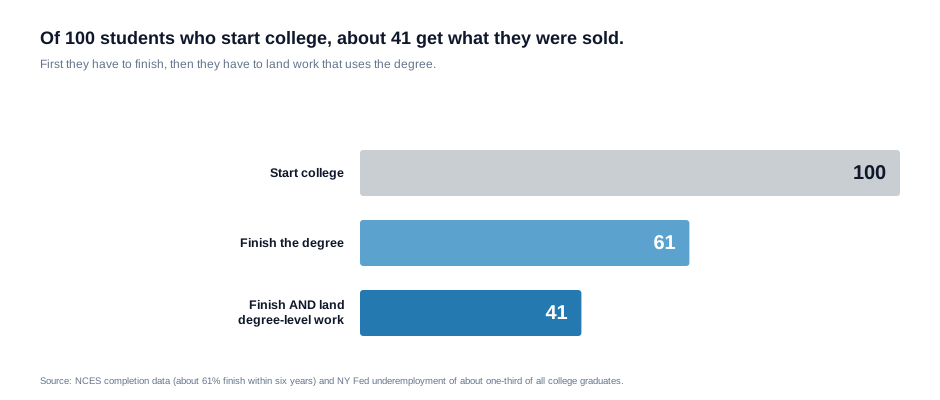
And even that 41 percent is not a win. It is a shot at one. Clearing both filters, finishing and landing degree-level work, is what buys you a chance at a real return. Whether you collect it still depends on the price you paid and the field you chose, which is where most of the real spread lives. That is the true shape of the bet on the single largest financial decision most families ever make, the one sold to them as safe.
The number you were promised is the payout on the winning ticket
Here is where the sales pitch gets slippery.
The Federal Reserve published an analysis in 2025 putting the return on a college degree at about 12.5 percent a year, and noted it beats stocks and bonds. That number got quoted everywhere as proof college still pays.
But read what it actually measures. The 12.5 percent is the median for the people who finish. It is not even the prize for a clean win. It blends the graduates in degree-level jobs with the ones stuck in work that never needed the diploma, then drops the 39 percent who never finish at all, the people who took the worst outcome in the deal. It keeps the survivors and quietly buries the losers.
You cannot judge a bet by what the survivors collect. You have to weight the payout by your odds of getting it. Do that, even roughly, and the picture changes hard. Take the 12.5 percent and weight it by the six in ten who finish, and you are down to about 7.6 percent, the completion-weighting I work through in full in Degrees of Assumption, my piece examining the Fed’s college math. And that math is generous, because it pretends the dropouts simply broke even. They did not. They lost. Weight by the losses instead of pretending they are zero, and the number falls further. The real expected return on the decision to enroll, for the average student, is well under 8 percent.
So the honest version is not the slogan that college earns 12.5 percent. The honest version takes three numbers, not one. Your odds of the clean win, finishing into work that uses the degree, are about two in five. The 12.5 percent is not the prize for that win. It is the median across everyone who finishes, the winners and the underemployed graduates together, with the dropouts dropped from the count. And the expected return on enrolling, once you weight that finisher number by the six in ten who reach it and generously call the dropouts a wash, lands well under 8 percent before you adjust for taxes. A real chance of a six-figure loss sits underneath it. And the one number anyone ever quotes you, the 12.5 percent, quietly assumes you finish at all.
Why this is a bad bet for the average player
A low win rate by itself does not make a bet foolish. Venture capitalists lose most of their bets and still get rich, because the rare win pays a hundred to one. The reason college is a poor wager for the average student is that it fails on every other dimension at once.
The upside is modest. The clean win pays around 12 percent, often a little more, not a hundred to one. That is a fine return on a small, safe stake. It is not the kind of payout that earns long odds.
The downside is severe and common. Drop out and you have debt and no degree. Finish into underemployment and you have a bigger debt and a job that never needed the diploma. These are not rare tail risks. Between them, they are the majority outcome.
And the stake is enormous and borrowed. You are not risking money you can afford to lose. You are risking $100,000 to $300,000, most of it borrowed on a loan that, unlike almost any other debt in America, you cannot walk away from in bankruptcy. I have written separately about how that financing is rigged against the borrower. For now, just hold the shape of it. Modest upside, severe downside, worse-than-even odds, and a stake you borrowed and can never escape. No one would call that a good bet if it were not wearing a cap and gown.
The part that saves it, for some
Here is what redeems the whole thing, and why this is not an argument against college.
A bet’s quality depends on the player’s edge, and the edges here are enormous. The 41 percent and the 7.6 percent are population averages, and almost nobody is the average. A well-prepared student in a high-demand major, at a school with a strong completion rate, paying a low net price, has personal odds and a personal return that blow the averages away. For that student, college is one of the best investments available anywhere.
A marginal student entering an oversupplied field at full sticker price on loans has odds and a return far below the average. For that student, it is a near-certain loss.
The average buries both of them. And that is the real sleight of hand. It is not that college never pays. It is that the survivors’ number gets advertised to everyone, including the millions whose true odds are terrible. The 18-year-old holding a bad hand is shown the same 12.5 percent as the one holding a great hand, and told it is a sure thing for both.
It is not. It is a bet, and the only number that matters is your own odds, which depend on your major, your school, the price you will actually pay, and whether you are prepared to finish.
What to do with the bet
None of this means college is a scam, and I want to be fair about what the bet frame leaves out. A degree carries things a financial return cannot capture, and early-career underemployment often fades with time. The money math is not the whole of the value, and anyone who tells you it is is selling a different oversimplification.
But the money math is most of what families borrow against, and on that ground the truth is simple. You are being asked to make a large, irreversible bet, and you are being shown the winner’s payout instead of your own odds. So compute your own odds. Look at your specific major and school. Find what its graduates actually earn and how many of them finish. Compare that to the price you will actually pay, not the sticker, and to the plain alternative of going straight to work. The famous numbers were never going to tell you whether to take the bet. Only your own numbers can.
You can run yours in a few minutes at collegeroi.org. If you want to see exactly how the famous returns get inflated, I take the major studies apart in a companion piece, Auditing the Numbers That Say College Pays. And the loan behind the bet, which is the most dangerous part of the whole wager, is the subject of Two Kinds of Debt. I first framed the degree as a bet families are never shown the odds of in Warning: This Degree Could Be Hazardous to Your Wealth. This piece puts the odds themselves on the table.
Sources and references
- National Student Clearinghouse Research Center, six-year completion data, showing that about 61 percent of students who start finish a credential within six years counting those who transfer and graduate elsewhere, the highest rate on record, so roughly 39 percent do not finish. The NCES same-institution figure runs higher because it does not count students who transfer and graduate elsewhere. https://nscresearchcenter.org/completing-college/
- Federal Reserve Bank of New York, Jaison Abel and Richard Deitz, “Is College Still Worth It?” and “When College Might Not Be Worth It,” Liberty Street Economics (2025), the source of the 12.5 percent return for the median graduate. https://libertystreeteconomics.newyorkfed.org/2025/04/is-college-still-worth-it/
- Federal Reserve Bank of New York, The Labor Market for Recent College Graduates, the source of the underemployment figures, about 42 percent for recent graduates in 2025 and near one-third, about 34 percent, for all college graduates over a career. https://www.newyorkfed.org/research/college-labor-market
- The completion-weighted return (the roughly 7.6 percent expected return on enrolling, before adjusting for the fact that non-completers do worse than break even) follows the method I set out in Degrees of Assumption, my analysis of the Fed’s college math.
- Institution-level and program-level returns are from my own model. You can run any school and major at collegeroi.org.